Audience Segmentation Strategies for Conversational AI Ad Campaigns
Unlock qualified buyers by reading the conversation, not the user profile.

Audience segmentation in conversational AI advertising starts with a different question than the one search and social have trained the industry to ask. The operative question becomes "what does this conversation reveal" rather than "who is this user." That shift matters because most AI chat platforms know almost nothing about the person typing, particularly on free tiers where accounts are anonymous or barely profiled. The prompt itself is the richest data available.
Segmenting audiences in conversational AI ad campaigns when no user profile data exists runs on three dimensions extracted from the prompt and the session itself: intent type (exploratory, comparative, transactional, or post-purchase), context depth (how many turns have accumulated constraints and stated preferences), and conversational stage (where in the session arc the exchange currently sits). These three dimensions combine to define a segment far more precisely than any demographic bucket, because a user who has specified a budget, a timeline, and a competing product already rejected is a materially different audience from one who just asked an opening question, even if both conversations started with the same word. The prompt surfaces explicit signals like category of interest, stated constraints, and comparative framing, and implicit signals like purchase proximity, sophistication level, and emotional register. Expressed intent and implied intent are both readable, but pulling them out requires reading the whole exchange, not just the triggering message.
What a prompt actually reveals and what it does not
A prompt surfaces intent earlier than a search query typically does, often before a consumer has visited a brand site or opened a retailer's app. Per Verve's analysis of more than a billion daily signals, over 20% of pre-purchase digital journeys now start inside an AI chat interface. That means the first moment of category consideration, for a fifth of purchase paths, is happening in a channel most advertisers still aren't reading.
What a prompt reveals explicitly is fairly concrete: category of interest (travel, finance, health, consumer electronics), stated constraints (a budget ceiling, a timeline, a geographic scope), comparative framing ("better than," "instead of," "worth the extra cost?"), and decision blockers, the specific thing holding a person back from acting.
What it reveals implicitly takes more work to extract. Purchase proximity separates an exploratory question from a "where can I buy" query or a "how do I set this up" follow-up; those are three different moments in a decision, even if they touch the same product. Sophistication level shows up in jargon and in how specific the follow-up questions get. Emotional register separates anxiety-driven exchanges from curiosity-driven ones from validation-seeking ones, and that register often matters more to message fit than the topic itself.
The limitation is real and worth stating plainly: early prompts in AI chat are usually unbranded. Users work through category considerations before they narrow to specific products, so early-stage signals run rich on context and thin on commercial specificity. A user asking about "best eco-friendly SUV" on a search engine hands over a fragment of intent. A user working through a multi-turn exchange about range anxiety, towing capacity, and family size hands over a map of where they stand in the decision, but that map may take three or four turns to fill in. Expressed intent (what someone says) and implied intent (what the trajectory of the conversation suggests) are both available, but pulling them out requires reading the whole exchange, not just the triggering message.
What three dimensions replace demographic buckets when the prompt is your only signal?
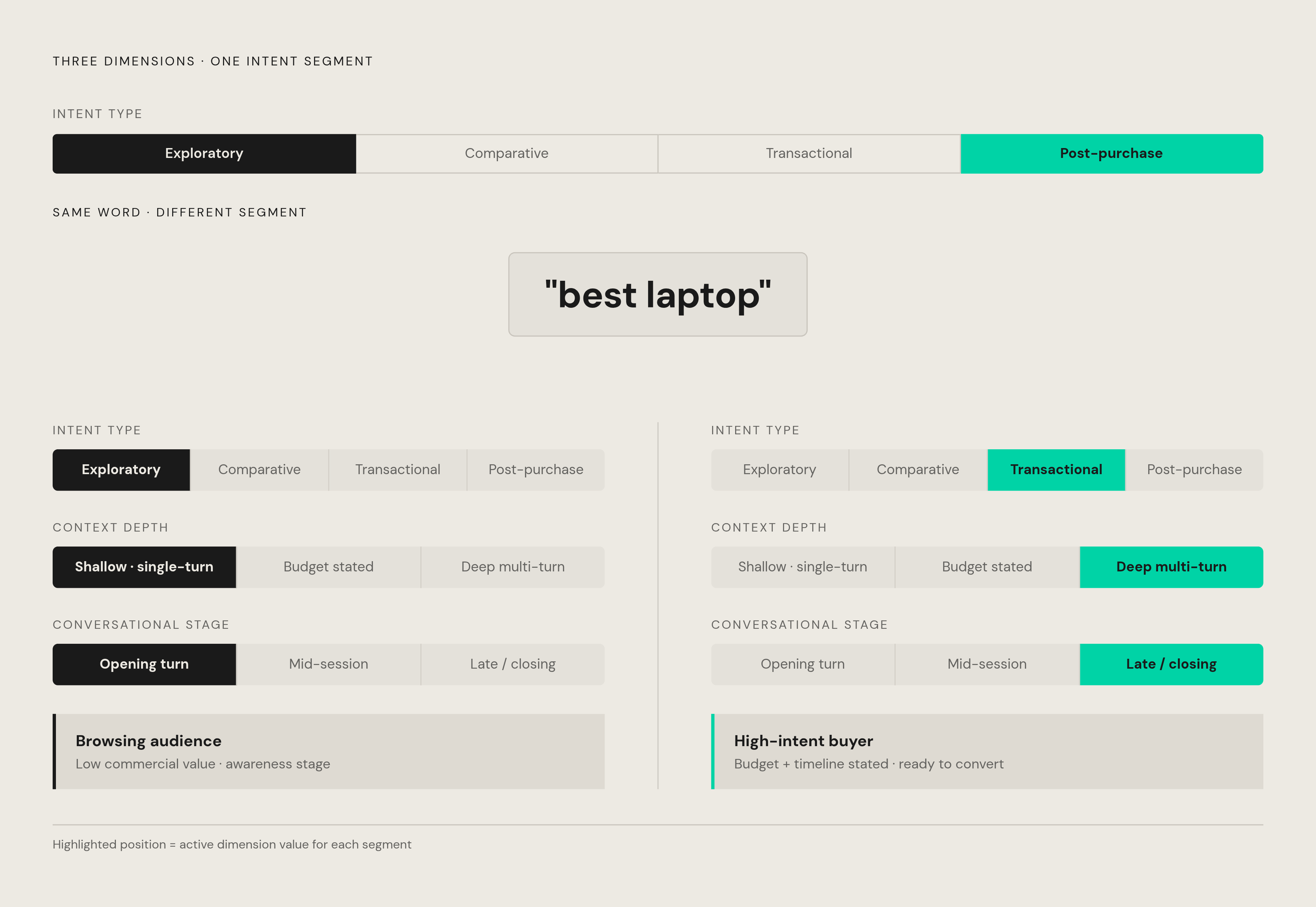
Once the question shifts from identity to conversation, three dimensions do the work that age, gender, and location used to do.
Intent type describes what kind of decision is underway. Exploratory prompts are broad category research with no clear purchase signal yet. Comparative prompts show active evaluation, usually with stated criteria attached. Transactional prompts ask where, how, or how much, meaning the person is ready to act. Post-purchase prompts cover setup, troubleshooting, and upsell moments. Each type calls for a different ad format: a sponsored recommendation card fits a transactional moment, while a branded content placement fits an exploratory one.
Context depth measures how much the conversation has revealed so far. A single-turn prompt gives shallow context; a multi-turn exchange accumulates constraints, preferences, and clarifications the way a sales conversation builds over a series of questions. Depth correlates directly with qualification. Someone who has specified a budget, a timeline, and a competing product they already rejected is a far more qualified segment than someone who just asked an opening question. As depth increases, segments can stack: topic plus stated constraint plus conversational stage produces a hyper-qualified moment that has no real equivalent on a search results page or a social feed.
Conversational stage locates the moment within the arc of a session. An opening prompt, a third-turn follow-up, and a closing action request carry different commercial weight, even inside the same topic. Bid logic should move across that arc rather than sit still. A price question asked cold is a materially cooler moment than a price question asked after ten minutes of product discussion, and should be priced accordingly.
These three dimensions combine to define a segment far more precisely than a demographic bucket ever could. "Exploratory, shallow context, opening turn" describes one audience. "Transactional, high context depth, late session" describes a completely different one, even if both conversations started with the same word.
How the technical infrastructure reads these signals at bid time
Targeting in LLM ad environments is conversation-matched. The system reads topic, intent type, and publisher category, and that reading triggers the bid. Emerging LLM ad infrastructure, including platforms operating through OpenRTB 2.6, passes conversational context into the bid request itself; topic signals stand in for the page-level contextual signals that used to drive display advertising.
Profile enrichment happens across a session rather than at a single point. A platform can build and update a lightweight intent profile in JSON as a conversation develops, inferring category interest, apparent stage, and the set of constraints a user has stated, all without ever needing to know who the user actually is. Segment IDs carry that logic through to reporting: each ad click can attach a custom UTM parameter tied to the intent cluster that triggered it, not just the standard campaign, source, and medium fields but a conversational context category. That lets post-click analysis run by intent segment instead of by audience demographic.
No cookies are required anywhere in this chain. The signal is the conversation, which makes this targeting structurally different from behavioral retargeting and largely unaffected by the ongoing deprecation of third-party data. The bid logic that follows should treat intent-type segments as separate line items with separate floors: a transactional, high-context, late-session moment justifies a materially higher CPM or CPC than an exploratory, shallow, opening-turn moment in the exact same topic category. The honest caveat is that most current platforms pass topic and publisher category and stop there; true multi-dimensional segmentation, all three dimensions read together in real time, is still a capability the industry is building rather than one that is standard today.
Vertical differences in how intent signals cluster
Prompts don't distribute the same way across categories. The mix of intent types, the typical depth of context, and how long a session runs before resolving all vary by vertical, and that variation should shape where an advertiser weights spend.
Travel is a useful worked example. Travel queries are among the categories most likely to start in an AI chat interface rather than a search engine, and travel prompts tend to run long and context-rich: dates, budget, travel party size, and experiential preferences often surface across a single extended session. The exploratory-to-transactional arc frequently completes within that one session, which makes late-session signals unusually valuable. Travel advertisers should weight bids toward high-context, late-session, transactional segments and reserve earlier-stage placements for brand-building rather than direct response.
Consumer electronics and other considered purchases skew comparative. Users tend to arrive already holding a shortlist and use the AI exchange to validate or challenge it. Stated constraints, compatibility, ecosystem fit, a price ceiling, tend to surface early and persist through the rest of the session. The decision-blocker signal is especially legible here: a phrase like "is it worth the extra cost" is a high-intent moment tailor-made for a premium-tier advertiser willing to bid for it.
Financial products behave differently again. Prompts in this category tend to be anxiety-driven and constraint-heavy, often tied to a specific life event: a home purchase, a refinance, a retirement decision. Emotional register does real work here. A user seeking reassurance is a different audience from one actively comparison-shopping, even inside the same topic category, and creative built for one will misfire on the other. Compliance adds another layer specific to this vertical; brand suitability constraints on financial advertising are stricter than most categories, and that shapes which segments are usable at all.
The general principle holds across verticals: map the typical intent arc before applying the three-dimension framework, and find where on that arc the highest-value segments sit and what signals make them identifiable.
Why conversational stage segmentation changes creative strategy
An ad matched to the wrong conversational stage doesn't just waste an impression. It reads as tone-deaf, and in a high-trust conversational environment, that mismatch costs more than the same error on a display banner ever would.
Exploratory-stage segments need a message that introduces the category or frames the problem, not one that tries to close a sale. Branded content, editorial-style recommendations, and "here's what to consider" framing fit the cognitive mode a user is actually in. Comparative-stage segments need clear differentiation tied to the criteria the user has already stated; if the conversation shows someone cares about durability and resale value, a price-focused ad simply misses the point they're making. Transactional-stage segments call for direct response creative, specific offers, and friction-reducing calls to action like "check availability" or "get a quote," since there's no need to re-establish category interest the user has already worked through.
The native, contextual format that fits inside LLM interfaces rewards this kind of stage-matching more than any other channel does, because the ad shows up inside the flow of a conversation rather than beside it. A message that fits the moment reads as helpful. One that doesn't reads as an interruption. The practical result: campaign creative should ship in at least three variants mapped to intent type from the start, not repurposed from search copy or social creative, because the conversational setting makes a mismatched format far more visible to the person reading it.
Measuring segment performance when the conversion path is nonlinear
The core measurement problem is structural, not incidental. An AI chat interaction is frequently a middle step, not the last touch; a user researches a purchase in a chat interface, sees a sponsored placement, and converts days later through a direct visit or an entirely different channel. Last-click attribution will systematically undercount that touchpoint. This isn't a minor nuance in reporting, it's a miscount that will make intent-segment performance look worse than it actually is.
Segment-level UTM tagging offers a partial fix. If every ad click carries a conversational context segment ID, intent type plus context depth plus session stage, post-click analysis can trace which segments drive downstream conversions even when the path crosses channels entirely. That's real progress over standard tracking.
What remains unsolved is exposure without a click. A user who reads a sponsored mention and converts later without ever clicking leaves no traceable signal in current infrastructure. That gap is honest and it hasn't closed yet.
The measurement posture worth adopting now has three parts. Treat conversational AI as a mid-funnel channel in attribution models rather than a last-touch one. Watch for correlated lifts in branded search volume and direct traffic during the same window as an AI ad campaign, since those are useful indirect signals even without a clean attribution path. And build segment-level reporting from day one, even while conversion data stays incomplete, so that when measurement infrastructure catches up, the historical data is already structured the right way. Measurement here is a condition for the channel's growth. Without it, there's no way to tell whether conversational AI advertising is creating new demand or simply redistributing intent that used to show up in search.
What agencies and programmatic buyers need to run intent-segmented campaigns across AI surfaces
A brand running ads on a single AI interface can build intent-segment logic tuned to that surface's signals, but it can't reach users across the wider and growing set of AI assistants, chat tools, and LLM-powered products where conversational intent now gets expressed. That's the single-surface problem, and it caps the value of even a well-built segmentation model.
Running campaigns across surfaces requires a buying layer that reads conversational context signals, not just page-level or topic-level ones, from multiple publisher integrations at once. It requires a consistent taxonomy for intent type, context depth, and conversational stage that holds up across different surface formats and bid request structures. And it requires direct supply relationships with publishers, not just open exchange access, because contextual fidelity degrades fast when conversational signals pass through intermediaries without LLM-native integration.
The market's current gap sits right in the middle of that requirement. Generalist DSPs have reach across many surfaces but can't parse conversational context. Single-surface AI ad networks can parse that context but only within one environment. Neither, on its own, satisfies both needs at once. Closing that gap requires infrastructure built to sit at that intersection, operating both a DSP and an SSP with direct AI publisher supply. Some emerging platforms attempt to address this by operating both a DSP and an SSP with direct AI publisher supply, offering one example of that kind of native integration.
There's an economics problem tied to this too. Intent-segment campaigns need upfront taxonomy work and creative versioning that push setup costs above a single keyword-targeted line item. Agencies pitching this to clients should frame it in terms of audience precision that cuts wasted spend, since that's the more accurate description of what's actually happening. A sensible way to start: pick one high-intent vertical where the conversational arc is well understood, travel or considered consumer electronics both work, build the three-dimension segment map for that vertical, and establish baseline segment-level performance before expanding to new surfaces or categories.
That circles back to the point this piece opened with. The audience in conversational AI advertising is defined by what the conversation reveals, turn by turn, and the buying infrastructure has to be built for that signal from the ground up, not retrofitted from a keyword-matching system that was never designed to read one.