AI Advertising Playbook for E-Commerce Brands
Context hints matter more than budgets when conversational AI reads the entire conversation arc.

Conversational AI advertising is not a new channel that slots into an existing media plan next to search and social. It runs on different principles entirely, so keyword logic, audience segments, and click-based attribution all fall short from the start. The targeting unit a performance marketer has relied on simply does not exist here: there is no keyword to bid on, no audience list to upload, no search results page slot to rank for. If a media buyer walks into this surface expecting to transplant a Google Ads account or a Meta campaign structure, you will find nothing to transplant it onto.
That gap matters because the surface itself has changed shape. An AI assistant delivers a single conversation, one turn at a time, with no page layout to design once and reuse across thousands of impressions. For e-commerce brands, the stakes are not theoretical. BCG's analysis found that shopping-related use of generative AI grew 35% in 2025, so shoppers are already researching and comparing products inside these chat surfaces rather than treating them as a novelty. A brand that waits for the channel to mature before building a strategy is waiting on a channel that is already carrying real purchase research traffic.
How the mechanics of conversational AI advertising work
The basic unit of targeting in LLM advertising is the conversation itself. It gets matched against where that conversation is actually heading. Instead of bidding on a keyword, an advertiser writes a context hint: a freeform, natural-language description of the conversations where the ad belongs, set at the ad group level and matched against the live exchange between a user and the assistant in real time.
That matching problem is harder than it sounds, because the system has to read the entire arc of the conversation rather than the most recent line of it. What the user asked several turns back, how the assistant answered, which follow-up questions came up, and where the exchange appears to be heading all factor into whether an ad belongs there. No single message in that exchange contains a keyword a travel brand would have bid on, but the trajectory of the conversation describes a traveler in active planning mode as clearly as any search query ever could. Contextual targeting in ChatGPT ads runs on transformer architecture that maintains coherence across multiple turns, and the same internal representations the model uses to generate a coherent reply are what the advertising system evaluates for relevance. A shopper who never types "project management software" but spends several turns describing team coordination problems, missed deadlines, and a remote team that cannot stay in sync is a stronger signal for that category than the exact product term would have been, because the system is reading the problem being described, not waiting for the product name to appear.
A context hint written as a comma-separated list of topics, the way a keyword list might be structured, tends to match poorly, because the system is not scanning for term overlap. The craft is describing what a person is actually trying to accomplish and whether an offer is useful to them at that moment, which is a different discipline from keyword research even though it occupies the same seat in the workflow.
The privacy architecture behind all of this is built differently from the cookie-based stack that search and social advertising grew up on, because it relies on live conversation rather than stored profiles. Relevance comes from the conversation happening right now, built on no historical browsing profile stitched together across sites. When the conversation ends, the signal ends with it, and no durable cross-site profile gets built or sold in the process. Inventory is structurally scarce, too: a response typically carries one sponsored card, though two-card placements have been observed. There is no cluttered results page to out-rank. The auction itself reflects that scarcity. It runs as a relevance-weighted second-price auction, so a more relevant ad can beat a higher bid. That property favors precision over budget size, and it rewards an advertiser willing to write a sharp context hint over one simply willing to outspend competitors, which is a genuinely unusual advantage in paid media while the discipline of writing for this format is still new.
Where Ads Are Running Today
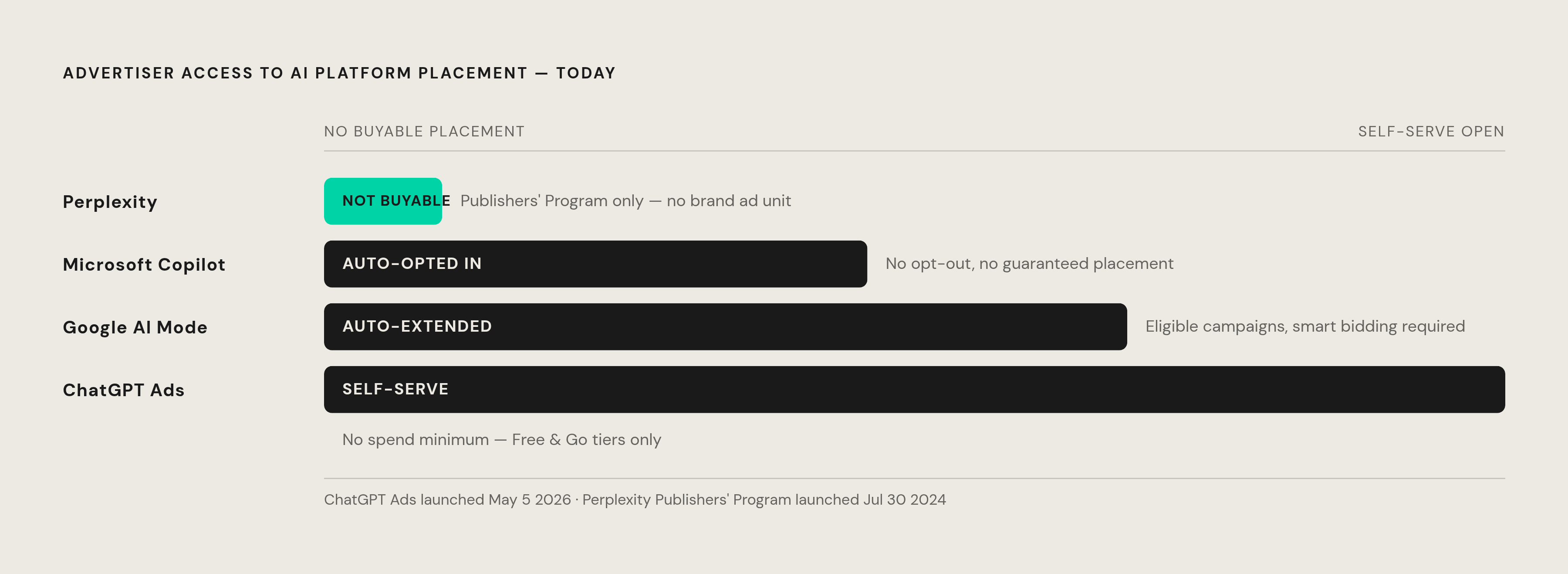
Four major platforms looked at the same opportunity in conversational AI and reached four different conclusions about how, or whether, to monetize it, and the surface an e-commerce brand picks determines the reach, the economics, the format, and the trust environment it ends up operating inside.
ChatGPT Ads opened self-serve buying through Ads Manager on May 5, 2026, removing spend minimums that had previously limited who could participate. The constraint that matters most for e-commerce planning sits in the audience itself: ads reach only logged-in adult users on the Free and Go tiers, while every paid tier, Plus, Pro, Business, Enterprise, and Education, stays ad-free according to OpenAI's own documentation. That single fact decides whether this surface fits a brand's buyer. If you sell into a broad, price-sensitive audience, you are likely to find meaningful reach on Free and Go. But if your buyers skew toward paid, professional ChatGPT usage, you will find a much smaller addressable audience than the platform's total user count suggests.
Google is building ad formats directly into its AI surfaces rather than launching a separate product: Conversational Discovery Ads and Highlighted Answers inside AI Mode, alongside AI-Powered Shopping Ads and Business Agent for Leads rolling out across Search. Existing search campaigns using broad match, AI Max, Dynamic Search Ads, Performance Max, and Shopping campaigns are all eligible to appear in these surfaces, provided smart bidding is turned on. Google is separately building commerce infrastructure, Universal Cart, Universal Commerce Protocol, and Agent Payments Protocol, and that infrastructure should not be confused with the ad products themselves; one is about how a transaction gets completed, the other about how a brand gets seen.
Microsoft Copilot follows the same operating model as Google AI Mode. Every eligible campaign and ad type already running gets automatically opted in to serving inside Copilot. Advertisers cannot opt out of that placement, and no specific placement is guaranteed in return.
Perplexity has moved toward subscription revenue rather than advertising revenue as its core business model, and it runs a separate Publishers' Program, introduced July 30, 2024, that shares revenue tied to citations inside ad-supported responses. That program matters to publisher strategy far more than it matters to a brand looking to buy placement, since it is not a buyable ad unit in the way ChatGPT's or Google's inventory is.
Amazon's Rufus assistant occupies a different category altogether. It built a large and fast-growing user base within its first year, and users who engage with Rufus show a higher likelihood of completing a purchase than users who do not, which makes Rufus a transactional surface rather than a research surface. For any e-commerce brand already selling on Amazon, Rufus represents a native AI surface sitting directly inside a purchase environment the brand already participates in, a strategic question distinct from whether to also advertise on ChatGPT or inside Google's AI surfaces. Four major platforms looked at the same opportunity and reached four different conclusions, and an e-commerce brand's job is to match its own buyer profile and existing campaign footprint against each one, since which surface it chooses determines not just reach but the economics, format, and trust environment it is operating in.
Conversational Intent Signals vs. Keywords and Demographics
A shopper describing a kitchen renovation, a budget range, and a style preference they have already ruled out hands a system stated intent in one exchange, where a search marketer would have to reconstruct the same intent from a three-word query and a string of inferred signals built up over time. That is the structural advantage: the system reads the situation a person is in right now rather than inferring who they are from a trail of browsing history. Verve Group's March 2026 launch of conversational intent targeting put this into practice at scale, unifying zero-party data, search intent, and pseudonymized AI chat activity into a single privacy-first intelligence layer that processes over a billion daily signals, the first open-market platform built to operationalize intent data from AI chat interfaces for programmatic buying.
For e-commerce specifically, that signal quality appears in measurable on-site behavior, not just in the richness of the conversation itself. Adobe's data shows that consumers who visit retail sites after using generative AI sources engage more, browse more pages per visit, and bounce meaningfully less than consumers who arrive through non-AI channels. Visitors who arrive through AI-driven search show much higher engagement value than visitors who arrive through traditional organic search, and you can see that gap directly in on-site behavior, not just in how people describe their intentions in a survey.
The privacy architecture described earlier is not incidental to this advantage, it is a structural part of it. A conversational intent signal needs no third-party cookie and no device identifier, because relevance comes from the conversation itself, not a stitched-together browsing history. So as cookie deprecation and identifier restrictions tighten across the broader advertising ecosystem, a targeting method that needs neither becomes more durable than one built on tracking infrastructure that regulators and browser vendors are actively dismantling.
The most common objection a performance marketer raises against this channel is cost per impression: CPMs here run high relative to social platforms. That comparison uses the wrong unit of measurement. Where conversion rates and session quality differ this much, cost per outcome is the number that matters, not cost per impression, and a higher-intent signal narrows the gap in the denominator of that calculation even when the sticker price per thousand impressions looks steep next to a social feed.
Building context hints and creative for conversational formats
Winning in this channel means unlearning two habits at once: keyword-list targeting logic, and static creative built for a fixed ad slot that gets designed once and served thousands of times. Both habits come from a media environment where the page was fixed and the audience moved past it. Here, the conversation moves and the ad has to fit wherever it lands.
A context hint describes what someone is trying to accomplish at the exact moment the ad should appear, and teams that write hints as comma-separated topic strings get poor matching results consistently. The craft lies in describing a problem narrative: what the person is dealing with, what decision they are working through, and whether the offer actually helps them right then, rather than simply stating what category the brand sells into. Because the system reads the full trajectory of a conversation rather than a single message, a context hint can describe a multi-turn arc: a conversation that opened as general research and is now narrowing toward a specific purchase decision represents a different moment than one that opened already naming a specific product. A kitchen equipment brand gains more from a context hint written around someone weighing induction cooking against gas for a first home than from one written around the search phrase "best induction cooktop," because the former captures a live decision in progress rather than a fixed product query.
Creative needs the same rebuild. No single evergreen banner works across every conversation a brand might appear in, so you have to produce creative for context, not for a placement that stays fixed. That requirement changes the production model entirely: the creative-generation pipeline inside LLM ad infrastructure is generative by design, because the sheer volume of tightly targeted creative units needed per assistant, per format, and per topic cluster is only achievable at machine speed. An e-commerce brand planning a budget for this channel needs to plan for that production reality rather than treat creative as a one-time asset built by an agency and reused for a quarter. Copy has to read as a helpful continuation of the conversation the user is already having, not an interruption of it: the assistant's actual answer is not for sale, and the sponsored card sitting next to it earns its place only through relevance. That sets up a dual-track creative requirement. Brand resonance and storytelling still matter to the human reading the card, but the AI system rewards semantic clarity, so fact-first structure tends to outperform prose-heavy brand copy inside these placements. Product feed integration, live on ChatGPT Ads as of May 2026, lets catalog-level creative get matched dynamically to conversation context, but this only works if you structure the feed data for semantic matching rather than build it purely for a shopping grid layout.
You need to check brand safety rules of its own before launch. Sensitive topic restrictions apply, and content policies run stricter than they do in search, so categories need auditing before a brand assumes it is eligible to serve. Brand safety inside an AI response depends directly on how precise the context hint is: a vague hint risks placing an ad into a conversation where the brand association does the brand no favors, which makes precision in the context hint a safety mechanism as much as a performance one.
Sources
- bcg.com
- Understanding Contextual Targeting in ChatGPT Ads: A 2026 Deep Dive
- Verve Group launches industry-first targeting capability activating conversational intent signals from major LLM environments
- LLM Ads Explained: How AI Advertising Works in 2026
- What Is LLM Ad Infrastructure? 4 Layers Explained (2026)