Creative Copywriting Constraints for AI-Native Ad Placements
Relevance and creative precision replace budget as the winning currency in AI assistant ads.

Advertising inside an AI assistant is a different medium with its own grammar, and the mechanics of serving an ad inside a large language model invert nearly every foundational assumption that search and social copywriting trained writers to rely on. That inversion is the subject of this piece: what changes, why it changes, and what a writer has to do differently to win.
How AI assistant ads differ structurally from search and social placements
Picture a parent who is mid-conversation with an assistant, planning a family trip to Japan. By the time an ad might reasonably appear, the exchange has likely already settled which city, what time of year, and roughly what the household is willing to spend. A conversational interface works nothing like that. The "content" alongside the ad is generated in real time through dialogue, and it shifts with every exchange between user and model. The ad has to earn its relevance against a target that is still moving as the conversation continues.
The placement itself makes this distinction physical rather than conceptual. A ChatGPT ad renders as a labeled sponsored card below the assistant's answer, and it is never woven into the answer text, because the model's response itself is not for sale, and the commercial unit has to sit adjacent to it rather than inside it. Ads reach only logged-in adult users on ChatGPT's Free and Go tiers, while Plus, Pro, Business, Enterprise, and Education tiers remain ad-free. That tier split is not a footnote. Because the population seeing these ads is defined by subscription status, not by a search query or a feed algorithm's guess at interest, it determines the audience and the intent profile before a single line of copy gets written.
What makes the conversational channel qualitatively different from a keyword search, though, is the density of what the conversation itself reveals. The conversation is intent, spoken in full sentences, and that is the raw material a writer now has to work with.
How the relevance-weighted auction rewards creative precision over budget
If the content a writer competes against is unstable this way, the auction that decides whether an ad even gets served has to weight relevance differently than legacy ad systems did. The placement auction is relevance-weighted and runs on a second-price basis. A precisely targeted ad backed by a modest budget can beat a vague ad backed by a large one, a property that is unusual in paid media and that concentrates competitive advantage squarely in the quality of the creative itself. The system reads the context hint, the ad title and copy, and the landing page as a single unit, scoring relevance holistically across all three, so a mismatch anywhere in that chain leaks auction score rather than merely weakening one component of it. Second-price mechanics compound the incentive: the winner typically pays just above the next competing bid rather than the full amount bid, so the reward for winning on relevance rather than on raw spend is direct and immediate rather than diffuse.
The practical consequence for copywriters is blunt. A poorly matched ad does not just underperform once it is live. It loses the auction before the impression is ever served. The writing has moved from a performance lever to a gatekeeping one.
The scale of that effect has precedent outside LLM advertising. Meta's own analysis attributes roughly 56% of ad performance variation to creative quality, more than targeting, bidding, and placement combined, and there is reason to expect the effect runs stronger still across LLM surfaces, since an assistant renders the ad inside a live conversation where tone and relevance carry more weight than they do inside a scrolling feed. Microsoft has made a related claim about its own Copilot surface: Copilot's targeting model reads the whole conversation within a session rather than just the most recent query, and Microsoft reports that Search ads on Copilot deliver significantly stronger click-through and conversion rates than traditional search ad placements. Even read cautiously, though, it points in the same direction as the structural argument: session-level context appears to be doing real work in why these placements perform the way they do.
The 280-character context hint as the highest-leverage creative input
If relevance is the currency the auction pays out in, the context hint is the instrument writers use to spend it. The context hint is a freeform, natural-language description of the conversations where a given ad belongs; it is capped at 280 characters, written at the ad group level, and it works as the primary targeting control in conversational AI advertising. The hint replaces keyword bidding outright, and the system matches it against the live conversation taking place, not against a string a user typed into a search box.
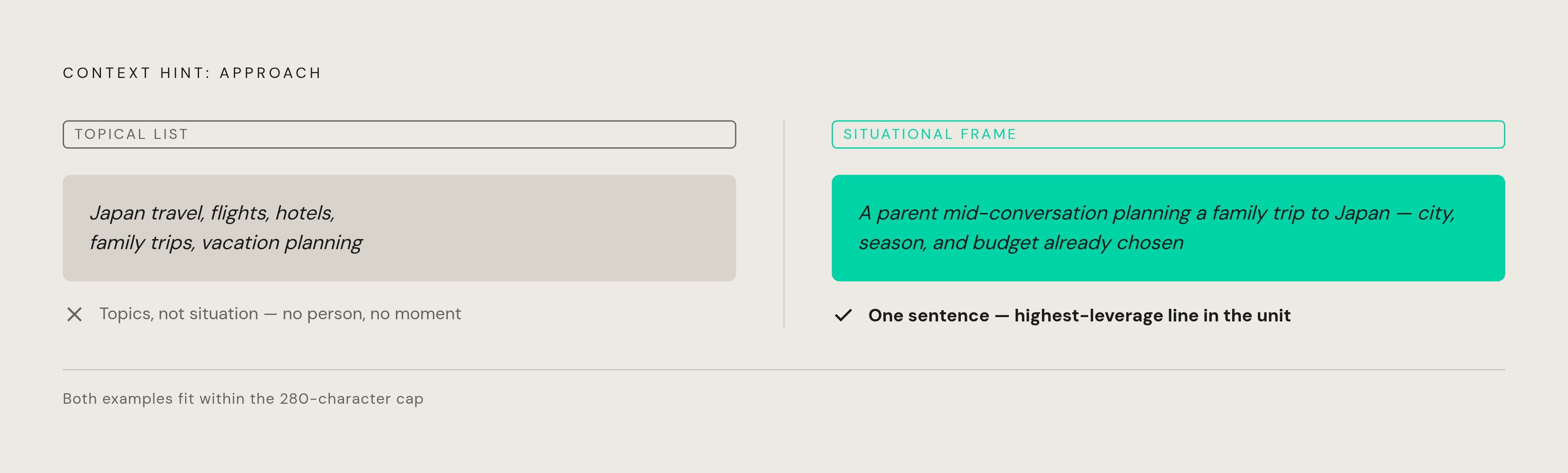
That distinction is the whole craft transition in miniature. Teams accustomed to keyword logic tend to reach for the same habits in the new format, and the most common failure mode is writing a hint as a comma-separated list of topics, essentially treating the 280-character field as a keyword box with punctuation. So matching comes out poor, because the system is scoring situational fit rather than topical overlap.
The contrast is worth making concrete. The first approach enumerates a topic. The second describes a situation, and situations are what the matching system is built to recognize.
The 280-character limit is not an incidental format detail to work around. You have roughly the space of a single tweet, so it pushes you toward specificity and situational clarity, with no room left for hedging, qualification, or topic enumeration. Getting the hint right is the real writing, and it may be the highest-leverage sentence a creative team produces across the entire ad unit.
How conversational intent signals reshape what ad copy needs to say
The depth of intent a conversation reveals should change not just how an ad is targeted but what the ad copy itself says. Conversational AI captures intent at a level of specificity that a search query never could, and copy that speaks to a user's actual situation, their stated constraint, their shortlist, what they have already ruled out, consistently outperforms copy written to a category.
This has a direct bearing on where in the customer journey copy should meet the reader. Copy that engages at the problem stage, rather than jumping straight to brand comparison, reaches more of that journey, because it is present for the deliberation rather than only for the decision.
The multi-turn structure of conversation adds a wrinkle that search advertising never had to account for. Say the next decision in the sequence is transportation between cities or how to structure a multi-stop itinerary: the copy that addresses it is the copy that earns its place. Effective creative has to be built in sets that correspond to different points in a decision sequence.
Writing copy that reads as native to a conversation rather than adjacent to one
An ad that reads as a natural continuation of the exchange it sits beside is doing something categorically different from an ad placed next to a search result, and this is primarily a writing problem rather than a design or targeting one. Contextual targeting in ChatGPT ads works on conversation-level understanding rather than page-level content matching. Tone and framing get evaluated against a conversational register that is actively shifting, not against a static editorial environment that holds still while the reader scans it.
That shifting register matters because a single exchange can move through several distinct tonal moments. Copy calibrated to the wrong phase of that progression reads as out of place even when the underlying product is genuinely relevant to the user's goal.
Meeting that bar operationally depends on having enough creative material to work with. These placements perform best when the advertiser supplies a wide enough library of high-quality assets that the system can adapt messaging to the specific question a user has asked. A rigid set of fixed templates leaves the system with little room to match message to moment. Asset variety functions less like a backup option and more like a precondition for the whole mechanism to work as designed.
Leaning too heavily on AI generation to produce that volume of copy tends to flatten it, since ads drawing from similar training data begin to resemble each other in ways users can spot while they're still processing a response from that same class of model. Sameness is conspicuous in a conversational interface in a way it rarely was in a feed built from thousands of competing voices.
Finally, the seam between assistant and advertiser has to be crossed deliberately. The ad sits below the answer, never inside it, so the copy has to carry the full weight of moving the reader from the assistant's conversational register into a commercial offer without friction. The "Sponsored" label is a visible seam, not an obstacle to disguise. Good copy treats it as a threshold the reader can be invited across willingly, rather than a boundary to be smoothed over or hidden.
Creative constraints in regulated categories: compliance without killing contextual relevance
Finance, health, legal, insurance, and B2B software advertisers face the sharpest version of every constraint described so far, because they have to satisfy platform-level content restrictions and internal compliance review at the same time, and the freedom to vary creative that these systems need in order to stay contextually relevant runs directly against both.
Inside the surfaces that do accept regulated-category advertising, the tension is asymmetric. Resolving that tension is a process problem, and it has a workable shape: build approved creative libraries with clearly bounded ranges of variation, tie disclaimer language to claim type rather than attaching a disclaimer to every individual ad, make sure landing pages match ad claims precisely (since the auction reads the landing page as part of its relevance score), and run a review process built to protect compliance without blocking every variation that would otherwise be contextually useful.
None of this is unique to conversational AI advertising. Generation left unconstrained tends to produce copy that gets truncated or overwhelms the viewer, regardless of platform, and the fix is the same regardless of category: platform-specific and compliance-specific constraints have to be built directly into the generation prompts before copy is produced. Regulated advertisers are not excluded from doing well in this channel. They simply have to build the constraint into the front end of the process rather than treating it as a filter applied at the end.
Brand safety and hallucination risk as creative constraints, not just compliance checkboxes
LLM advertising introduces a brand safety problem with no real analogue in legacy digital advertising. When a model produces an inaccurate or hallucinated answer, the risk to an adjacent advertiser is apparent association with misinformation generated inside the very interface hosting the ad. In an extended conversation, that exposure can compound: a brand appearing repeatedly across a session in which the model produced a flawed answer accumulates the appearance of endorsing that answer, turn after turn.
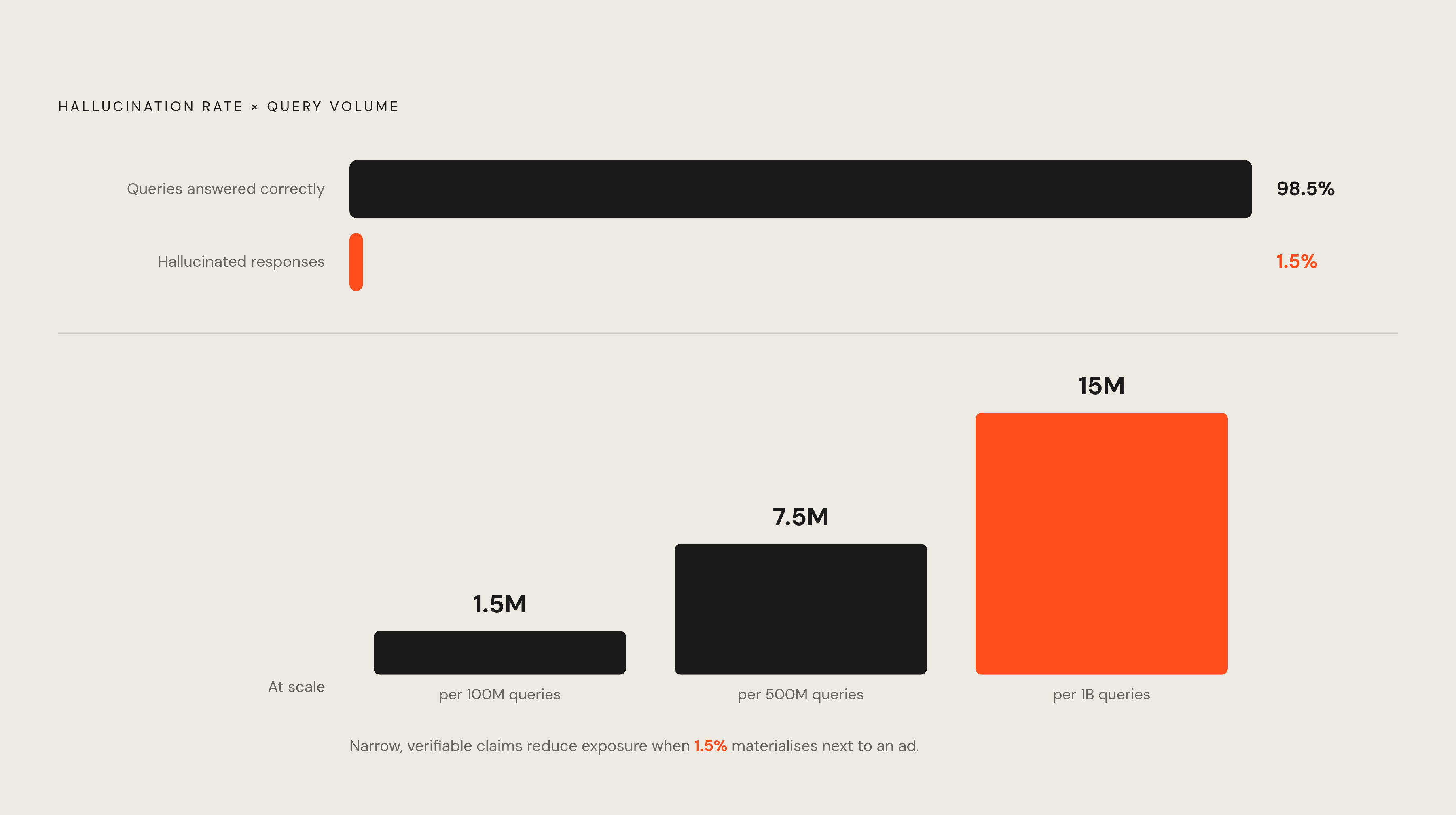
The scale of the underlying risk is measurable rather than hypothetical. Hallucination rates vary by model, with GPT-4o at 1.5%, and while that figure sounds small in isolation, it scales across hundreds of millions of queries, and some models run meaningfully higher. The creative response to that reality is a matter of claim design. Ad copy built on narrow, verifiable claims is structurally less exposed than copy built on broad, category-level assertions, because if the model's own answer contradicts a sweeping claim sitting in the ad beside it, the dissonance is immediate and visible to the user reading both. Landing pages matter doubly in this environment: the auction scores them for relevance, and a landing page that contradicts the ad copy sitting next to a response the user has just trusted compounds the credibility damage rather than merely disappointing a click.
Disclosure norms are moving in a direction that reinforces this discipline rather than working against it. The IAB released its first AI Transparency and Disclosure Framework in January 2026, recommending consumer-facing disclosure of AI use in advertising, backed by machine-readable metadata built on C2PA standards; adoption remains voluntary, but the direction of travel toward disclosure as a norm is now established. Writers who treat that label as a creative asset, writing copy that earns the commercial relationship rather than obscuring it, draw on the trust the assistant has already built with the user instead of spending against it. Hallucination risk, understood this way, is a known, quantifiable constraint that should shape how narrowly a claim gets written and how tightly a landing page has to match it.
The platform landscape and the cross-surface creative practice it demands
Every constraint covered here, the context hint, the relevance-weighted auction, the conversational register, the compliance workflow, the hallucination exposure, plays out differently depending on which assistant the ad runs inside, and no single set of habits transfers cleanly across all of them. Google's AI Overviews carry their own set of excluded verticals, and a writer has to know them before a regulated-category campaign is even drafted.
Writing for this landscape as a single undifferentiated "AI ads" skill set misses the point of how differently each surface is built. The craft that emerges from everything above, precise, situational hint-writing; copy calibrated to conversational register rather than static page context; claim discipline built for an environment where the model beside the ad can be wrong; compliance workflows that protect variation instead of eliminating it, is transferable in principle. But applying it well still means knowing, surface by surface, which rules are actually in force before you write a single line of copy.