Demand Capture vs Demand Generation in AI Advertising Channels
AI conversations are replacing search queries as the primary site of buyer intent.
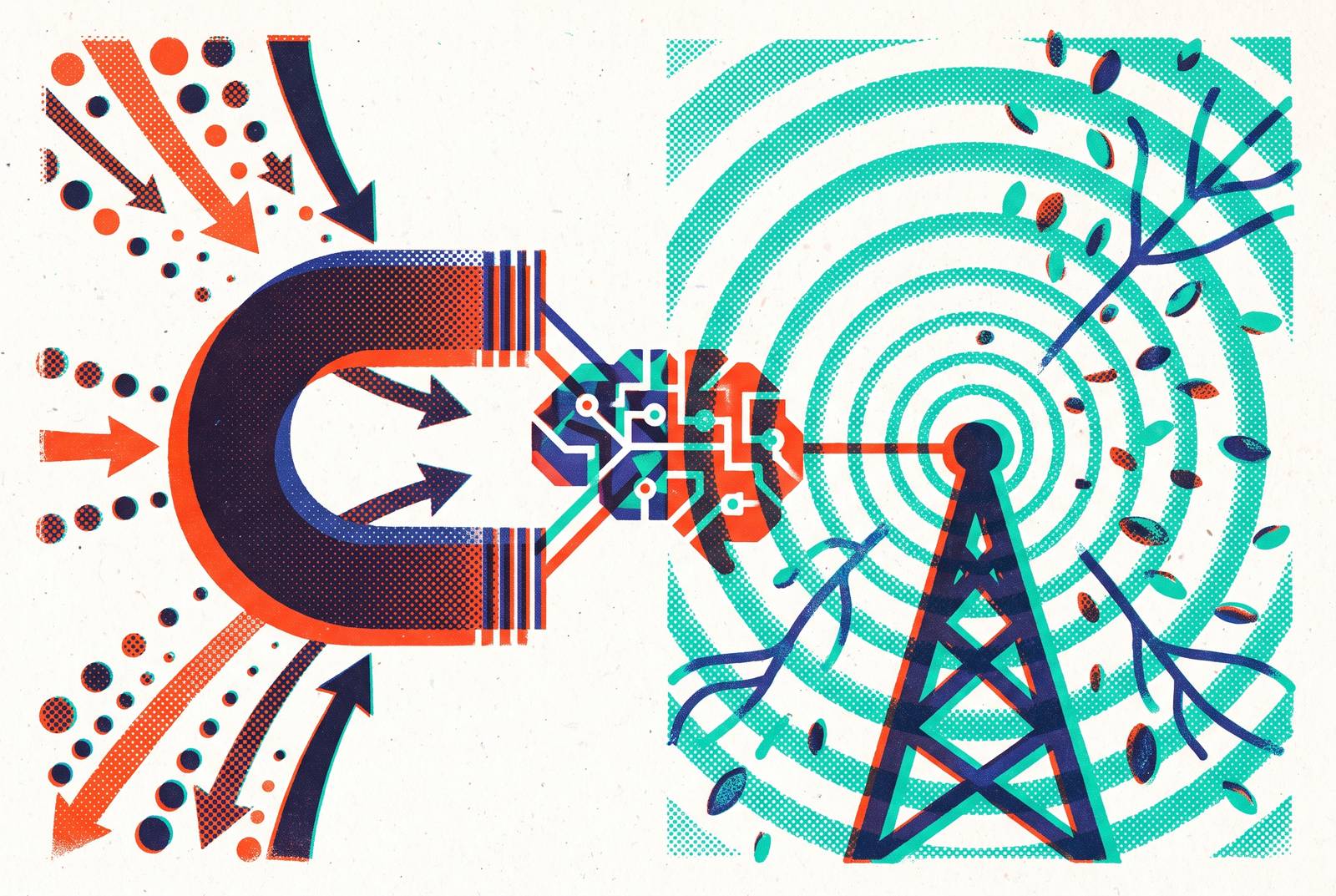
A small share of any market, around 5%, is actively buying at any given moment, and the rest has to be moved toward that state before it will buy anything. What has changed is which channels perform each job. Most marketing teams still budget around a media plan where paid search sits at the capture end and brand media sits at the generation end, but that assumption fails often enough now to matter.
Why the demand capture / demand generation distinction holds
The 5% figure is not a rule of thumb marketers invented to feel better about targeting the rest of the funnel. It describes something close to a structural constant: at any moment, most of a market is not shopping, and a smaller slice is actively deciding. Demand generation exists to move people from the first group toward the second. Demand capture exists to win the decision once someone arrives there. That division of labor has held for decades, and nothing about AI changes the underlying behavioral split.
What AI has changed is the machinery each function depends on. Demand generation built its home in awareness media, brand campaigns, display, video, content, all aimed at people who were not yet looking. A typed query was the cleanest signal you could get that someone had crossed into active decision-making, so demand capture built its home in paid search. That mapping made sense as long as search was the place where decisions got made. It no longer is. AI-driven zero-click searches now account for more than half of all Google queries, so the query itself is disappearing as a usable signal at the exact moment it matters most. The buyer gets an answer and never generates the click that used to tell marketers where intent lived. The old function still needs doing. The channel built to do it is losing the very signal it was built around.
AI conversation layers as the new site of intent formation
Intent has not evaporated. It has moved upstream, into conversational interfaces, before the buyer ever reaches a search bar. So by the time someone opens Google, in many categories they've already built a shortlist, weighed tradeoffs, and ruled things out inside a chat window.
What makes this shift consequential is how much a conversation reveals compared to a query. A buyer several turns into a conversation with an AI assistant has typically already stated a budget, named constraints, said what they've rejected, and described what they need to happen next. No keyword captures that, because no page-level contextual system was ever built to read it. Consider a user who asks three follow-up questions about connecting a project management tool to an existing CRM, mentions frustration with their current setup, and then asks for pricing comparisons. That single thread carries more declared intent than any keyword string could hold: it is intent stated directly, in the user's own words, across several turns.
That intent narrows fast. Buyers researching through AI tend to land on a shortlist of around two brands before they ever return to the open web to buy, and in categories like flights and electronics, some convert within 48 hours of that research. The window to act on that intent is short in another sense too: most users leave the conversational interface after roughly six prompts. If you place a relevant message somewhere in that stretch, it can reach someone mid-decision. Placed outside it, the opportunity is gone.
Structural differences between conversational AI advertising and search advertising
None of this means conversational AI advertising is just search advertising with a new interface. It works on a different mechanism entirely. It reads live conversational context instead of matching keywords, it skips third-party behavioral data and demographic profiles altogether, and it evaluates the whole arc of a dialogue rather than a single isolated query.
The architecture underneath makes that arc readable in a way search never allowed. These systems run on transformer models, so when they process appended conversation history within a bounded context window, an ad system can weigh relevance against more than the most recent message. It can account for what the user asked earlier, how the assistant responded, and where the exchange seems to be headed.
A system built for this channel reads real-time conversational context instead of matching keywords, and it looks at the entire dialogue trajectory instead of an isolated query, rather than waiting for an explicit product-category label. It also changes the privacy picture. Relevance comes from the conversation happening right now, not from a history of browsing behavior, so a system built for this channel, especially one running its own publisher exchange with direct supply relationships, can read conversational context without persistent identifiers or cross-site tracking. Each conversation stands on its own as a targeting context, built fresh every time.
The ad itself sits differently too. A ChatGPT ad appears as a labeled sponsored card placed below the assistant's answer, never folded into it. The model's response is not for sale. The commercial unit sits next to it, visibly separate.
That separation points to the clearest structural difference from search: inventory scarcity. A search results page can carry several ads at once. A single conversational answer generally cannot. That constraint raises the value of each placement and reshapes the competitive dynamics of the auction, and a lot of marketers still thinking in search-volume terms haven't adjusted their bidding logic to account for it.
The platform landscape
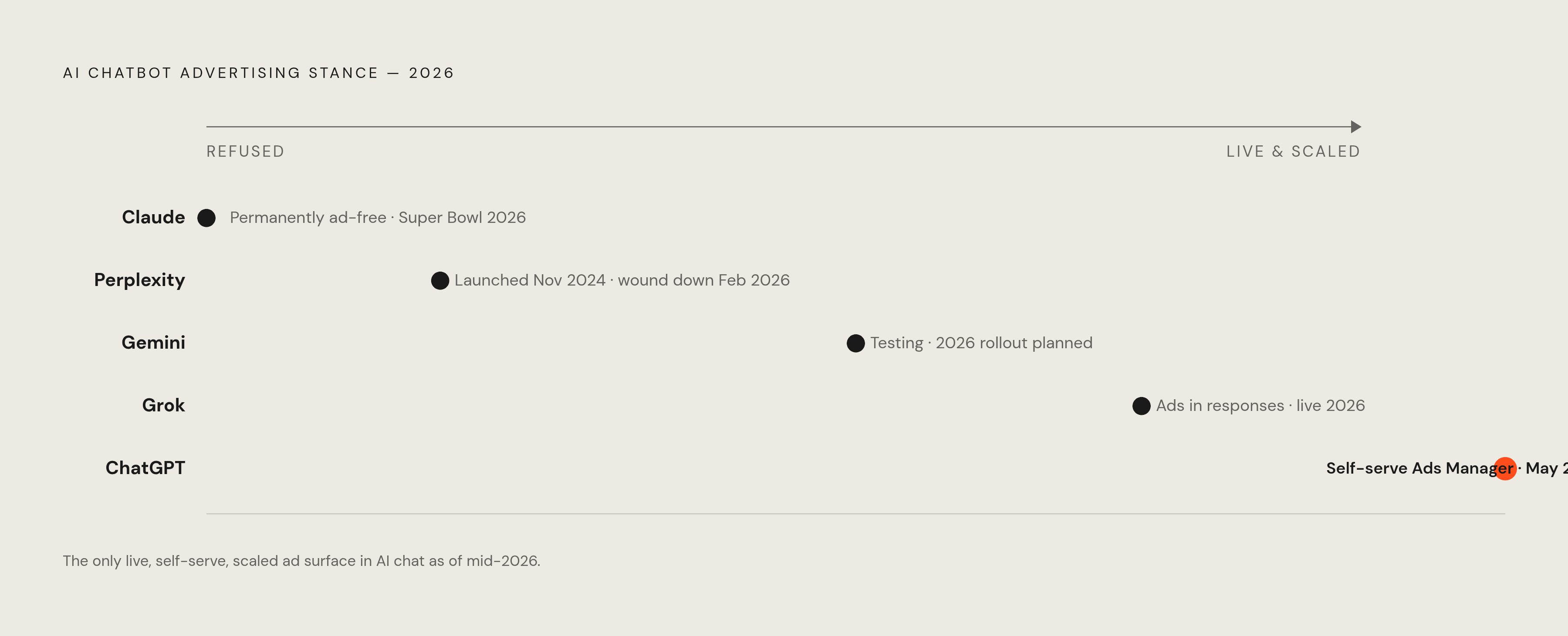
Four major AI platforms have taken four different positions on advertising, and those positions show you where conversational demand capture is available right now, not just where it might eventually be.
ChatGPT launched ads on February 9, 2026, as labeled sponsored cards below the answer, reaching only logged-in adults on the Free and Go tiers. Every paid tier, Plus, Pro, Business, Enterprise, and Education, stays ad-free according to OpenAI's own documentation. The self-serve Ads Manager opened on May 5, 2026, and it took away the spend minimums that had defined the pilot phase. That pilot had launched at a premium CPM with a substantial entry commitment, with Target, Adobe, Williams-Sonoma, and Albertsons among the first partners. The surface is now live and expanding across a growing list of countries, including 31 European markets. OpenAI has also introduced Sponsored Agents, so a user can chat directly with a brand-sponsored agent after clicking an ad, built from material the brand supplies, such as website content and product details.
Perplexity moved in the opposite direction. It launched sponsored answers in November 2024, but it stopped accepting new advertisers in October 2025, and by February 2026 it had wound the program down entirely; leadership told the Financial Times that sponsored placement risks making users suspicious of the whole answer. That retreat signals an unresolved tension between trust and monetization on that particular surface, and is a cautionary case rather than evidence the category doesn't work elsewhere.
Claude has never carried advertising. Anthropic went further than simple abstention: it pledged publicly that Claude will remain ad-free, and it ran a Super Bowl campaign against in-chatbot ads less than three weeks after OpenAI's launch. Claude remains ad-free today.
Gemini carries no live ads inside the chatbot itself, though Google has been briefing advertisers on a 2026 rollout for the Gemini app and testing is underway. AI Overviews continues expanding across the results page, but that is a separate surface from Gemini, and Gemini still carries no ad placement of its own.
Grok announced a pro-ads direction in August 2025, and by 2026 it had shipped both ads inside Grok's responses and Grok-integrated discovery ads.
For any B2B marketer weighing ChatGPT specifically, reach is limited to Free and Go users, which skews the available audience away from the enterprise seats most likely to run on paid tiers. That constraint doesn't disqualify the channel, but it does mean the audience available for purchase isn't identical to the audience a brand might assume it's buying.
What funnel function conversational AI advertising performs
Conversational AI advertising functions primarily as a demand capture channel, but it does not capture demand evenly across a conversation. Research-stage exchanges and purchase-ready exchanges carry different intent signals, so if you collapse them into a single performance metric, you get the same blended, misleading numbers that have dogged display advertising for years.
Early in a conversation, when a user is still asking exploratory or comparison-framed questions, click-through rates tend to run higher simply because curiosity costs the user nothing. Conversion rates at that stage run lower, because the user is building a shortlist rather than choosing from one. Later in the conversation, once the questions turn to specific constraints, pricing comparisons, or some version of "which one should I pick," clicks drop but conversion rates climb substantially. That pattern echoes the old distinction search marketers drew between navigational and transactional queries, except the signal available here carries more texture than any query taxonomy ever offered.
An advertiser that measures a single blended conversion rate across both stages will misprice the channel in both directions: overpaying for early-stage attention and underpaying for the late-stage placements that actually convert. Segmenting by conversational stage is a prerequisite for the channel to make financial sense.
Demand generation has not disappeared from this picture either, it has just moved to a different part of the mechanism. Brand presence inside organic AI answers produces its own lift: Adidas saw an increase in branded search after appearing inside LLM conversations, a downstream awareness effect that functions like a top-of-funnel touchpoint even though the interaction producing it looked transactional on its face. Google has built its own campaign architecture that treats these as genuinely separate layers, not one blended motion. The "Power Pack" framework unveiled at Google Marketing Live in May 2025 assigns Demand Gen to awareness-building, AI Max to capturing search intent, and Performance Max to converting across the full funnel. That structure mirrors the argument this piece is making: capture and generation are still different jobs, even when they run through adjacent surfaces inside the same conversation.
What prompt-level intent signals reveal
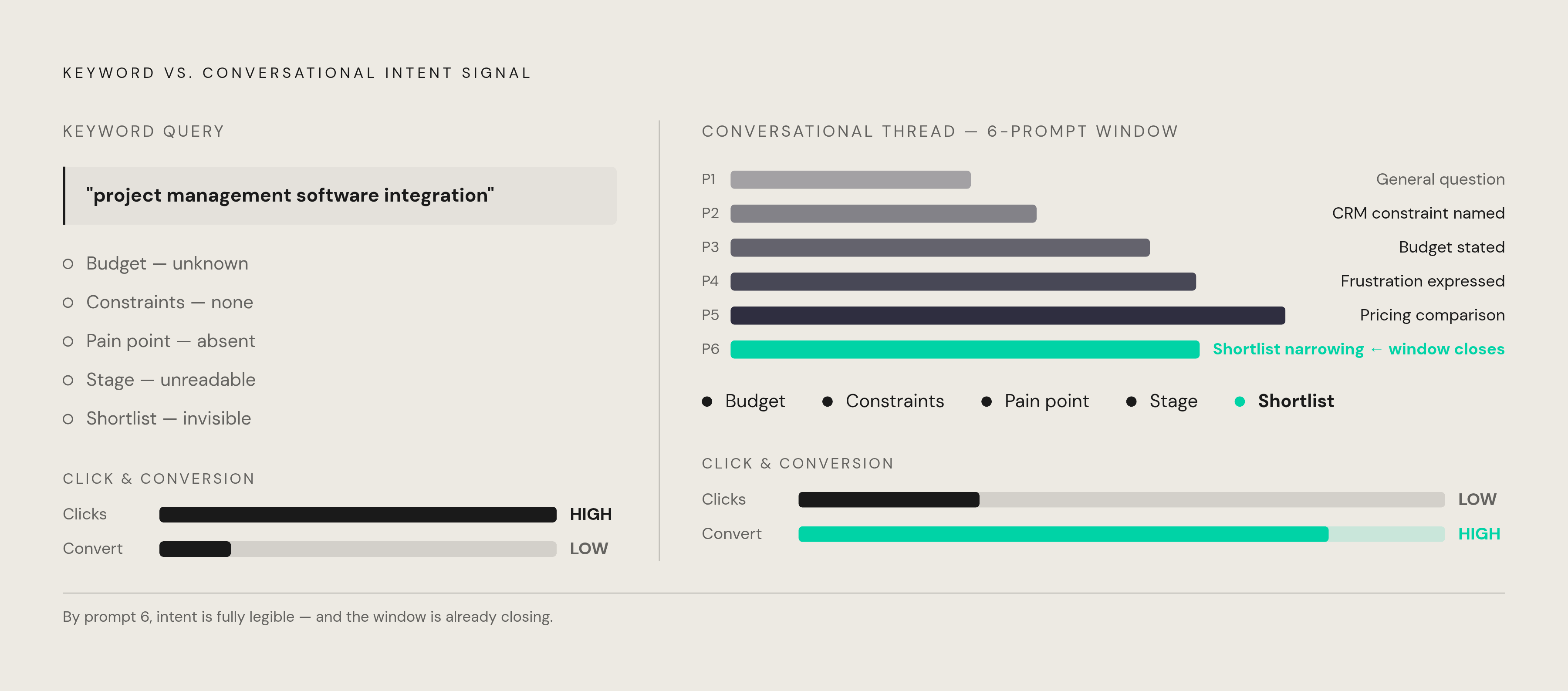
A keyword has always been a proxy. It tells a marketer what string a person typed and little else. A conversational prompt tells a marketer what the person is trying to accomplish, under what constraints, against what alternatives, and after rejecting what. That is a different category of signal.
Take the earlier example again: a user asking about connecting project management software to a CRM would, in a keyword system, generate a query like "project management software integration." That string says almost nothing about where the buyer stands. The multi-turn version of the same intent, the follow-up questions, the stated frustration with the current tool, the request for pricing, says a great deal. It arrives as a plain description of what the person wants.
This has a privacy dimension that matters alongside the targeting dimension. A system like this reads the conversation happening now rather than a stored history of past behavior, so it doesn't need persistent identifiers or cross-site tracking to work. Each conversation stands on its own as a targeting context: it gets built, then discarded, with the conversation itself. As privacy regulation tightens, that architecture is not just a technical detail, it's a structural advantage for any system trying to operate in this space long-term.
The skill this demands of advertisers is genuinely different from keyword bidding. A keyword asks what string someone typed. A context hint asks what the person is trying to accomplish and whether a given offer is useful to them at that moment. Teams that treat context hints as comma-separated topic lists, the way they once built keyword match lists, tend to get weak matching back, consistently, because the system is built to read intent expressed in language, not categories expressed in tags.
The attribution gap: why conversational AI advertising is harder to measure than search
The clearest objection to everything argued so far is also the most legitimate one: this channel is genuinely harder to measure than search, and that difficulty is structural, rooted in how conversational exchanges resist page-level tracking. A user can spend several minutes deep in a multi-turn conversation, then leave the interface entirely, and convert hours or even days later through a completely different channel. Last-click attribution assumes the final touch deserves the credit, so it will undercount what the conversational exchange actually contributed.
That interval between AI-assisted research and eventual conversion, sometimes called the conversation gap, often leaves no trace in standard analytics stacks. Those stacks were built around pixels and UTMs made to catch page-level events, so when a conversation never generates a page view at the moment it matters most, it simply doesn't register.
The practical response is not to abandon measurement but to layer it. Platform pixels, conversion APIs, and UTMs remain the baseline layer to keep in place. On top of that, creative-level tagging and holdout tests are the better-suited approach for a channel where last-click can't be trusted to tell the full story. Funnel-stage segmentation matters here too, for the same reason it mattered in the previous section: research-stage exposure that later shows up as a direct or branded search conversion is a downstream effect of the conversational exposure itself, and the Adidas branded-search lift is exactly that kind of effect, one that standard attribution models are not built to catch.
The gap is widest on the platforms carrying the most volume right now. Google's AI Overviews and AI Mode offer no segmented reporting at all, so advertisers running eligible campaigns are already showing up inside those AI surfaces with no way to see which placements produced which outcomes. That is the honest state of measurement in this channel: real demand is being captured inside conversations, and the infrastructure built to prove it is still catching up to the infrastructure doing the capturing.
The structural soundness of demand capture versus demand generation has not weakened. The channel map underneath it has shifted, and with that shift, the media buying infrastructure built around search-based intent signals has started to show its age. The frameworks marketers trust are still correct. The tools built to act on them are the part still catching up.