Intent Signal Decay in Multi-Turn AI Conversations
Early purchase signals dissolve faster than marketers realize—usually within two conversation turns.
Purchase intent in an AI conversation doesn't get misread so much as it gets outrun. A user states exactly what they want in turn one, and by turn five, that signal is buried under clarifying questions, hedges, and pivots the model never quite reconciles. Anyone trying to act on conversational intent, for advertising, personalization, or sales routing, needs to understand that decay before they can time anything against it. This piece is about where the signal actually lives and how fast it moves.
The taxonomy of user intents that appear across a conversation — and how they shift
Research on multi-turn dialogue from 2025 catalogs the intent types a user cycles through in a single session — social exchanges, task requests, information-seeking, fact-stating, added context, expressed emotion, role-play, technical or error statements, among others. What matters isn't the count, though. It's that these categories don't arrive in order. A user doesn't move neatly from greeting to task to resolution; they loop back, repeat themselves, abandon one intent mid-sentence for another.
That mutability is the engine of decay. A sharp, transactional signal in turn one can be followed by an informational question, an emotional hedge, or a pivot to an entirely different product category. None of that means the original need vanished. It means the conversation moved into a different mode, and the model has to decide what to do with a signal that's still technically live but no longer visible.
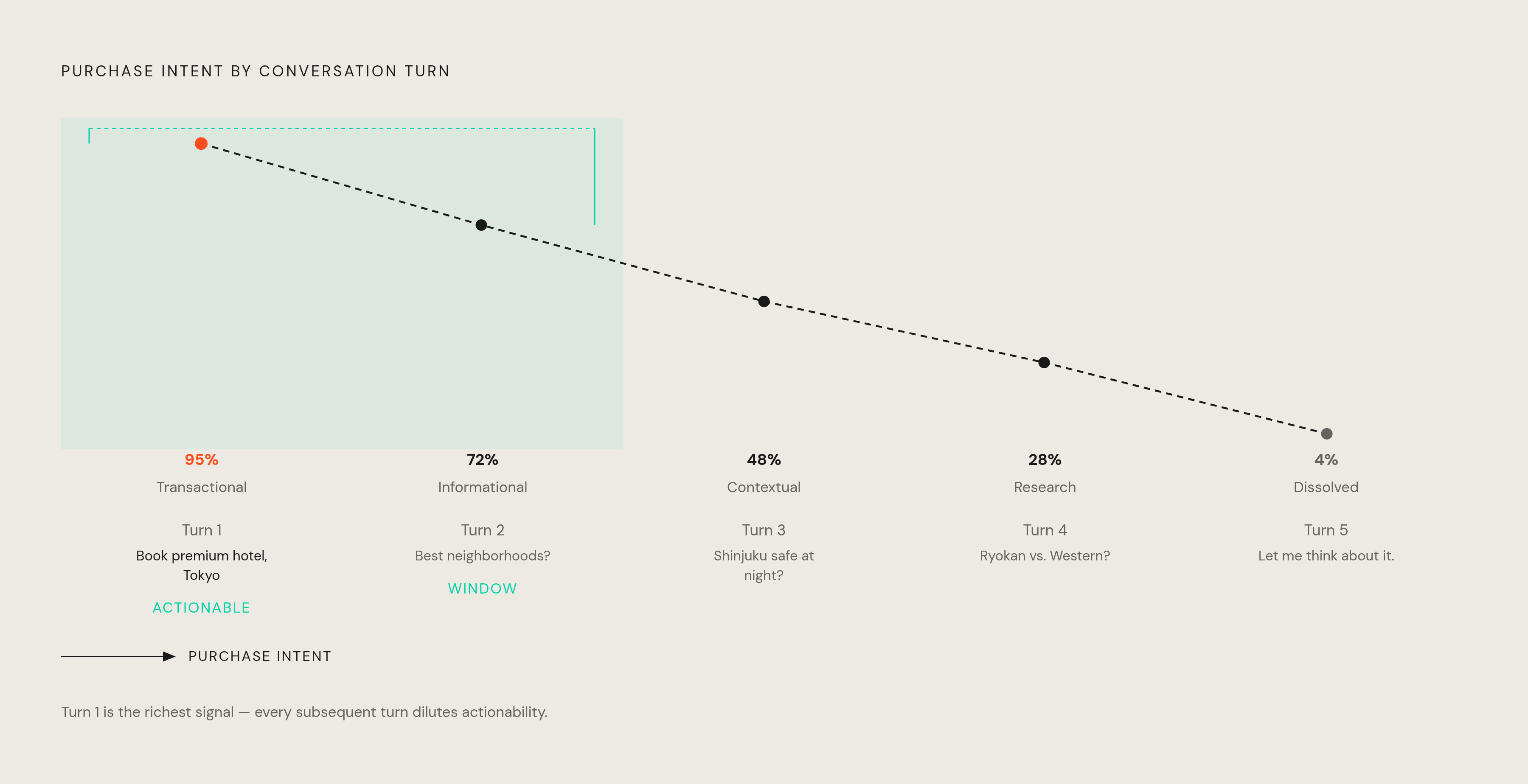
Take a real arc. Turn one: "I want to book a premium hotel in Tokyo for two weeks from now." Specific, actionable, about as clean a purchase signal as a conversation produces. Turn two: "Actually, what neighborhoods are best for first-time visitors?" Informational now. Turn three: "Is Shinjuku safe at night?" Emotional, contextual, and the original purchase intent is sitting underneath it, unaddressed. Turn four: "Can you compare ryokans to Western hotels?" Research mode, no product signal in sight. Turn five: "OK let me think about it." Intent has, for practical purposes, dissolved by then.
Turn one was the richest moment in the whole exchange. Everything after diluted it, not because the user stopped wanting a hotel, but because the conversation drifted into exploration. Act on turn five and you're spending an impression on someone who's already checked out for the day. Miss turn one and the window that mattered most is gone before anyone notices it happened.
Why LLMs tend to lock in early assumptions and drift away from what the user actually meant
Laban and colleagues, in the 2025 paper that coined the term "Lost in Conversation" (LiC), found something specific and honestly a bit alarming: language models lose roughly 30% of their performance when a task shifts from single-turn, fully specified instructions to multi-turn, underspecified ones. A third of a model's effectiveness, gone, simply because the same information arrived in installments instead of all at once.
The mechanism matters more than the number. Under incomplete information, models form an assumption about the user's goal early, often by turn one or two, and then lock into it. Later corrections get partially absorbed but don't fully overwrite that working interpretation. So the drift compounds: the model answers a slightly stale version of what the user wants, the user corrects or elaborates, that correction adds noise on top of noise already there, and the original signal sinks a little deeper with each round.
This is a structural fact about conversation, not a capability gap you patch with a bigger model. Laban and colleagues say as much directly: LiC is not primarily a model failure, it's a breakdown in how intent gets communicated and tracked across turns. A larger model just locks in its early assumption with more confidence, not less, which is arguably worse.
Compare that to keyword search. Every query is complete and self-contained; type "best ryokan Kyoto" and that string carries its full intent with zero history required. Conversation doesn't work that way. Intent is distributed across turns, much of it implicit, evolving as it goes. The deeper you read into a session, the less reliably any single turn reflects what the user currently wants. Conversation is built this way. The only sensible response is designing around that shape instead of wishing it were a search bar.
Where high-intent moments actually live in a conversation arc — and how quickly they pass
The opening turns of a session carry disproportionate weight for a reason that goes beyond simple recency. eMarketer's analysis of multi-prompt consumer behavior found users bring an average of 1.43 brands into an LLM conversation after having considered 4.21 brands during earlier research. By the time someone opens a chat, they've already done the broad comparison work somewhere else. They arrive narrowed and specific.
Which means the first prompt or two is often the actual peak of intent, not an early data point on a rising curve. Transactional requests, direct product comparisons, "what's best for my situation" framing, these cluster in the first one to three turns almost by default.
Past that point, the center of gravity shifts toward exploration. Across ChatGPT queries broadly, 52% are informational, compared to 36.4% on Google, a gap that says something about the platform's natural pull. Conversation invites browsing in a way a search bar doesn't. And the decay doesn't fade gradually, the way a signal fades on a graph. It can collapse in a single turn, the moment someone asks one clarifying question or voices one hedge.
The practical window for acting on a high-intent moment is often one to two turns wide, and it closes on schedule whether anyone takes advantage of it or not. In traditional B2B intent data, decay gets measured in weeks; a signal from three weeks back still carries some residual value. Compress that same phenomenon into a chat session and the unit becomes the individual turn. Not a little worse. Several orders of magnitude more acute, because shelf life drops from weeks to seconds.
How the confidence threshold problem complicates intent detection mid-conversation
Detecting purchase intent isn't a yes-or-no classification. It's a confidence spectrum, and wherever you set the bar for acting on it determines almost everything about whether the action lands well or badly.
Set the bar too low and the system flags exploratory chatter as purchase-ready, which reads as presumptuous. Programmatic infrastructure for AI chat interfaces, like Thrad's, is built specifically to navigate that threshold in real time. User sentiment backs that up: research tracked by getchatads.com found only about 34% of users actually want an AI taking purchasing actions on their behalf. Set the bar too high, waiting for explicit language like "buy now," and the moment's already gone, because most high-intent expressions are oblique. "What's the best option for someone in my situation" is a purchase signal wearing a question mark as a disguise.
The problem compounds as conversations lengthen. More turns generate more context, and it's tempting to assume more context means a clearer read. It doesn't. Richer context often makes the underlying intent harder to isolate, because it's tangled up with everything else the user has said along the way. Several intent types look like purchase signals on the surface but usually aren't: information-seeking that happens to mention product names is often comparison shopping, not readiness; fact-stating about budget or timeline is frequently planning rather than buying; asking for "the best" option, even phrased with real specificity, is commonly upper-funnel behavior dressed up to sound closer to a decision than it is.
eMarketer's sportswear analysis puts a number on how mixed this population really is: 39% of prompts reflected upper-funnel informational activity, 37% were transactional, nearly an even split. That's not a population a system can afford to guess on. And the threshold problem gets structurally harder the later it gets applied. A transactional signal sitting in turn four, arriving after three informational turns, is much harder to surface with confidence than the identical signal at turn one, simply because it now has to be pulled out of noise that didn't exist yet back then.
What signal layering — across turns and across channels — recovers from the decay problem
None of this makes conversational intent unreliable. It makes a single turn, read in isolation, unreliable. The conversation taken whole carries an extraordinary amount of information, arguably more than most signal sources marketers currently lean on.
Follow-up prompts work less like noise and more like a progression map. Each one adds a layer: why the user is asking, what's holding them back, how close they are to deciding. A prompt like "what marketing automation platform handles complex multi-division consent requirements best" is, on its own, a dense expression of intent, the kind of specificity that, per Logarithmic's analysis, would otherwise take dozens of tracked web visits to infer from behavioral data alone. That holds even when the prompt isn't explicitly transactional.
Layering that signal properly means reading at three levels. Within a session, the arc itself is the unit of analysis: a user who opens transactional and drifts informational hasn't left the consideration cycle, they're still inside it, and the early turn stays valid context even while the current turn looks exploratory. Across sessions, someone returning to a related topic in a fresh conversation is showing sustained consideration, and that return visit can function as a new early-turn peak in its own right. Across channels, A useful line can be drawn between the two signal types: search intent shows where a consumer sits in the funnel, while conversational signal adds richer context about the reasoning behind that position. Put the two together and the picture gets a lot more complete than either provides alone.
There's a broader shift underway that makes this layering more urgent. The pre-purchase journey now begins inside AI chat for over 20% of users overall, and separately, 37% of sportswear prompts observed in one analysis were transactional in nature. Users increasingly arrive in chat already at a high-consideration state, so the opening prompt of a session isn't just one data point among many; it's often the richest one available, full stop. The unit of analysis worth building around isn't the turn. It's the session arc, read against whichever peak came first.
What intent signal decay means for ad timing and placement inside AI conversations
Here's where the mechanics turn into an operating constraint. An ad delivered during the first one or two turns of a high-consideration session sits in a completely different environment than one delivered three turns later, even in the same conversation, even for the same user. Early on, the goal is maximally legible, the model hasn't locked into a stale assumption yet, and the conversation hasn't drifted into exploratory territory. That's the window where a well-matched placement reads as useful instead of intrusive.
Late-turn placement carries three distinct risks. Intent may have recontextualized entirely, so the user's current frame no longer resembles the one that triggered the original signal. The model's own locked-in assumptions may have drifted from what the user actually wants now, which makes downstream context-matching unreliable by extension. And by turn four or five, the user's stated goal has usually accumulated enough hedging and pivoting that no single offer maps cleanly onto it.
Native placement, a sponsored result woven directly into a response at the moment intent peaks, fits that early-turn window in a way interruptive formats can't replicate. An interruptive ad has no mechanism for timing itself to an intent arc, because it isn't reading the arc at all. Speed matters more than most people building in this space seem to credit: a prompt sits at peak intent for a matter of seconds before the next exchange lands, so any ad infrastructure too slow to evaluate and respond inside that window is structurally late, regardless of how sharp the targeting logic underneath it is.
Platforms and brands that build around the intent arc, evaluating turn by turn instead of matching against a broad conversation topic, are working with how intent actually behaves in chat. Those that treat AI conversation as a slower, chattier search engine will keep placing bets after the signal has already decayed. No amount of budget fixes a timing problem.