programmatic buying options for advertisers entering AI chat placements
Conversational ads demand new auction mechanics purpose-built for dialogue, not search or display.
Programmatic advertising is entering its third major infrastructure shift, and this one looks nothing like the move from banner networks to real-time bidding, or from desktop to mobile. Advertisers moving budget into AI chat interfaces are buying against dialogue, not pages or keywords, and the tools built to serve display and search auctions were built to serve those auctions, not to read a conversation as it unfolds. The money is already there. What isn't there yet is a settled answer for how that machinery plugs into a chatbot, and most buyers evaluating this space are asking the wrong question first: not "which platform has the best reach," but "does this platform even know how to read what a user just said."
What makes conversational intent a structurally different targeting signal
A search keyword is a thin slice of intent. Someone types a short query, and the system guesses at what they meant, stripped of any surrounding context. A multi-turn conversation gives up far more: how the user framed the problem, what they already know, what constraints they've mentioned, where they sit in the decision process. An LLM builds a picture of a user from what's being asked, turn by turn, without relying on the cross-site tracking signals traditional programmatic depends on.
That's a different kind of profiling than programmatic buyers are used to. It is inference drawn from behavior confined to a single site and session. It's inference from what someone is actively saying, right now, in the middle of trying to solve something. That distinction matters more here than in display, because in a chat interface, the content around the ad is the AI's own answer. Get the match wrong and the ad doesn't just underperform. It taints the thing the user came for.
There's a sharper risk buried in that setup, too. Research on LLM ad auctions describes what amounts to a generative externality: inserting an ad into a response can change the tone, length, and specificity of the AI's answer itself. A banner ad next to a news article doesn't rewrite the article. An ad injected into a chatbot's reasoning process can quietly reshape the reasoning. That has no real equivalent in a static search results page or a display slot, which is why targeting accuracy and creative fit stop being separate problems in this channel. A mismatched ad doesn't just waste spend, it degrades the answer the user showed up for, and that hits the user experience and the advertiser's own outcome at the same time. None of this bolts onto a legacy DSP workflow without real re-engineering, and buyers who assume otherwise are the ones who'll get burned first.
How auctions and ad serving actually work inside LLM interfaces
The LERA framework describes a two-stage auction, and it's worth walking through, because it explains exactly why "just add AI inventory to the existing seat" doesn't work. Stage one is coarse filtering: candidate ads get narrowed down based on relevance to whatever the prompt is actually about. Stage two queries the LLM itself with a designed prompt, and the model's own output, the logits over the candidate ads, produces a refined relevance score. That score combines with the bid, and a critical-value payment rule accounts for both filtering thresholds along the way, which is what keeps the auction honest for advertisers trying to win on merit rather than game the system.
A related mechanism in the same research has advertisers influencing LLM responses through reinforcement learning from human feedback, using both retriever relevance and bid amount to decide how ads get placed inside a generated response. Either way, the ad doesn't sit apart from the content. It's part of how the content gets written.
Creative format follows a different logic too. Under the publisher SDK pattern described in that research, a served ad object carries a title, body copy, a call to action, an advertiser URL, and a disclosure string, all rendered by the publisher inside its own interface. That's closer to a native ad unit than a banner.
Latency is the part that kills most "we'll just adapt our stack" plans. Latency requirements at auction scale are strict, and any platform that can't make decisions in milliseconds isn't viable, no matter how good its targeting story sounds on a slide. PubMatic's infrastructure in this space is built around sub-millisecond decisioning, which gives some sense of the speed this environment actually demands, not the speed vendors claim on a pitch deck.
Brand safety changes shape as well. It can't be a filter bolted on after the fact to a URL. It has to run against the conversational context itself, before the response even generates, which is a harder problem than blocking a domain list. Any buyer evaluating a platform here should ask three plain questions: at what stage does contextual matching actually happen, who controls the granularity of brand safety filtering, and what's the real latency SLA at p95, not the number in the deck.
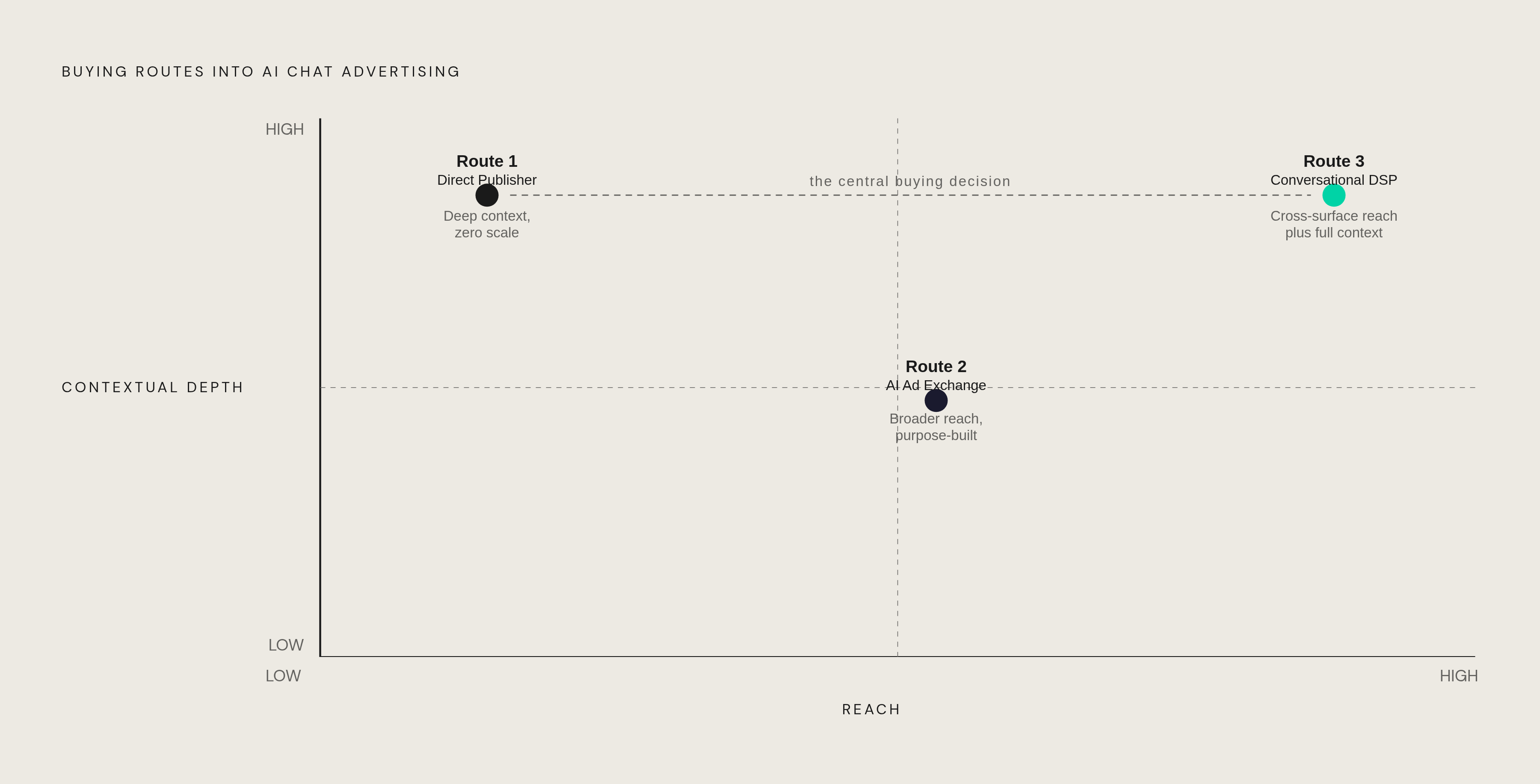
The three buying routes into AI chat inventory and what each one actually offers
Direct publisher deals. This means negotiating with one AI publisher at a time, and right now it's the only real way into ChatGPT's inventory for most advertisers. Buying runs through OpenAI's own auction, a relevance-weighted second-price model, with either a Maximize Results automatic mode or Manual Max CPC bidding. Skai has confirmed integration partner status for ChatGPT ads, joining Criteo and Pacvue as commerce-media platforms with a direct pipe in, though access is still surface-specific. Microsoft has been expanding Copilot ad testing as of mid-2026, another direct-deal surface still taking shape. The upside here is contextual depth on a single surface. The downside is real: there's no scale beyond it, and every additional publisher relationship adds its own operational overhead, its own auction logic, its own reporting quirks. Buyers chasing this route alone are trading reach for depth, and should know that's the trade they're making.
Purpose-built AI ad exchanges and SSPs. This is infrastructure built specifically for conversational inventory: matching context to ad, running the auction, applying brand safety at the exchange layer, then connecting that supply to programmatic demand. PubMatic's partnership work here, announced in December 2025, is an early example of an SSP integrating with a conversational monetization layer built for exactly this kind of matching. Ad creative in this model gets generated dynamically to fit the flow of the conversation, rather than repurposed from a static banner template. Early rollout has favored curated private marketplace deals for initial testing, with plans to widen into open exchange access over time. One early campaign in this environment, a Liquid Advertising buy, reportedly delivered 70% higher ROAS than the client's target, with a click-to-convert rate 1.5 times stronger than other platforms tested, though that's one campaign, not a benchmark worth building a media plan around. This route gets buyers more reach than a single direct deal, and the matching is purpose-built rather than adapted. But breadth still depends on how many publishers have actually integrated, and buyers still need a DSP seat to access it programmatically.
Conversational DSPs. This is a demand-side platform built to read conversational context directly, not pass along a cookie or a keyword, and to buy across more than one AI publisher surface from a single seat. Generalist DSPs built for display, video, and CTV have plenty of programmatic reach, but they weren't built to parse prompt context, so they approximate AI inventory rather than genuinely serving it. Single-surface AI ad networks sit at the other extreme: they read context well, but they're boxed into one publisher's audience with no reach beyond it. A conversational DSP that also runs its own exchange and holds direct publisher relationships sits between those two failure modes, offering cross-surface reach plus real contextual matching, without forcing the buyer to stitch together five separate direct deals by hand. A platform operating on this model runs its own SSP and exchange rather than depending on someone else's, which gives it direct visibility into conversational context across publisher inventory and lets it read dialogue-level signals that a generalist buying platform simply isn't built to parse. This is roughly the arc legacy programmatic followed years ago: scattered direct deals first, exchanges next, and DSPs with broad access showing up once the market matured enough to support them. Buyers betting on this space long-term should expect the same consolidation to repeat here, and probably faster.
The walled-garden question: what ChatGPT, Google AI Mode, and Copilot offer buyers today
OpenAI moved fast. ChatGPT ads launched in February 2026, and the platform reportedly hit $100 million in annualized revenue almost immediately, reaching a $1 billion annualized run rate in under 200 days. Tens of thousands of advertisers are now buying across more than 40 countries. Bidding runs on that relevance-weighted second-price auction, with Maximize Results or Manual Max CPC, plus a conversion-optimized CPC option. Ads are labeled clearly and shown apart from the organic answer in the current build, and conversion tracking, including a pixel, a Conversions API, and attribution windows inside Ads Manager, is live now. It's early infrastructure, but it's real. The catch for buyers: this is a walled garden with its own auction. There's no side door into it through a generalist programmatic seat, and anyone telling a client otherwise is selling something that doesn't exist yet.
Google took a different path, and arguably the smarter one for buyers already living inside its ecosystem. Ads expanded into AI Overviews on desktop starting in May 2025, and testing is underway inside AI Mode, Google's fuller conversational search experience. Ads now show up at the bottom of roughly a quarter of AI Overview results pages, up sharply from around 3% in January 2025. Access doesn't require a new campaign type: existing Search campaigns using broad match or dynamic ads, along with Shopping and Performance Max, simply pick up AI placements as an additional surface. AI Max for Search uses intent signals to decide when ads show up inside AI Overview and AI Mode. The buying workflow is familiar, which is the appeal, but it's still entirely inside Google's own ecosystem, and the contextual depth is tied to Google's signals rather than any open programmatic layer. Gemini is a separate story: Google's leadership has talked publicly about native ad concepts specific to the standalone Gemini app, but that inventory isn't formally open to buyers yet. Gemini-powered placements inside AI Overviews and AI Mode are reachable now, but only through existing Google Ads campaigns.
Microsoft has been testing ads inside Copilot, with expansion ongoing as of mid-2026, accessed through Microsoft's own ad ecosystem. The finer details of programmatic integration aren't fully specified yet, and buyers should treat this surface as a wait-and-watch, not a budget line for this quarter.
Perplexity is the cautionary tale worth sitting with, and it should temper how much faith anyone puts in a single-publisher deal. Sponsored Questions launched in November 2024, and brands including Whole Foods and Indeed came on board through early 2025. Then Perplexity stopped taking new advertisers in October 2025, and by February 2026 confirmed a full pivot to a subscription-first model, walking away from advertising entirely. The exit pointed to the fragility of a direct publisher relationship built on advertising in this channel. The lesson extends well beyond Perplexity specifically: a direct publisher relationship in this channel can vanish. A surface a media plan was built around six months ago may simply not accept ad spend today.
Performance signals worth taking seriously and the gaps that remain honest problems
The most eye-catching signals so far suggest ChatGPT-referred ecommerce traffic converts at notably higher rates than Google organic traffic. That gap holds up even after accounting for early-adopter selection effects, where the users showing up via ChatGPT right now skew toward people already primed to buy. Criteo's figure is more conservative but points the same direction, putting conversion from that referral source at around 1.5 times other referral channels.
Click-through tells a less flattering story, and it's worth taking at face value rather than explaining away. Chatbot ad CTR runs well below what Google search ads typically deliver, according to figures in circulation for 2026. That gap actually functions as a strength. It's structurally expected: the user already got an answer before the ad ever showed up, so the ad isn't standing between them and information the way a search result often is.
Reach quality looks strong on its own terms. ChatGPT-referred visitors skew heavily toward new users, which matters a great deal to brands trying to grow rather than just retarget an existing base. Conversion rates also swing hard by industry, with research-heavy categories like financial services likely to see far lower rates than transactional ones. Intent and where someone sits in the decision process at the moment of the conversation seem to drive performance more than the vertical itself does.
None of this should be mistaken for settled ground. Perplexity's exit illustrated how quickly a direct publisher relationship can collapse, and the attribution gap that plagued that platform hasn't closed anywhere in the space. The benchmarks in circulation come from a young platform with a self-selected pool of early advertisers, and they'll shift as volume scales and the novelty wears off. Zero-click behavior compounds the measurement problem regardless of channel: a large share of AI Mode queries end without a click to any external site, which means last-click attribution is structurally blind to most of what's actually happening. Treat today's conversion numbers as a directional signal, not a stable benchmark, and build measurement around assisted and view-through attribution from day one. Retrofitting that thinking later, after a budget commitment, is the wrong order to do it in.
What legacy programmatic buyers need to unlearn before evaluating AI chat options
The instinct to treat AI chat as just another line item inside an existing DSP seat is the first thing that has to go. A keyword-and-cookie mental model doesn't map onto a system that reads dialogue in real time and can reshape its own output based on which ad wins. Auction mechanics differ, creative formats differ, latency requirements differ, and brand safety has to run before generation rather than after placement.
The second habit to drop is treating "AI advertising" as one category. Buying ChatGPT inventory, buying through Google's existing Search campaigns as they extend into AI Overviews, and buying through a purpose-built conversational exchange are three different operational problems, with three different levels of access, three different auction designs, three different attribution setups. Roughly 80% of what gets labeled "AI advertising" in 2026 shows up adjacent to machine-generated content rather than inside the actual chatbot conversation, which means most budgets tagged for this channel aren't reaching genuine conversational placements at all, even when the buyer assumes they are.
The last habit worth dropping is patience around measurement. The attribution infrastructure here is still being built in public, and Perplexity's exit shows what happens when a direct publisher ad relationship unravels. Buyers who question the auction, question the latency claims, and question where the attribution numbers actually come from are the ones who'll be positioned to use this channel well once the rails finish settling. Everyone else is buying on faith.