AI Channel Attribution Models for Multi-Touch Campaigns
AI channels create touchpoints standard attribution models can't track or measure.

Walk through a normal search journey and every handoff leaves a fingerprint behind it. Query goes to a search engine, results page loads, someone clicks, the landing page fires a pixel, and the session lands in a campaign report. Each step hands a baton to the next one.
When an AI assistant like ChatGPT names a brand and the user closes the chat, then types that brand directly into search or a browser, standard attribution reads the resulting session as direct traffic or branded search and gives the assistant zero credit. This is the dark conversion problem: the model treats the absence of a click as the absence of influence, and the two rarely line up. The most practical approaches available right now are incrementality testing, which holds out a comparable group from AI channel exposure and measures the outcome gap without needing any click data at all, and tracking branded search volume lift during and after an AI campaign window as a proxy signal for awareness the MTA report can't see. Platform aggregate numbers from ChatGPT can also be fed into a media mix model as an input variable, which lets the regression estimate AI channel contribution the same way it handles TV or out-of-home spend.
Conversational AI sessions skip most of that. A user asks a question, the assistant pulls an answer together from a mix of sources, a brand gets named or recommended, and the person may act on that recommendation without ever touching a link. There's no results page to click from, no referral URL to log, no cookie sitting around to tie the session back to an earlier ad. A UTM parameter has nothing to hold onto when there's no click for it to attach to. The whole decision can form and finish inside the chat window.
I've started calling this the dark conversion problem, mostly because I couldn't think of a better name for it. The user closes the chat, types the brand name straight into a search bar or an address field, and buys. To the attribution model, that reads as direct traffic or branded search. The AI assistant that actually did the persuading gets credit for nothing. And, it gets worse: advertisers working with ChatGPT currently only see aggregated performance numbers. Individual conversation content stays private, per OpenAI's own policy, so even a placement that's working has no path back to the budget line that paid for it. The model reads the absence of a click as the absence of influence, and the two rarely line up.
Mobile doesn't help. Adjust's Q2 2025 numbers put App Tracking Transparency opt-in at 35% among users who even see the prompt. Cross-device stitching was already falling apart before AI showed up. The AI layer just adds one more broken link to a chain that had plenty of gaps already.
Why do AI touchpoints drop out of the credit chain in an MTA model?
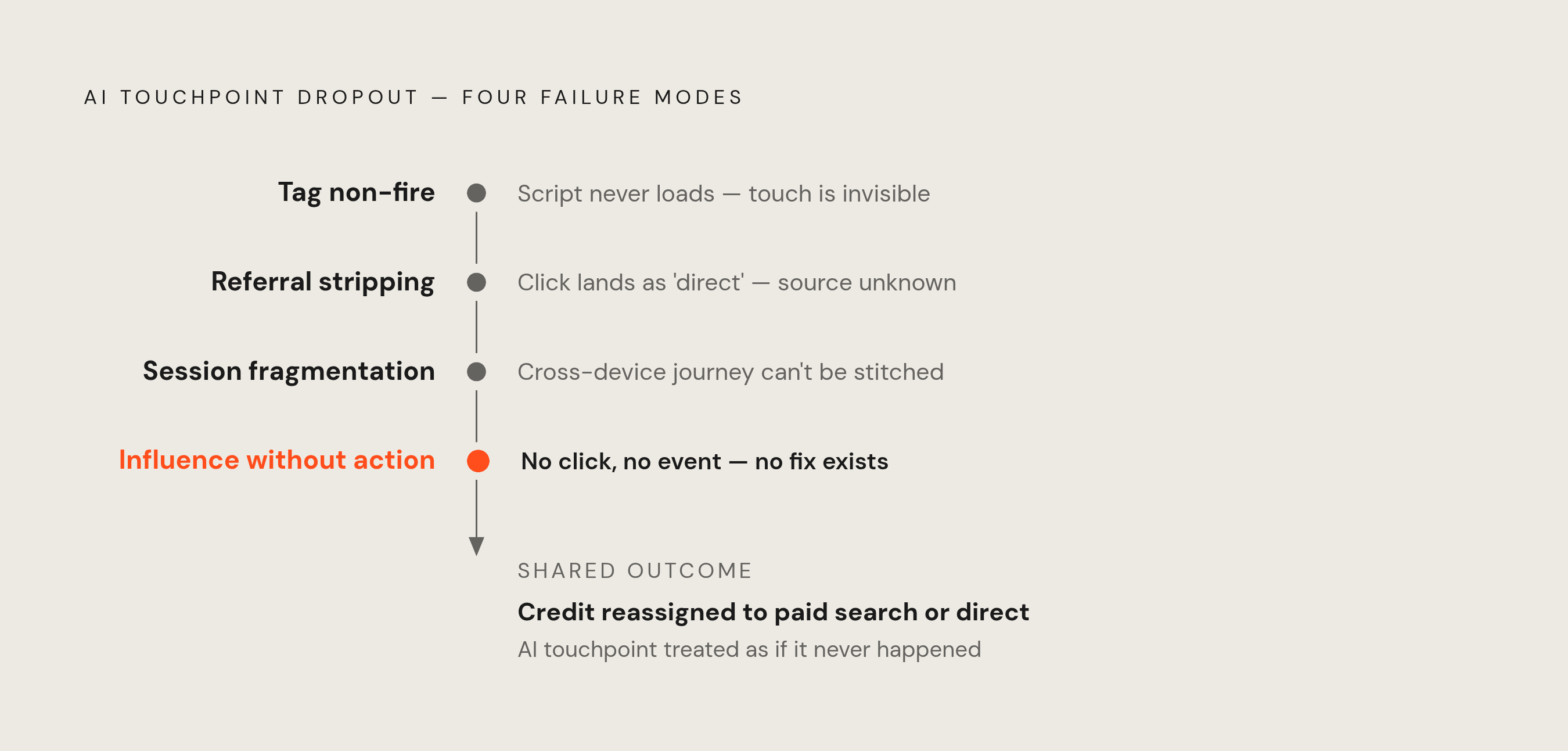
There are four ways this credit disappears, and they're different enough that each needs its own fix.
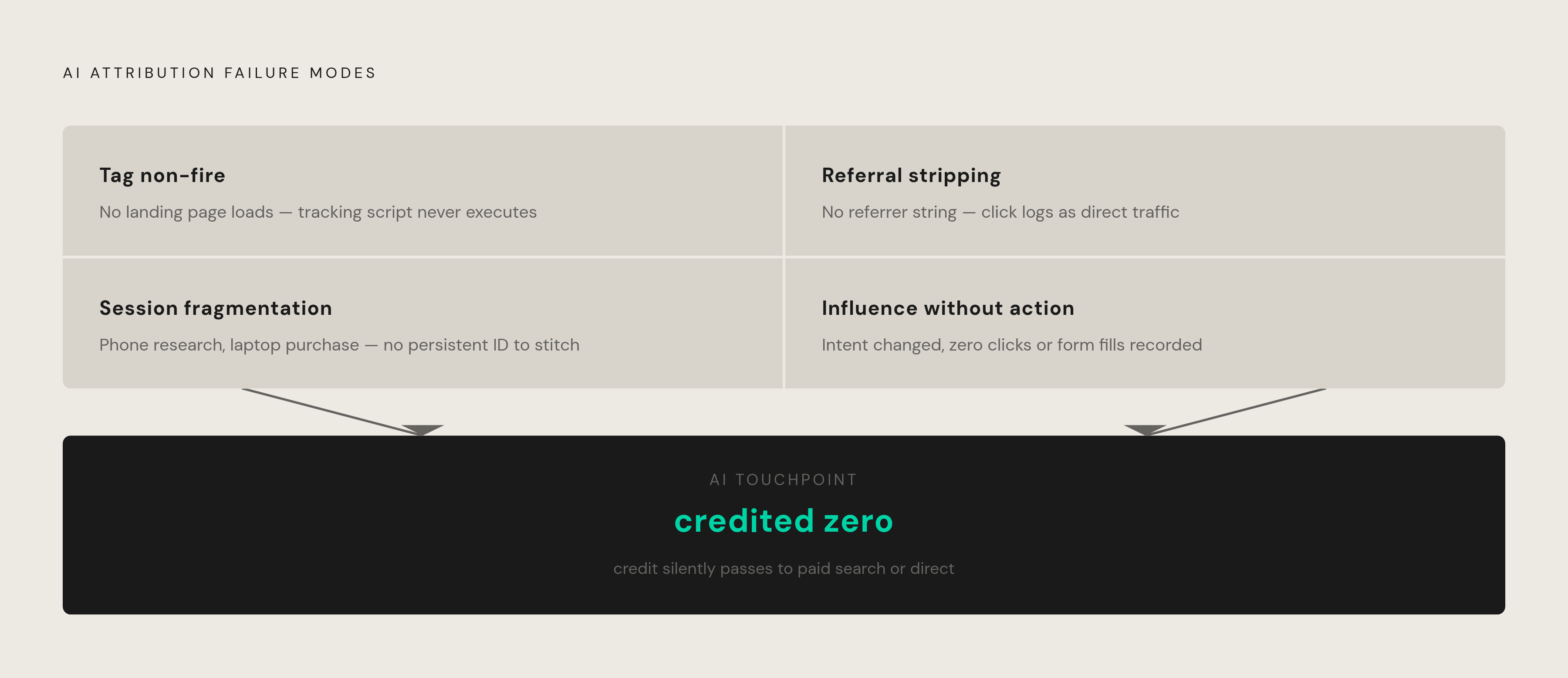
Tag non-fire is the easy one. The tracking script on a landing page never loads because nobody ever lands anywhere; the AI assistant is the destination, not a stop along the way. Referral stripping is sneakier. When a user does click through from an AI answer, most standard analytics tools log that traffic as "direct" instead of crediting the AI platform, because there's no referrer string built for this the way there is for a search engine. So, the system just assumes someone typed the URL from memory.
Session fragmentation is what happens when the research happens on a phone and the purchase happens on a laptop three days later. Stitching that together needs a persistent identifier, and those are getting harder to find every quarter, not easier. The hardest case is influence without action: the AI touchpoint changes what someone believes or wants, and produces no click, no form fill, nothing for the model to grab.
All four collapse into the same outcome inside standard MTA logic. The AI touchpoint gets treated as if it never happened, and whatever credit it earned gets handed to the nearest trackable event, usually paid search or a direct-traffic line. Display and social went through a version of this fight years ago, before cookies started dying off and incrementality testing became normal practice in those channels. AI touchpoints inherited that same bias, except the tracking gap is wider here, so it's worse. A team staring at its MTA dashboard sees one channel that looks like it's doing nothing next to one that looks like it's doing everything, and cuts the budget for the first while raising it for the second. That's exactly backward from what the customer's actual behavior would tell you to do.
How AI-native targeting in conversational environments differs from keyword and demographic models
A keyword is a proxy for intent, imperfect and often stale. Someone typing "kitchen appliance brands" into Google could be six months out from buying or six minutes out, and the keyword gives you no way to tell which. Social ads target a profile built from past behavior, which is useful, sure, but it's often stale too: it chases who someone used to be rather than who they are the moment the ad shows up.
A prompt inside an AI assistant works differently. "I'm renovating a kitchen on a $15,000 budget and deciding between two appliance brands" hands over budget, timeline, category, and decision stage in one sentence, volunteered with full context instead of pieced together from click history. LLM-based placements respond to what that sentence means, not to a keyword bid in a fixed auction slot. The formats right now: sponsored suggestions, contextual product mentions, and recommended follow-up prompts folded into the assistant's answer, built to read as a genuinely useful suggestion instead of an interruption. Most platforms allow only a handful of these per session, based on what's publicly documented, so each placement carries more weight than a typical display impression ever did.
This is intent-based targeting, tied to the session itself rather than a profile built over months of browsing. It also doesn't need the third-party cookie infrastructure that's falling apart everywhere else. Conversational AI advertising sits in its own category, distinct from search and distinct from social, closer to a new targeting primitive that needs its own measurement approach to match. The maddening part is that the signal here is richer and more precise than anything search or social has ever handed advertisers, and standard MTA can't read a word of it.
Attribution approaches that can actually account for AI touchpoints
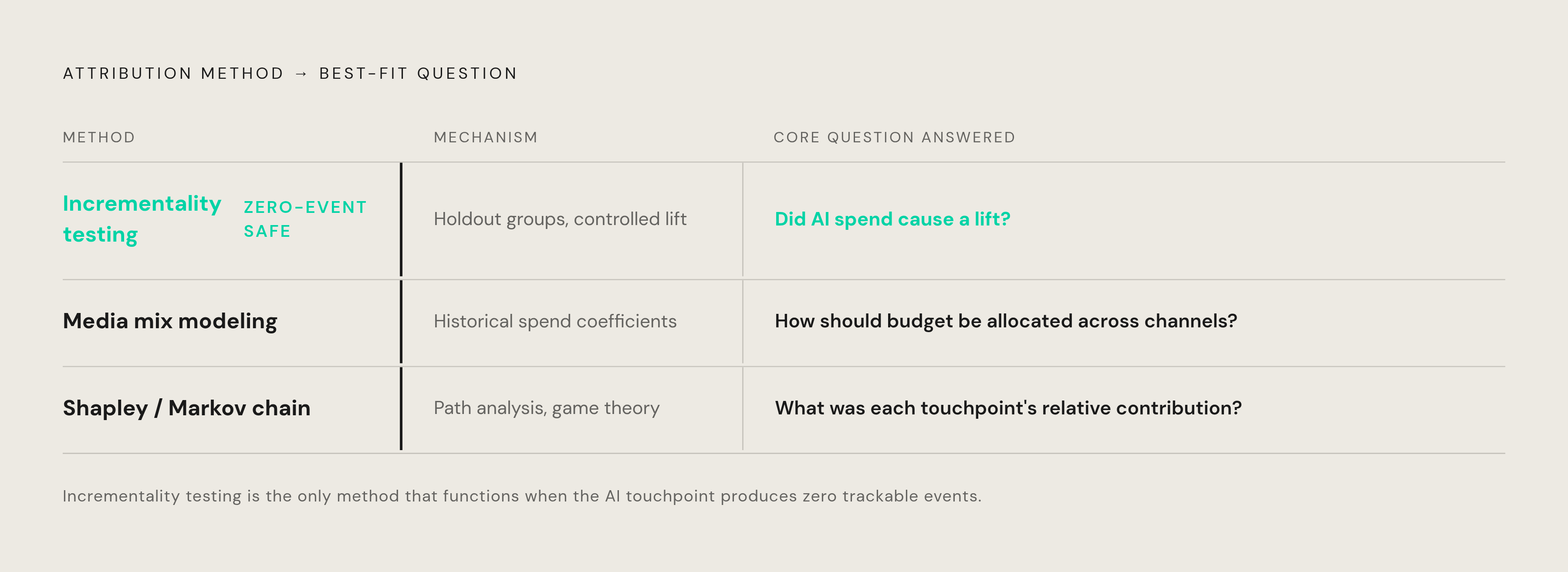
Incrementality testing is where this has to start, because it doesn't need a pixel to work at all. Hold out a comparable group of users from AI channel exposure, measure the gap in outcomes against the exposed group, and you get a real read on lift, whether or not anyone clicked anything. It's the only method here that still works when the AI touchpoint produces zero trackable events.
Media mix modeling fills in the budget-planning layer above that. MMM runs statistical regression across channels using aggregate spend and outcome data, not individual tracking, so it can take AI channel spend as an input and estimate its contribution to conversion the same way it handles TV or billboards. The catch: it needs a real volume of historical spend to produce a coefficient that isn't just noise, and early AI budgets are often too thin to isolate cleanly.
Beyond those two, there's a set of models built for exactly this kind of ambiguity, and they deserve more use than they're getting. Shapley value attribution splits credit across every touchpoint in a path based on its marginal contribution to the outcome, which makes it far less vulnerable to the last-trackable-click bias baked into simpler models. Markov chain models estimate how much removing a touchpoint would change the odds of conversion, so they can assign weight even to a touchpoint that never generated a click, as long as its presence shows up somewhere in the data. There's a newer method too, sometimes called AI visit scoring, that looks at behavioral signals inside a single session to estimate how much that visit raised conversion odds, rather than depending on where in the sequence it happened to fall.
Platform aggregate data helps, even in its limited form. Impression and engagement numbers from a platform like ChatGPT can feed straight into an MMM as an input variable, and tracking branded search volume during and after an AI campaign window gives a rough, but usable, proxy for AI-driven awareness. None of this solves individual-journey attribution in real time across AI surfaces. That gap is real. Pretending otherwise doesn't help anyone, least of all the team that has to defend the budget next quarter.
Where AI-enhanced MTA platforms are now and what they still cannot do
The current wave of AI-enhanced MTA platforms has genuinely gotten better at forecasting, for the channels it was trained on. Vendor studies report forecast accuracy in the high 80s to low 90s percent range, with budget efficiency gains between 18% and 27%. Gartner projects 65% of enterprises will adopt GenAI-enhanced attribution systems by Q3 2026. Those numbers describe performance on pages, clicks, cookies, and sessions, the environment MTA was built for from day one.
None of that progress closes the AI-channel gap. There's no standard way, right now, for these platforms to take AI-session intent signals in as an input. There's no cross-platform identity resolution linking an assistant conversation to whatever happens downstream. And, because AI ad platforms only report in aggregate, individual journey reconstruction isn't possible with the tools that exist today, no matter how sophisticated the math running on top of them is.
McKinsey's 2025 report found 42% of organizations now use AI somewhere in sales and marketing. That's a real adoption number, but it measures AI use inside the marketing function, not whether that function's measurement stack can actually see AI-channel contribution. Those are two different questions, and mixing them up is a mistake worth saying plainly. Here's the honest read: even a team running a best-in-class MTA setup is under-counting its AI channel right now, today, as you read this. The open question is how much, and what proxy metrics carry the load until platform reporting catches up.
What the AI ad platform landscape actually makes measurable today
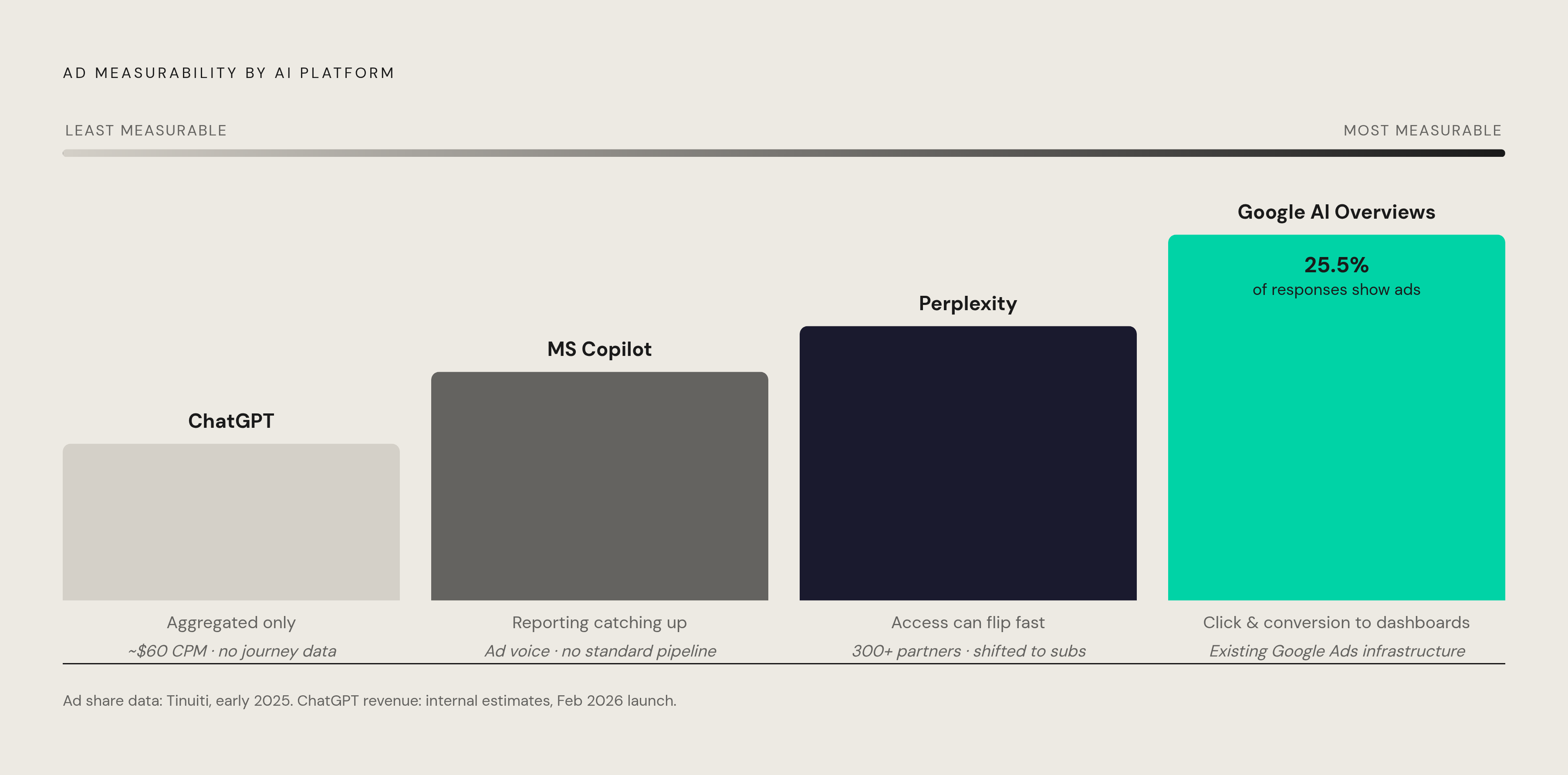
ChatGPT advertising launched in February 2026 and reportedly hit $100 million in annualized revenue within two months, with early placements priced around $60 CPM. Ads carry clear sponsored labels, kept separate from organic responses, and OpenAI has said paid placements don't influence what the assistant says organically. Advertisers only get aggregated numbers; conversation-level data stays locked away. The platform also moved from a pilot that required a $200,000 minimum commitment to a self-serve model, and its measurement tooling is going to need to grow up fast as smaller advertisers start buying in.
Google's AI Overviews offer a cleaner measurement path, mostly because the ad infrastructure behind them is the same one that's run search campaigns for two decades. According to Google, ads appeared alongside 25.5% of AI Overview responses, up from 5.17% in early 2025, which is a steep climb by any measure. Because those placements run through existing Google Ads reporting, impression, click, and conversion data flow into the same dashboards teams already know. The "AI shapes the decision before the click happens" problem hasn't gone anywhere, but at least the click that eventually happens is recoverable.
Microsoft Copilot is building its own conversational search ad format, including placements below AI-generated answers and a bridging format the company calls "ad voice," meant to connect the assistant's answer to the sponsored message right after it. Reporting infrastructure for this is still catching up. Perplexity tested sponsored follow-up questions in late 2024 and scaled a revenue-share program to more than 300 publisher partners, with its monetization focus shifting toward subscription and enterprise revenue. That reversal is itself a data point worth sitting with: monetization strategy in this space can flip fast, and attribution data availability flips right along with it.
Put the four together and, what you get is a patchwork of separate reports rather than one connected system. Each platform reports different data, in a different format, on a different schedule, at a different level of detail. A campaign running across ChatGPT, AI Overviews, and Copilot at the same time means stitching together three separate summary reports and hoping the seams don't matter too much.
How to build a measurement framework that doesn't erase AI channel contribution
Start by saying the gap out loud instead of letting the model quietly bury it. Run a parallel line, sometimes called dark funnel tracking, watching branded search volume, direct traffic, and conversion rate trends during AI campaign windows as a stand-in for what the MTA report is missing. Tell stakeholders plainly that AI touchpoints will look under-credited in the standard report, and that this is a limit of the model, not proof the channel isn't working.
Make incrementality testing the main way AI channel spend gets justified, ahead of whatever the MTA dashboard claims. Build holdout groups in from the start of a campaign instead of trying to reconstruct one afterward, and size those groups against the campaign's expected volume so the test can actually detect a real difference if one's there.
Instrument what can still be instrumented, even knowing it won't catch everything. Append UTM tags to any clickable AI placement; the clicks that do happen are still worth counting, even as a minority share of the real influence. Treat platform aggregate numbers as MMM inputs, keeping in mind they were never built for individual journey data. Watch branded search lift as an early signal, since it tends to show up before conversion data does.
Match the model to the actual question. Shapley or Markov chain attribution works best for understanding relative contribution across a full campaign, especially for surfacing upper-funnel influence that position-based models tend to bury. Incrementality is the right call when the question is budget justification, since it's the one method that doesn't depend on tracking continuity through the AI session. MMM does its best work in cross-channel planning, once AI spend gets large enough to produce a stable read.
Measurement infrastructure for conversational AI advertising is under construction everywhere, all at once, on every platform. Teams that build honest measurement habits now, leaning on the proxies available instead of pretending the gap isn't there, will be the ones ready to use richer data the moment platform reporting catches up. As AI assistants turn into a primary surface for high-intent research, the cost of running an attribution model that can't see them keeps climbing. The gap between what the report says and what the channel actually did will keep widening unless someone builds the framework to close it, and nothing about that is optional.