Prompt-Level Purchase Intent Signals and What They Reveal
Conversations reveal budget, timeline, and rejected options that search keywords never could.

Prompt-level intent analysis works by reading the full arc of a conversation and matching ads against a natural-language description of the moment rather than a keyword bid. A platform doing this well reads decision stage, budget, timeline, and what the user already rejected directly out of the dialogue, because a multi-turn exchange volunteers that information instead of forcing an advertiser to infer it. That distinction, between a signal that is inferred and one that is handed over freely, is the whole argument for why conversational advertising behaves differently from search.
A richer intent signal than a search query
A search query tells you what category someone belongs to. A conversation tells you how they got there, what they've already decided, and what they're still weighing. A three-word query like "Nike sneakers" can only confirm that a person is in-market for athletic shoes; it carries no information about why, no sense of timeline, and nothing about what else the person has considered and set aside. An AI conversation structurally cannot help but expose more, because a prompt is a request for help, and people describe their situation when they ask for help.
Compare the same shopper in two environments. A search for "Nike sneakers" signals that someone is in-market. A ten-prompt conversation about marathon training signals the same purchase intent, but it also layers on product preferences, performance requirements tied to distance and terrain, and a timeline shaped by a race date. The keyword confirms that someone is shopping. The conversation explains how they're shopping, what tradeoffs they're weighing, and when they need to decide. That gap between "in-market" and "in-market in this specific way" is where conversational advertising draws its advantage.
The pattern holds outside retail, too. A conversation that opens as a request for a restaurant recommendation can move, within the same thread, into trip planning, then a budget conversation, then a question about transportation logistics. Each of those phases carries a distinct, usable signal: a dining preference, a destination, a spending ceiling, a mode of travel. No static keyword query, run once and treated as a snapshot, could capture that sequence, because the sequence only exists as a sequence. It's the accumulation of context across turns that gives the conversation its value, not any single prompt inside it.
What the conversational targeting system reads
A targeting system built for this environment reads the entire thread. The signal worth evaluating is the full arc of a decision in progress, and treating each new prompt as an isolated event would throw away most of what makes the conversation valuable in the first place. A user prompt inside an AI conversation carries not just a topic but a decision stage, a constraint set, and an urgency level that a keyword query structurally cannot encode.
The unit an advertiser actually controls is called a context hint: a plain-language description, capped at 280 characters under the platform specification, of the kinds of conversations an ad belongs in. The system matches that description against the live dialogue as it unfolds, not against a fixed list of keywords and match types set up in advance. The skill this demands is different from keyword list-building. Advertisers have to think in terms of problem narratives instead of search terms, conversational journeys instead of keyword lists, and semantic intent clusters instead of match type variants, as the Adventure Media 2026 analysis on contextual targeting puts it.
The underlying language models that power these conversations keep track of what was said earlier in the thread in order to generate a coherent reply; a follow-up question like "what about vegetarian options?" only makes sense read against the exchange that preceded it. A targeting system built on top of that same architecture reads that coherence for a different purpose: judging whether a given ad fits the moment the conversation has actually reached. Relevance comes from the live conversation, not a browsing history built up over weeks, so the system needs no persistent user identifier and no cross-site tracking to work. Each thread is its own self-contained targeting environment, built and discarded in real time.
How a conversation encodes decision stage, constraints, and urgency
A prompt does more than name a topic. It places the user somewhere on a decision path, exposes the limits shaping their choice, and signals how soon they need to act.
Decision stage appears in how specific a query gets over the course of a thread. Early prompts stay at the category level and skip brand names, but as the conversation goes on, the questions narrow toward particular products, features, or comparisons. A system reading the thread can watch that narrowing happen turn by turn. Decision stage isn't a single data point to be inferred once; it's a trajectory that gets clearer with each exchange. Adventure Media's analysis finds that an opening query establishes initial intent, while the follow-up questions reveal which direction the conversation, and the decision behind it, is actually heading.
Constraints are the second layer, and they're the one keyword search has never been able to reach. A budget ceiling, a geographic restriction, the makeup of a household, a deadline: a multi-turn AI conversation can contain all of this, volunteered rather than inferred, in a way a three-word query cannot. Consider a single opening line: "I need to plan a two-week trip to Japan with my family." That one sentence encodes trip duration, destination, and household composition all at once, information an advertiser would ordinarily have to buy from a third-party data provider or collect through a form. No search engine has ever extracted that much structured detail from a single query.
Urgency is the third layer, and it appears as a narrowing of scope rather than as an explicit statement of timeline. Someone who asks for a general overview of project management software is earlier in their decision cycle than someone who asks how a specific tool handles permissions for a team of a given size; the narrowing itself is the urgency signal, not a separate thing layered on top of it.
AI conversations capturing buying journeys that search never saw
None of this is theoretical. Analysis of more than a billion daily signals found that more than one in five digital pre-purchase journeys now begins with AI chat, with travel standing out as one of the categories where that pattern is most visible.
What makes this gap matter for advertisers is that these opening prompts are usually unbranded. Users are working through category-level considerations before they've settled on a brand, so the AI conversation captures a moment of genuine, pre-commitment exploration that keyword search was rarely built to reach. By the time most of these same users type a branded query into a search engine, the exploration phase is already over.
Call this the intent signal black hole: a buyer's path from awareness to consideration to readiness to purchase used to leave a visible trail of search queries and retargeting cookies spread across the open web. Now that same path can happen inside one conversational thread, invisible to every ad platform built on the old architecture. Amazon reports that a large majority of users who completed a purchase after clicking a sponsored prompt in its retail chatbot were new to the brand they bought from, suggesting conversational advertising is reaching shoppers at the category-exploration stage rather than simply closing out consideration sets that were already decided elsewhere. As pre-purchase research increasingly starts inside AI chat interfaces rather than search bars, the intent signals described above are being produced at real scale, and platforms designed to read conversational context as it happens can reach buyers at the moment their intent is most precisely stated, before they ever leave the interface to search elsewhere.
Why the auction rewards signal precision over budget size
The auction structure built around this kind of signal behaves differently from a conventional search auction, and it favors precision over raw spend. Placement runs on a relevance-weighted, second-price mechanism: an advertiser generally pays just above the next competing bid, as in paid search, but relevance weighting means a more relevant ad can beat a higher bid. That single property changes who wins.
A guide from Gupta Deepak states the implication directly: an advertiser with a precise, well-written context hint and a small budget can beat an advertiser with a vague hint and a much larger one, a dynamic that's unusual in paid media and worth taking advantage of while most of the field is still learning how the system works. The context hint, that 280-character description of the decision moment an ad belongs in, is the main lever an advertiser controls, and writing one well, as a description of a moment rather than a subject category, is a skill almost nobody in the industry has practiced yet.
Access to that advantage is also cheap to test. The self-serve ChatGPT Ads Manager opened to all US businesses in May 2026 with no account minimum spend, and campaign budgets start at $25 per day. That's a low bar for an advertiser to run a real experiment in context-hint writing rather than reason about the opportunity from the outside.
The measurement gap that still limits what these signals can prove
The signal quality argument made above is strong, but it runs ahead of the measurement infrastructure you need to prove what that signal produces in revenue terms. Attribution is the core problem: a user might ask several follow-up questions inside a thread, leave the conversation, and convert later through an entirely different channel. Last-click models systematically undercount what a conversational ad actually contributed, and multi-touch attribution hasn't been standardized for this kind of environment yet.
The reporting advertisers have received so far compounds the problem. Early advertisers in ChatGPT's pilot got limited performance data, mostly impressions, clicks, and spend, which makes it hard to tie a given ad exposure to a specific business outcome. The intent signal going into the system is far richer than the reporting coming back out of it. The broader spending picture reflects the same imbalance: near-term ad dollars are concentrated more in the AI search-adjacent layer, where attribution tools already exist and work reasonably well, than in the pure conversational layer, where the intent signal is richest but the measurement tools are least developed.
None of this is a reason to wait. Specific practices close most of the gap. Creative-level UTM tagging, structured holdout tests, and server-side conversion APIs give an advertiser a way to measure outcomes without depending on platform-reported last-click numbers. A stack guide from Lapis names the fix in those same terms: the conversation gap makes last-click reporting unreliable, so pair creative-level tagging with holdout testing instead of waiting for the platforms to solve attribution on their own.
The trust question that divides platforms and shapes ad placement design
Every major AI platform has had to answer the same question: can advertising sit inside a trustworthy AI answer without undermining the thing that makes the answer trustworthy? How each platform answers decides its placement design, and that design then decides whether an advertiser can reach the intent signal inside a conversation.
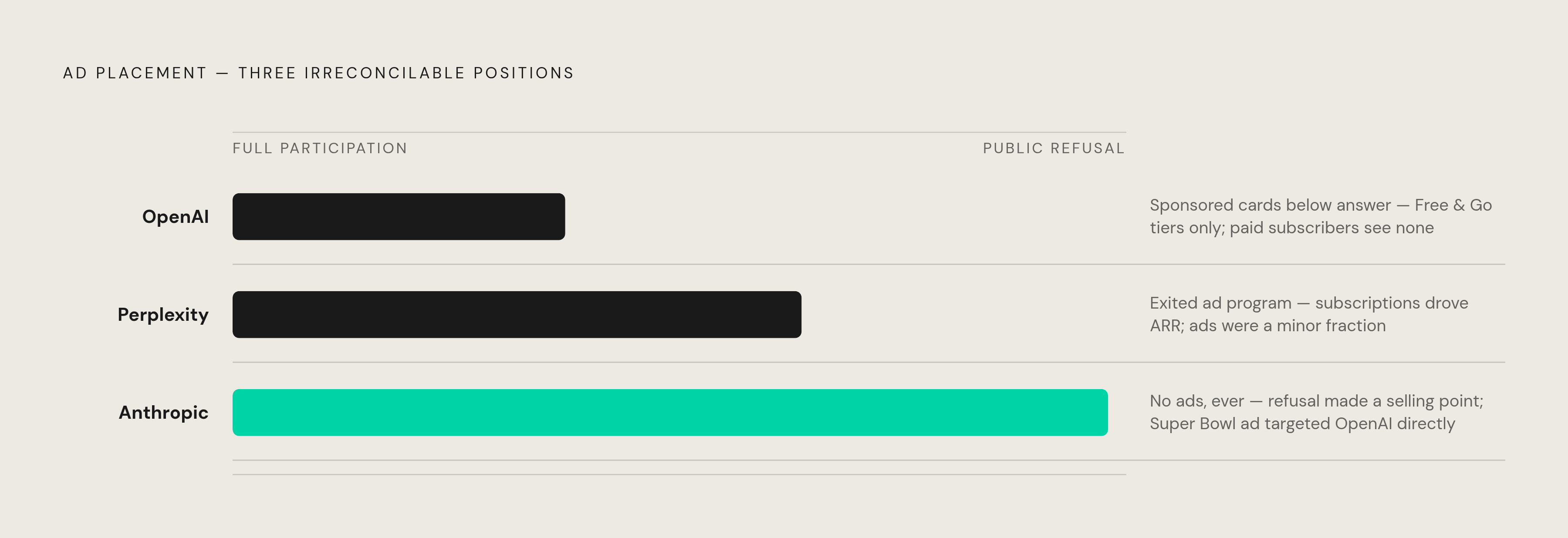
OpenAI's answer is strict separation. A ChatGPT ad renders as a labeled sponsored card below the assistant's answer, never woven into the answer text itself, so you can't buy your way into the model's response. That placement is also limited by tier: ads appear only on the Free and Go tiers, and every paid subscription tier stays ad-free, a constraint with real consequences for B2B advertisers whose buyers tend to cluster on paid plans rather than free ones. The structure preserves the model's answer as untouched territory, but it also means a whole segment of high-intent paid-tier users sits outside the reach of this ad format.
Perplexity's answer was to exit the business. The company wound down its ad program and moved to a subscription-first model, with executives telling the Financial Times that sponsored placement risks making users doubt everything the platform tells them, a concern one executive summarized as being in the accuracy business. The company hasn't ruled out returning to ads at some point. The exit wasn't a failure to monetize: advertising reportedly made up only a small fraction of Perplexity's revenue, while its subscription business was already generating substantial annualized recurring revenue on its own. The exit was a product decision about what kind of trust the platform wanted to protect.
Anthropic went further still: it chose to run no advertising in Claude at all. The company didn't just stay quiet about that choice. Three weeks after OpenAI's ad launch, Anthropic ran a Super Bowl ad aimed squarely at its rival, and that turned its ad-free position into a public, explicit selling point rather than a background policy. Three platforms, three answers: full separation with a tier carve-out, exit after a trust-driven product decision, and a public refusal to enter the business in the first place. Each choice sets a different boundary around where a conversational intent signal can actually be monetized, which matters enormously to any advertiser deciding where to spend.
A new brand safety problem that keyword blocklists cannot solve
Brand safety inside conversational AI advertising means preventing the AI system itself from generating a false claim about a product or a brand in the course of answering a user's question, a different problem than the disreputable-website issue keyword blocklists were built to solve. A blocklist can keep an ad off a page full of misinformation. It cannot stop a language model from stating, in its own generated answer, something untrue about the very brand whose ad sits just below that answer. That's a different category of risk, native to how these systems produce language in the first place, and the placement debate described above, separation, exit, refusal, is in large part a set of early, differing attempts to manage exactly that risk before it becomes an industry-wide liability.
Sources
- LLM Advertising: Your Chance to Be an Early Adopter
- LLM Ads Explained: How AI Advertising Works in 2026
- Understanding Contextual Targeting in ChatGPT Ads: A 2026 Deep Dive
- Large Language Model Advertising in 2026: Who’s Winning the AI Attention War?
- How to Build an LLM Advertising Stack: Tools, Workflow, and Budget (2026)