AI Advertising Budget Allocation for Performance Marketers
AI surfaces now demand separate budget strategies based on conversational intent, not keywords.

Performance marketing budgets have run on the same math for two decades: compare CPM, reach, and historical CTR across channels, then shift dollars toward whatever ratio wins. That math is breaking right now, and the cause is concrete, not a vague AI disruption story. Paid CTR on queries where Google shows an AI Overview has fallen sharply over the past year, while zero-click searches have climbed toward the majority of all queries, trends widely reported across industry tracking sources. Meanwhile a new set of AI ad surfaces has come online that targets on a completely different signal than keyword or demographic match. Slapping a line item labeled "AI" onto a CPM-optimized media plan doesn't answer either force. The planning has to change, and this piece is my attempt at laying out what replaces it.
The core budget shift is to stop treating paid CTR as the primary planning metric and instead separate spend across surfaces by what each one can still deliver. On Google AI Mode and AI Overviews, impressions keep accumulating while clicks keep falling, so that inventory now functions more like awareness spend than direct-response spend, and budgets should be weighted accordingly. ChatGPT's ad product runs at a reported $60 CPM against 900 million weekly active users, Microsoft Copilot has run ads since 2023 and now supports in-conversation purchase flows via Copilot Checkout, and both require separate line items because their targeting runs on conversational intent rather than keyword auctions or cookie profiles. Perplexity pulled its ad product entirely in February 2026 after reaching real scale, which is reason enough to avoid concentrating budget on any single AI surface and to treat inventory availability as a planning risk, not a constant.
Why can't I just move my existing keyword budget into AI ad placements?
A conversational AI ad lives inside a dialogue the user experiences as personal and responsive, a structural difference from how a display banner or a social placement sits beside content or interrupts a feed. That difference changes what "targeting" even means.
The targeting basis is conversational intent, meaning the topic, the phrasing, and the surrounding context of a user's prompt, not a keyword match or a cookie-based profile. Someone typing "what's the best carry-on bag for a three-day business trip" into a chat window has just handed over purchase intent, price sensitivity, use case, and a rough timeline in one sentence. No keyword carries that much information. A search for "carry-on bags" tells an advertiser almost nothing by comparison, and that gap is exactly why the old targeting stack, built for keyword auctions and cookie profiles, can't read conversational signal at all. You need a different layer underneath, one that parses natural language for intent instead of matching strings. Programmatic ad infrastructure built for conversational AI connects advertisers to LLM and AI chat inventory by reading live prompt context rather than keywords, and that kind of tooling is built specifically for that job, platforms built precisely for this layer operate as DSPs and SSPs for conversational AI interfaces, running their own publisher exchanges and using real-time prompt analysis to match ads to live conversational context, platforms built precisely for this layer operate as DSPs and SSPs for conversational AI interfaces, running their own publisher exchanges and using real-time prompt analysis to match ads to live conversational context.
Worth separating this from categories that get lumped in out of habit. Conversational marketing, the chatbot-sells-things idea dating back to roughly 2016, is brand-initiated and bot-mediated; no ad auction anywhere in it. AI-generated ad creative is a production tool, good for making ads faster, but it says nothing about where those ads run. And a search ad next to an AI-generated summary is still a standard keyword auction underneath; the AI framing around it is decorative. The actual novelty is the format itself: contextual recommendations and in-chat sponsored placements that show up inside the AI's response flow, apart from any separate sponsored rail.
None of this needs cookies. Targeting runs on live conversational context, which matters to marketers who were already bracing for a cookie-free future and now find one arriving faster than planned. On the plumbing side, OpenRTB 2.6 is emerging as the programmatic layer for these environments, though the auction dynamics differ from anything display or search built for. A large language model folds an ad into generated output that changes shape from query to query, and that alone makes CTR modeling a harder problem than it ever was in a fixed-format banner or search result.
The AI ad surface landscape a budget has to span in 2026
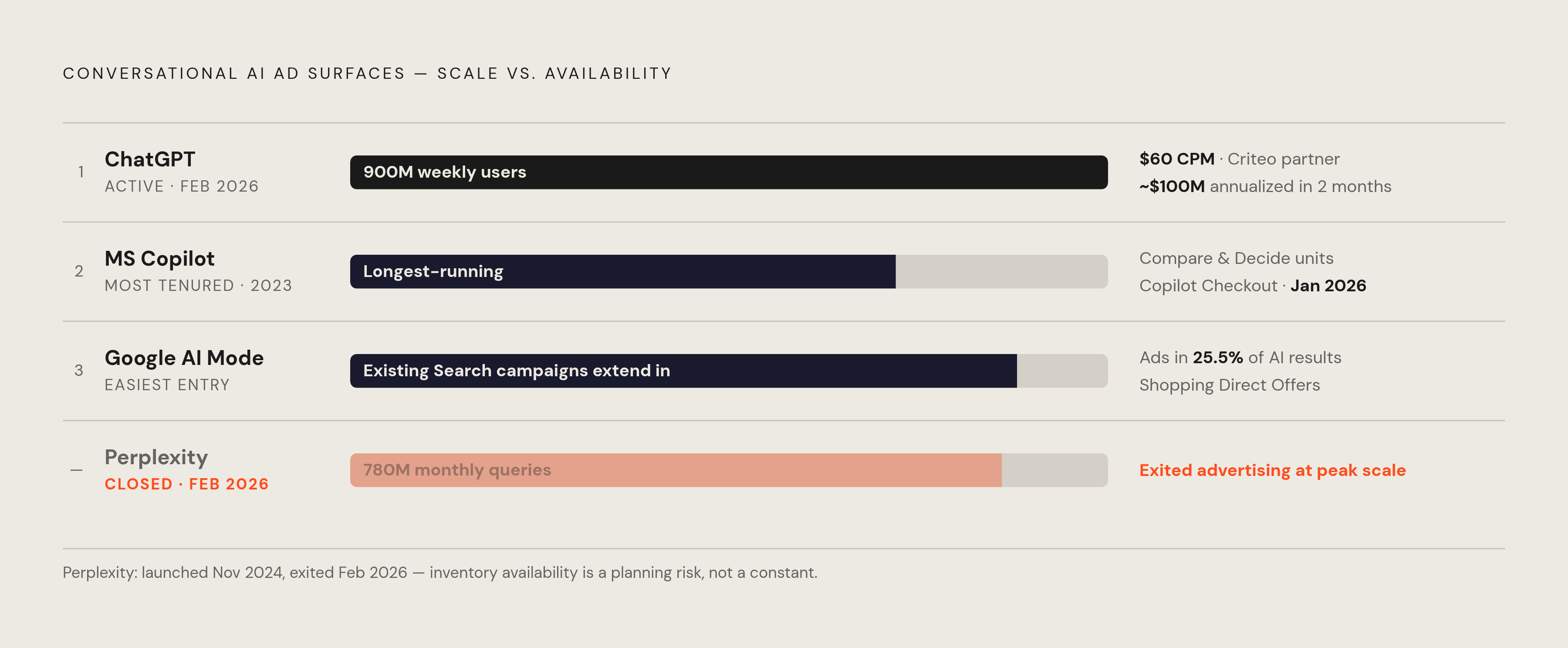
Several surfaces run ads at real scale now, each with its own mechanics, audience, and buy-side access rules, and a 2026 budget plan has to account for all of them separately.
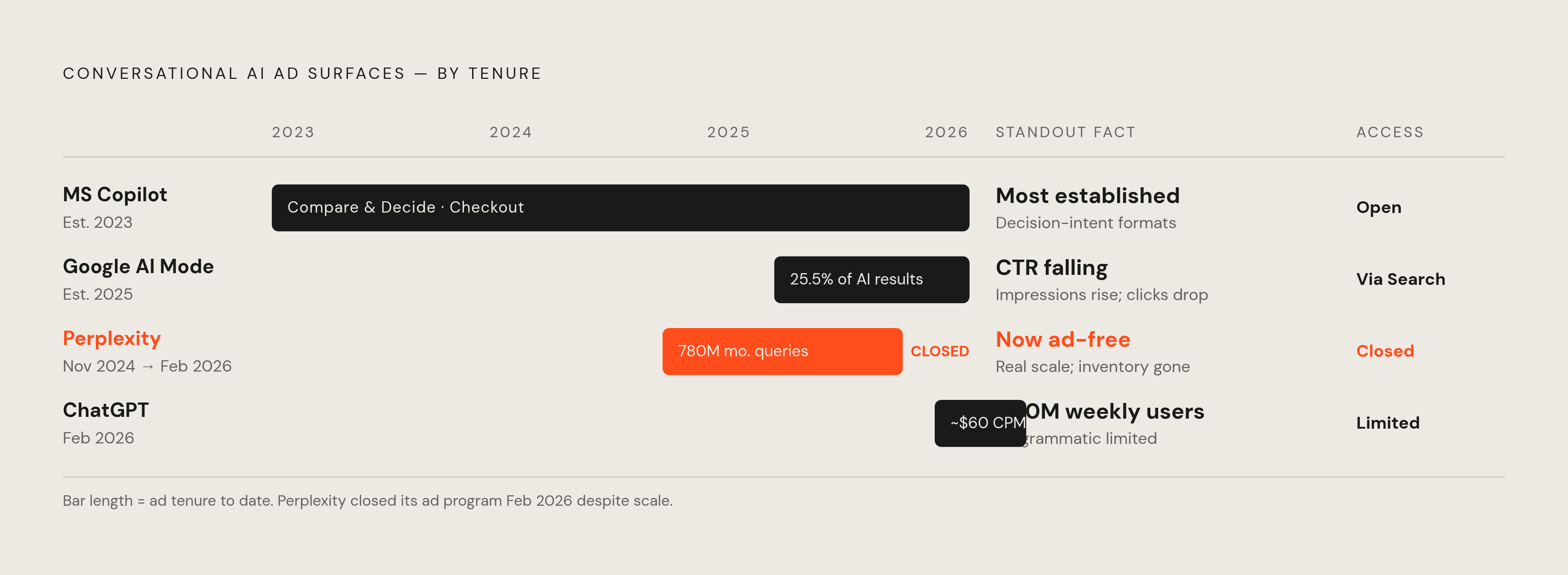
ChatGPT turned on ads in February 2026, on the Free and Go tiers only; Plus, Pro, Business, Enterprise, and Education stay ad-free. OpenAI reports 900 million weekly active users and more than 50 million consumer subscribers as of that same month, and the ad product reportedly hit $100 million in annualized revenue within about two months of launch, at a reported $60 CPM. Criteo is the first named technology partner, though programmatic access is still limited and still being built out. OpenAI says ads are clearly labelled and don't influence ChatGPT's answers.
Google's path is more familiar. AI Mode and AI Overviews are the easiest surface for most advertisers simply because existing Google Ads campaigns extend into them without any separate setup. AI Mode ads showed up in 25.5% of AI results, up from 5.17% earlier in the year, and shopping ads with Direct Offers now run inside AI Mode, which Google frames as monetizing conversational search at rates comparable to traditional search. The buying interface will feel familiar to anyone running Search campaigns today, though the CTR collapse cited above lands squarely on this surface. Impressions keep piling up while clicks keep falling.
Microsoft Copilot has run ads since 2023, inherited from Bing Chat, which makes it the most established conversational AI ad product on the market by tenure. Recent additions include Compare & Decide ad units, shopping campaigns, and Copilot Checkout, an in-conversation purchase flow that launched in January 2026. Copilot's ad voice feature builds a bridge between the AI's answer and the sponsored message, a format distinct enough from anything else here that it deserves its own test budget.
Perplexity is the cautionary tale. It launched sponsored follow-up questions in November 2024, then walked away from advertising entirely in February 2026, citing user trust concerns, and is now chasing $500 million in annualized subscription revenue as an ad-free product instead. It had reached 780 million monthly queries by May 2025 and 100 million users. The scale was real, and the channel closed anyway. Anyone building a media plan around a single AI surface should read that as a warning about inventory volatility, not a one-off fluke. Anthropic's Claude, for its part, is ad-free by design, and used the 2026 Super Bowl to draw a public line between itself and OpenAI's ad launch.
Underneath all of this sits a buy-side access problem. Generalist DSPs have reach across the open web but were built for display and video inventory; they can't read conversational context. Single-surface AI ad networks tied to one platform can read that context but obviously can't offer reach beyond their own walls. Expect a split market for a while: ad-funded assistants like ChatGPT's free tier, Copilot, and Google AI Mode on one side, subscription-funded ad-free assistants like Claude and post-2026 Perplexity on the other, with real differences in who actually shows up on each side.
How to read conversational intent signals and why they change what budget efficiency means
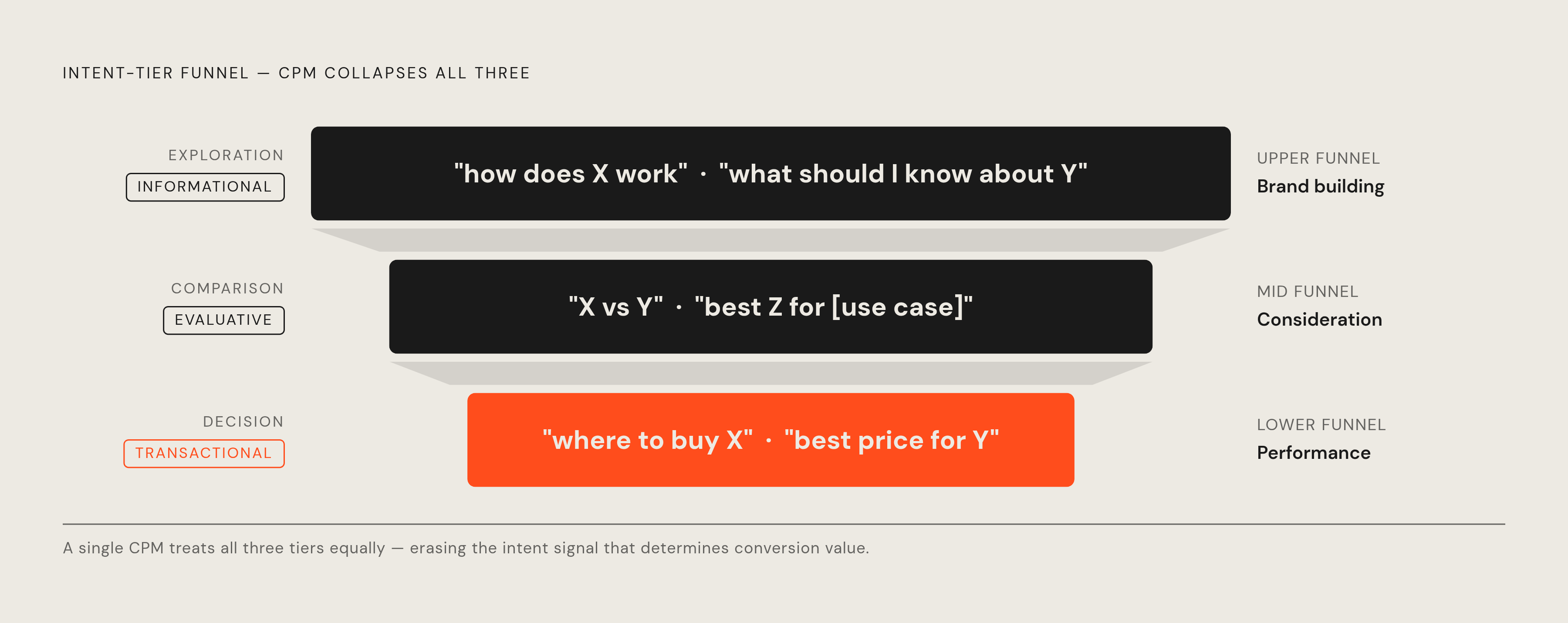
In a conversational AI environment, the prompt is the targeting signal. That's the whole reframe, and everything else here follows from it.
A prompt can reveal purchase stage directly. "I'm trying to decide between X and Y" reads nothing like "how does X work," even though a keyword-matching system might bucket both under the same product term. A prompt can carry constraints stated in plain language, budget, timeline, use case, none of which show up in a search query string, and it can carry emotional context and urgency too. On some platforms, prior turns in the same conversation extend that signal further still, building a fuller picture of what the person wants as the exchange goes on.
The budget consequence is easy to miss but hard to overstate: a high-intent conversational moment is not the same unit as a high-volume impression. Treating them as equivalent is exactly where CPM breaks down as a primary metric. A smaller number of deeply contextual placements can beat a much larger CPM buy on a lower-intent surface. CPM assumes a generic impression; conversational inventory produces graded ones instead.
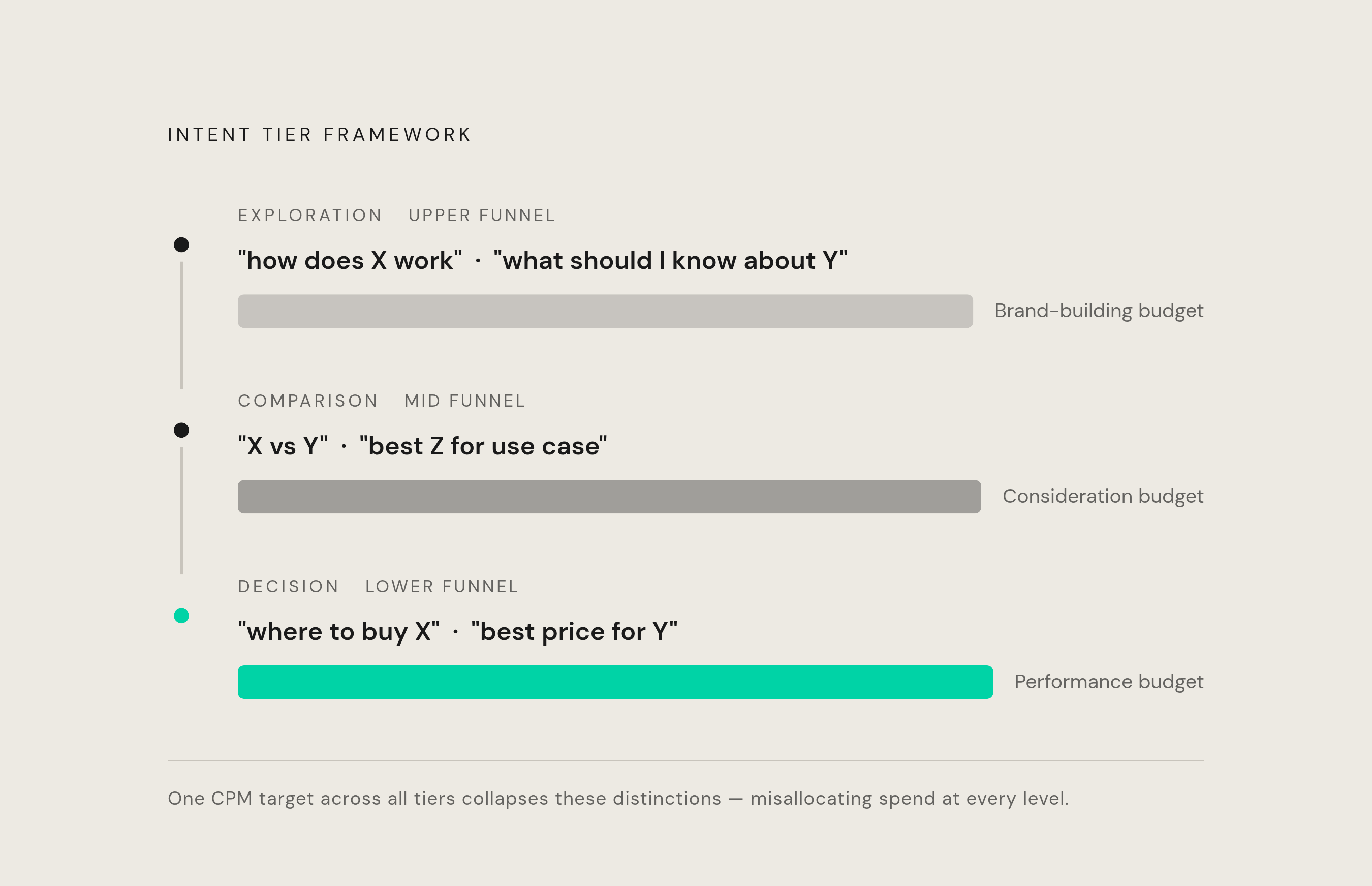
The practical fix is planning around intent tiers instead of channels. Exploration intent covers users still learning ("how does X work," "what should I know about Y") and belongs in upper-funnel, brand-building budget. Comparison intent covers users narrowing options ("X vs Y," "best Z for [use case]") and belongs in mid-funnel consideration budget. Decision intent covers users ready to act ("where to buy X," "best price for Y") and belongs in lower-funnel performance budget. Each tier needs its own bid strategy and its own success metric. A single CPM target applied across all AI inventory just ignores the tier structure.
One caveat worth sitting with: measurement infrastructure for conversational AI is early, full stop, and attribution across these surfaces is still an open problem industry-wide. Build that uncertainty into the plan rather than assume standard last-click logic carries over cleanly, because it won't.
A practical framework for deciding how much budget to allocate to AI channels and why
Start from the intent tier map, not from a list of channels. Budget weight should follow wherever a tier lines up with a campaign's actual objective.
First, audit. Look at current paid search spend and find the query categories where AI Overviews show up most; those are the categories where paid CTR is already collapsing underneath the advertiser. Upper-funnel informational spend sitting on those queries is buying impressions at cost with shrinking click returns, and it needs to move. The destination is conversational AI surfaces that meet the same informational intent natively, inside the exploration tier.
Second, map products to intent surfaces. Categories with complex purchase decisions, travel, finance, health, high-consideration e-commerce, generate rich comparison-intent conversations, and that's where mid-funnel conversational AI spend belongs first. Commoditized or impulse categories may not gain much from conversational placement at all; existing search and social logic probably still holds up better there, and there's no reason to force a shift where the old model still works fine.
Third, size the pilot. I don't have a confident percentage benchmark to hand over here, because the market genuinely isn't old enough to produce one yet. A test-and-learn budget, ring-fenced from existing channels rather than carved out of them, is the safer starting position. The IAB's 2026 Outlook Study found 67% of marketers now prioritize agentic AI for ad buying and campaign execution, which tells you the category has entered mainstream planning even while the infrastructure underneath it is still catching up. A workable pilot picks one intent tier, one platform, and one measurement proxy, engagement quality or an assisted-conversion signal, before anyone starts talking about scaling it.
Fourth, account for how different buy-side access actually is across surfaces. Google AI Mode is the easiest entry point since existing campaign structure extends into it directly, even though format and context differ from standard search results. Microsoft Copilot is the most established option, and its Compare & Decide and checkout formats suit decision-intent budget well. ChatGPT carries a higher CPM and earlier-stage programmatic access, but its ad-supported tier reaches a high-intent user base worth piloting against consideration and decision intent specifically. Cross-surface conversational AI DSPs make sense once the goal shifts to reach across multiple AI surfaces under one consistent intent-based approach, rather than managing each platform on its own terms.
Fifth, build measurement proxies before launch, not after the campaign's already running. Last-click attribution will undercount conversational AI's contribution almost by definition, since it shapes decisions that end up converting somewhere else entirely. The proxies worth planning for now: branded search lift measured after exposure, assisted conversion rate inside a multi-touch model, and lift in direct navigation traffic.
Where the budget reallocation math actually comes from — the search spend displacement case
The mechanism is simple to state: as AI Overviews absorb informational queries, paid search costs hold steady while clicks fall, so advertisers end up paying the same, or more, for less traffic. Research has shown that when an AI Overview appears on a search results page, clicks on traditional organic results fall meaningfully compared with pages where no overview appears, with clicks inside the AI box itself remaining very low.
Run that math against any campaign spending heavily on informational, upper-funnel keywords in categories where AI Overviews show up often, and the efficiency loss is already happening, whether anyone on the team is watching for it or not. This isn't a call to abandon search broadly. Lower-funnel, commercial-intent queries that AI Overviews tend not to absorb keep their conversion value intact, and that spend should stay exactly where it is.
The reallocation case is about the specific dollars that were subsidizing impressions without clicks on upper-funnel, AI-absorbed queries. Free those up, and point them at conversational AI surfaces where that same upper-funnel intent shows up natively and the ad format actually fits its context. At the industry level, AI-powered ad spend is growing three times faster than total digital ad spend globally, a pattern that reads more like existing budget in motion than new budget appearing from nowhere.
There's a supply-side reason this motion should keep going. ChatGPT's infrastructure reportedly costs around $700,000 a day to run, and costs at that scale need an offsetting revenue line somewhere. Advertising is that line, which is why the ad-funded tier is stable footing for OpenAI rather than a side experiment, and why ad inventory on these surfaces is expanding rather than shrinking.
What responsible budget planning in AI ad environments requires on safety and measurement
Brand safety works differently here than in display or social, and treating it as the same problem wearing a new interface is a mistake. An ad appearing inside a dialogue the user experiences as personal carries a different reputational risk when it lands next to a harmful or off-brand conversational topic than a banner ad does on some low-quality webpage. Contextual targeting, keyed to conversational topic and publisher category, is the main safety lever available right now, so budget plans should require explicit topic exclusion lists and publisher-category allowlists rather than leaning on whatever default a platform ships with.
Transparency is a related but separate obligation. OpenAI says ads must be clearly labelled and must not influence ChatGPT's answers. Verify labelling standards on each surface before activating rather than assume every platform holds itself to the same bar; nothing here is standardized yet, and probably won't be for a while.
The measurement gap deserves plain framing. Conversational AI has no measurement infrastructure today that comes close to what search or display built over the past two decades. LLM ad systems have a specific technical problem on top of that: the ad integrates into generated output that changes from query to query, which makes CTR modeling harder than in a fixed-format environment, a challenge documented in ACM SIGecom research from March 2025. No cross-platform attribution standard exists for conversational AI impressions as of this writing, and I wouldn't hold my breath for one arriving soon.
None of that is a reason to sit on the sidelines. It's a reason to build proxies into the plan now: geo-controlled brand lift tests to isolate what conversational AI is actually contributing, share-of-voice monitoring inside AI-generated responses, both organic and paid, as a stand-in for category presence, and incremental reach measurement against audiences that end up converting through other channels entirely. The channel is too big to ignore and too young to measure the old way, and the budget plan has to hold both of those things at the same time.