Measuring Incremental Lift from Conversational AI Ad Placements
Standard lift measurement breaks when ads run inside AI chatbots.

Measuring incremental lift from ads placed inside conversational AI needs a method built for this medium, not one borrowed from search and social. The signals, the attribution paths, and the holdout structures that work on a results page or a social feed don't map onto a placement embedded inside a chat response. Advertisers are treating them as if they do map over, and vendors selling old measurement frameworks under a new label are counting on nobody checking the math. This piece lays out what incremental lift actually means, why the standard formula breaks in an LLM setting, and what measurement looks like once the old assumptions stop holding.
Start with the basic definition. Incremental lift measures what advertising changes, not what advertising touches. The formula is simple: lift equals the conversion rate of the exposed group minus the conversion rate of the control group, divided by the control group's rate. That denominator matters, because it turns a raw difference into a percentage that says how much of the outcome the ad actually caused, versus how much would have happened anyway.
That distinction, between what the ad touched and what the ad caused, is the whole reason lift measurement exists as a discipline separate from attribution. Attribution answers a within-campaign question: which creative, which placement, which touchpoint got credit for an engagement. Lift answers a between-campaign question: which channels bring in demand that wouldn't have shown up without the spend. A channel can look outstanding by attribution and still add almost nothing on a lift basis. Branded search proves the point: lift tests on branded keyword campaigns commonly find that 60 to 80 percent of the conversions credited to those campaigns would have happened anyway, ad or no ad. The attribution report says the campaign worked. The lift test says most of that spend bought nothing, and the lift test is the one telling the truth.
What makes conversational AI ad placements structurally different as a measurement object
Search and social ad models rest on a quiet assumption: the surface stays put. The ad sits next to content that doesn't change just because the ad is there. A banner doesn't rewrite the article above it, just as a search ad doesn't alter the organic results below it.
Conversational AI breaks that assumption at the root. When an ad gets inserted into an LLM response, it can shift the flow, tone, specificity, and length of the entire answer the model gives back. Researchers call this a generative externality. The exposure and the content stop being separable the way they are in a banner or a search result, because the ad's presence can change what the surrounding response actually says.
The placement mechanics reinforce how different this is. Ads here get matched to conversational intent and topic, not a page, not a keyword typed into a search box, not a demographic profile pulled from a data broker. The dominant format right now, ChatGPT's chat_card, is a sponsored card that shows up below the AI's response: a title, a short description, an image, a link out. Targeting runs on conversational intent, topic category, and publisher category, no cookies required. The auction runs on relevance-weighted, second-price logic, similar in spirit to how Google and Meta run their auctions, except the relevance score here gets computed against conversation context instead of keyword match.
The intent signal itself beats anything search ever offered, at least on paper. A user prompt can reveal decision stage, level of specificity, the competing options someone's weighing, sometimes even budget or timeline, all surfaced in plain language rather than inferred from a search query or a behavioral profile built from past browsing. But that richness costs something: the signal is short-lived. It lives inside the conversation, and there's no standard way to log it across different AI surfaces the way an ad server logs an impression. Sit with that tradeoff long enough and it stops looking like a bonus feature and starts looking like the whole design problem.
Then there's the multi-turn problem. A single research session inside a chat interface can run across many exchanges. Someone might ask about a product category, refine the question, ask for a comparison, then click a link, all in one continuous conversation. Which turn counts as the impression? Which turn actually drove the consideration that led to the click? Last-touch models have no answer. Multi-touch models weren't built with this shape of interaction in mind either.
Layer on surface fragmentation. Conversational AI ads run across multiple AI publishers, each with its own identity graph, its own logging format, its own reporting shape. A user exposed to a brand on one AI assistant might convert later on the brand's site after coming in through a search engine or a direct visit. That path stays invisible to any single surface's own reporting.
Put it together and the practical risk is plain: a lift test that treats a conversational AI placement like a display impression will misattribute the control group, undercount exposure, and hand back a lift number that looks precise but doesn't mean much.
Why holdout design is harder to execute cleanly in LLM environments
The standard holdout method splits an audience at random into an exposed group and a control group, withholds ads from the control group, and compares what each group does afterward. It works well when the advertiser controls the surface and can suppress delivery to a matched group with confidence.
Conversational AI complicates that in three specific ways, and working through them in order shows why the third is the one most vendors still ignore.
Identity comes first. Without cookies that persist across sessions or a shared user ID, matching exposed users to control users at the individual level needs either a consented panel or an identity layer built by the platform itself. Neither exists off the shelf at scale.
Surface bleed comes second. A user held out of ads on one AI assistant can still run into the brand organically inside a response on a different AI surface, or in a regular search result, or through an old-fashioned channel like TV or out-of-home. Keeping the control group clean is structurally harder here than inside a single walled-garden platform.
Organic mentions are the third, and the one that quietly wrecks the whole test once you trace it through. Even with zero paid placement, an LLM can surface a brand name on its own if the brand is well known or heavily represented in training data. The "zero-exposure" control group isn't really zero-exposure, not the way it is when a banner simply gets withheld. If a control group user asks about a product category and the model recommends the advertiser's brand with no ad involved, that user just got exposed without an impression ever getting logged. Standard holdout design counts that user as unexposed anyway, which inflates the apparent lift of the paid placement. Fixing this means either restricting the test to brands with low organic share-of-voice in AI responses, or measuring the organic mention rate directly and adjusting the control baseline for it. Neither step comes built into legacy lift tools, and that gap alone should rule out most off-the-shelf tools for this job until someone rebuilds them for it.
Platform-side holdouts are the closest thing to a clean answer available today. An AI publisher running its own ad delivery setup can assign users to holdout cells internally, keep identity continuous across sessions, and stop bleed within its own surface. That's structurally close to how Meta and Google run geo- or user-level holdouts inside their own walls, except it requires the AI publisher to build that capability and hand it to advertisers. Cross-surface holdouts, spanning multiple AI publishers at once, remain unsolved. No shared identity spine connects one AI publisher's users to another's today.
What DISQO's AI Search Lift launch reveals about where the industry's measurement infrastructure actually stands
DISQO launched AI Search Lift on June 17, 2026, the first commercially available product built specifically to measure whether ad exposure makes people more likely to engage with a brand inside LLMs and other AI-powered environments.
The method leans on DISQO's consumer-consented research panel: people who've explicitly agreed to let their behavior get logged. That consent connects verified, multi-channel ad exposure logs to observed behavior inside AI environments, and the comparison runs on exposed-versus-control logic with deterministic matching rather than a probabilistic model guessing at who saw what. The panel structure is what makes the holdout hold up: identity stays continuous across sessions because users agreed to be tracked, which sidesteps the cookie and cross-surface identity problems described above.
Early beta results, running from Q4 2025 through Q2 2026 across five categories (automotive, insurance, beauty and personal care, CPG, and travel), found higher volumes of brand engagement inside AI environments among exposed groups in the higher-consideration categories: automotive, insurance, and travel. That tracks with how people actually use these tools, once you think through the mechanism rather than just the topline number. Buying a car or shopping for insurance involves research and comparison before commitment, and a chat interface is a natural point for a brand to shape that process. The finding backs the broader structural argument here: high-intent conversational moments carry real signal, not incidental noise.
The tradeoffs in the DISQO approach deserve to be named plainly, not glossed over. The consented panel solves the identity and holdout integrity problems, but panel-based measurement has its own ceiling: panel size limits statistical power once a campaign gets aimed at a niche audience or runs for a short flight. The method measures lift in AI engagement behavior, not necessarily downstream conversion; connecting that engagement to actual revenue still needs an extra bridge. And the approach is proven for AI search-adjacent placements. Whether it extends cleanly to fully in-conversation, chat-native placements, where the generative externality problem is sharpest, hasn't been established yet.
The larger point stands regardless: the industry now has its first working proof-of-concept for AI-native lift measurement. That's a starting point, not a finished answer. Anyone selling it as the finished answer is overstating what the data supports, and that gap between what's proven and what's marketed is exactly the kind of thing this piece opened by warning about.
The signals that a conversational AI lift framework should actually track
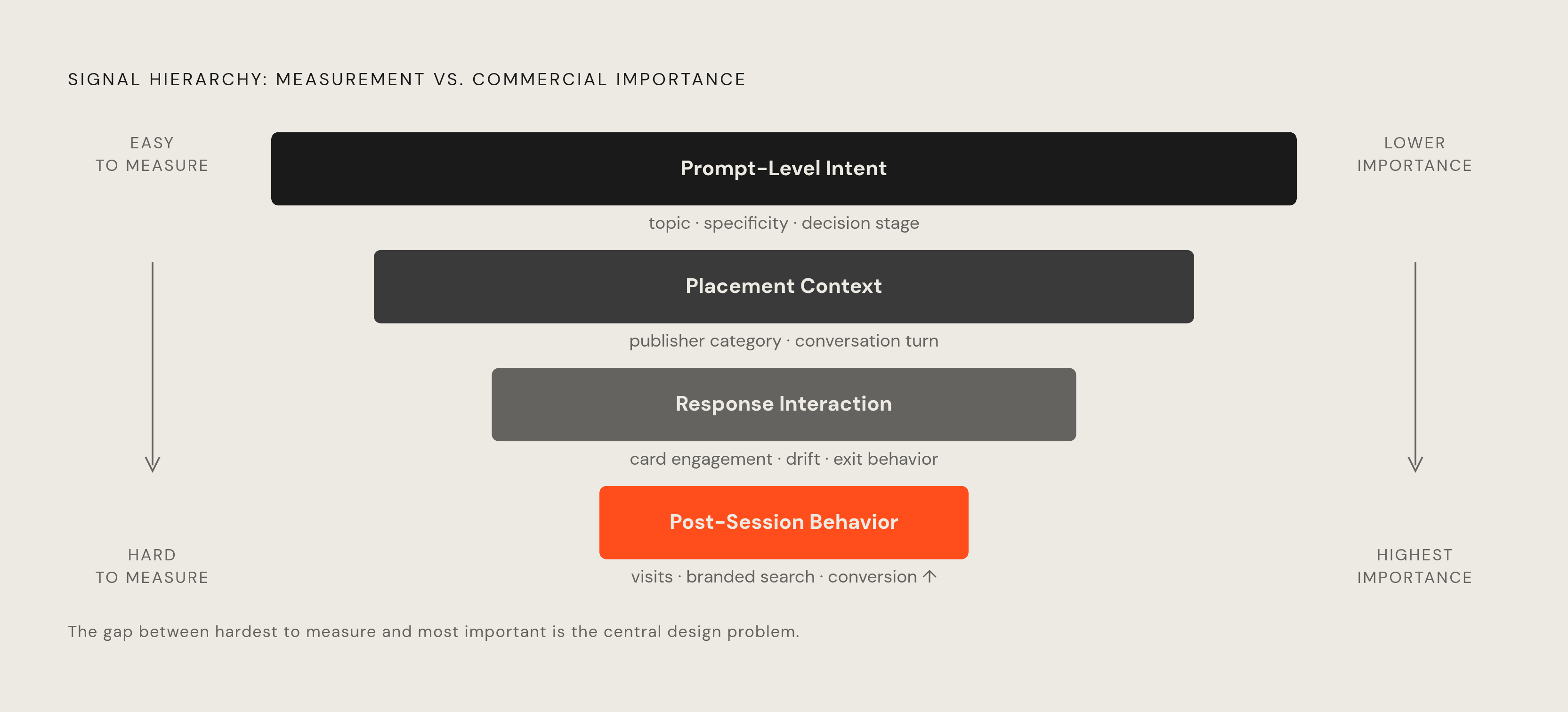
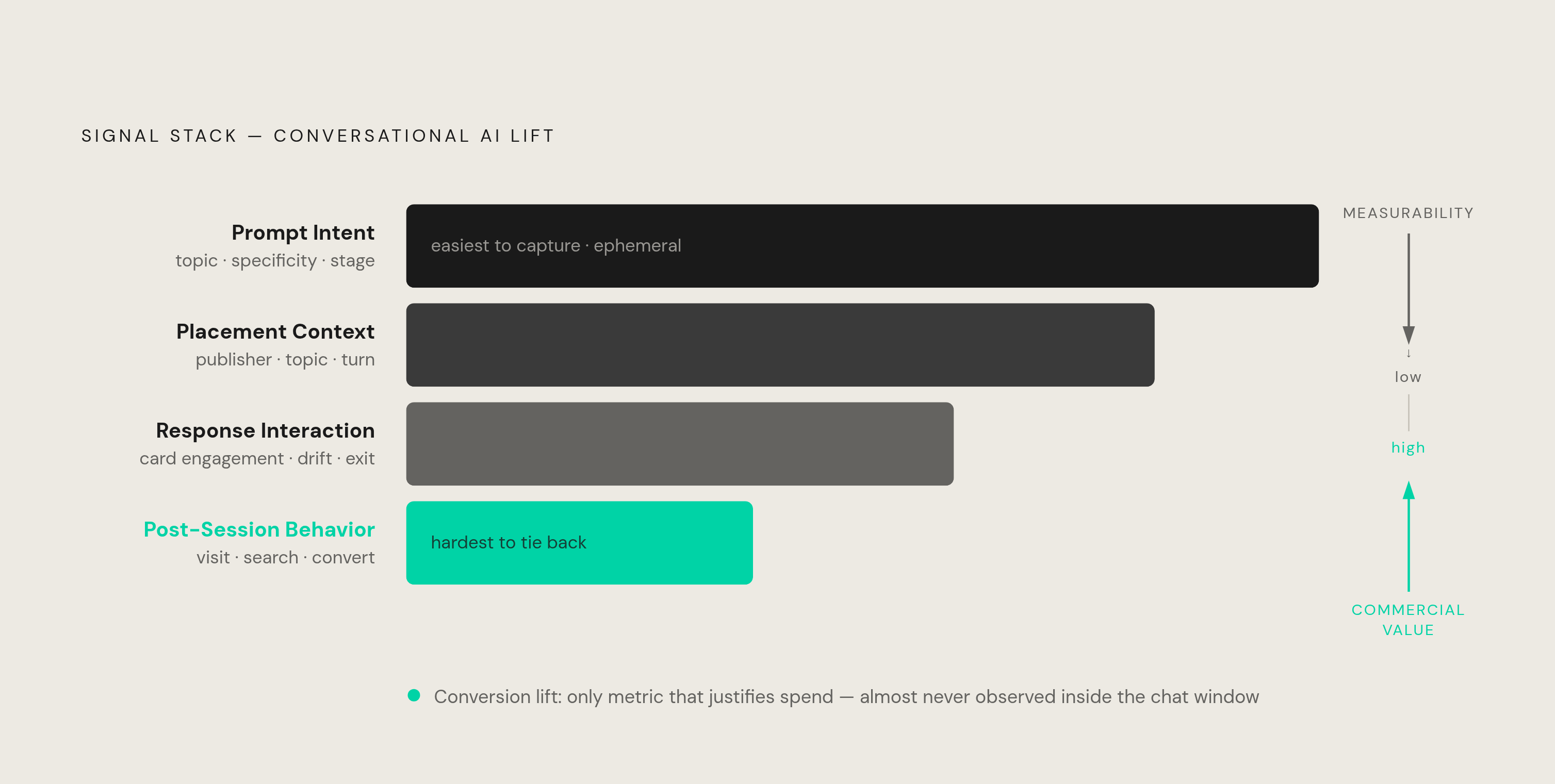
A useful framework tracks signal at four levels, moving from the moment a user types something to the moment, days later, when they might buy.
At the top sits prompt-level intent: the topic, the specificity, the decision stage visible in what the user actually typed. This is the richest signal available, both for matching the ad and for later analysis of which intent moments actually produced lift. Below that sits placement context: publisher category, conversation topic, which turn in the session the ad appeared on. That context tells you whether the placement landed at a high-leverage moment in the conversation or a low-leverage one. Below that is response interaction: did the user engage with the sponsored card, did the conversation keep drifting toward the brand's category afterward, did the user exit the AI surface shortly after seeing the ad. And at the bottom, post-session behavior: site visits, branded search activity, direct navigation, and eventually conversion.
That last layer is both the most important and the hardest to get at. Conversion almost never happens inside the chat window itself; the user leaves for a brand site, a retailer, or a search engine. Without a persistent identity link tying the AI session to whatever browser session comes next, that path stays invisible to the AI publisher's own reporting. A few bridges exist to close that gap: platform-provided conversion APIs (OpenAI confirmed a Conversions API along with pixel-based tools as of May 5, 2026), consented panel tracking of the kind DISQO runs, or modeled probabilistic matching. Every one of those bridges introduces its own error, and a serious framework writes down which bridge is in use and what its known error rate looks like, instead of presenting the final number as clean.
On priority, in roughly descending order of how easy each is to measure and roughly ascending order of how much it actually matters commercially: aided brand recall inside the AI environment, category consideration lift (does the brand show up more often in a user's later AI queries about the category after exposure), site visit lift, and conversion lift.
Two metrics deserve real caution, more than the industry currently gives them. Click-through rate inside the AI interface says something about creative quality and ad relevance, but nothing about incrementality on its own; a high-intent user who clicks might have found the brand anyway. Raw reach inside a conversational surface isn't equivalent to reach on a feed, either, since a single high-intent conversation can outperform a dozen low-intent impressions. That makes impression counts a weak proxy for value here, weaker than they already are elsewhere. Treat any vendor pitch built mainly around reach numbers as a red flag, not a selling point.
A DSP with direct publisher supply relationships has a structural edge on all of this: it can normalize signal formats across different AI surfaces and run consistent holdout logic across inventory sources, something a single-surface ad network can't offer.
How to design a lift test that produces a defensible number


Five decisions, made in order, and made before the campaign starts trafficking.
First, pick the holdout architecture. Platform-side holdouts win wherever the AI publisher supports them, since the publisher can assign users to exposed and control cells internally and keep session continuity intact. Panel-based holdouts, the DISQO approach, solve cross-session identity through consent but run into panel-size limits on power. Geo-based holdouts, suppressing the campaign in matched markets, are cruder but don't need platform cooperation; they suit broad awareness campaigns better than intent-matched placements, where geography is a weak stand-in for who was actually exposed. Post-hoc audience splitting based on modeled exposure should get avoided outright: exposure modeling in a cookieless environment carries enough uncertainty on its own that the resulting lift number inherits that uncertainty without ever disclosing it.
Second, set the measurement window before looking at any data. Higher-consideration categories like automotive, insurance, and travel run on longer consideration cycles; a seven-day window will undercount lift badly, and 30 to 90 days fits the category better. Lower-consideration categories like CPG and beauty tend to show lift faster, but the effect also fades faster, so shorter windows paired with repeat-exposure tracking give a more honest read.
Third, name the primary outcome metric in advance: site visit lift, branded search lift, or conversion lift, one as primary and the rest as secondary. Testing several metrics as if they're all primary inflates the false-positive rate. If the primary metric doesn't move, the campaign didn't produce meaningful incremental lift, whatever the secondary numbers happen to show.
Fourth, account for organic LLM share-of-voice before trusting the baseline. Measure how often the brand shows up organically in AI responses for the target query categories before running the paid test. A high organic mention rate means the control group isn't really zero-exposure, and the lift estimate needs an adjustment for that organic baseline, or the test needs to shift toward a query category where organic mentions are rare.
Fifth, pre-register the design: holdout architecture, measurement window, primary metric, minimum detectable effect, all written down before launch. That single step keeps the eventual result from turning into post-hoc rationalization, and it's what makes the number defensible in front of a skeptical CFO or an agency client asking hard questions about where the budget actually went.