Conversational AI Ads vs Google Search Ads CTR Comparison
ChatGPT ads convert better despite lower click rates than Google Search.
Google's advertising business pulled in $348.15 billion in 2024. Growth slowed to 13.9% year-over-year, down from the 41.3% pace it posted during the pandemic era. That deceleration matters more than the topline figure: a channel this large, growing this slowly, is running out of new territory to expand into.
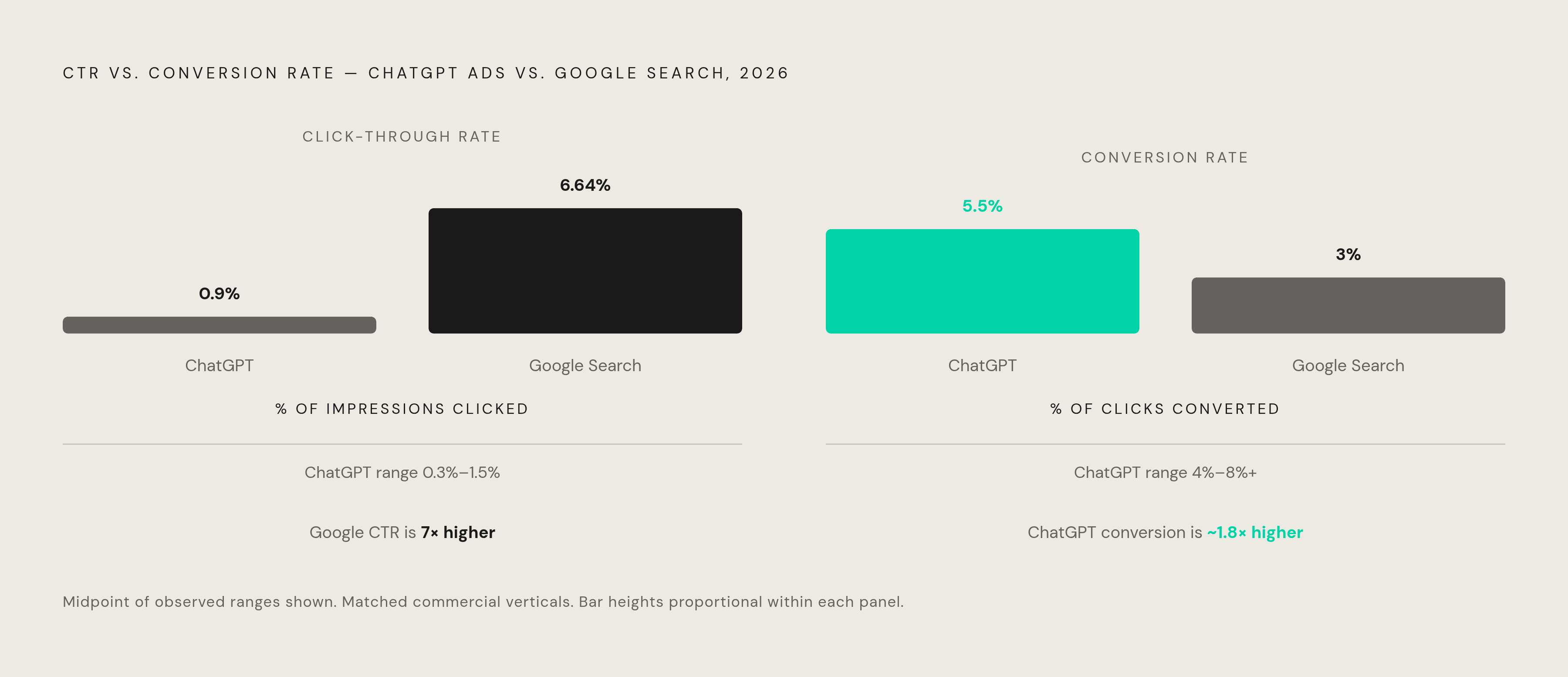
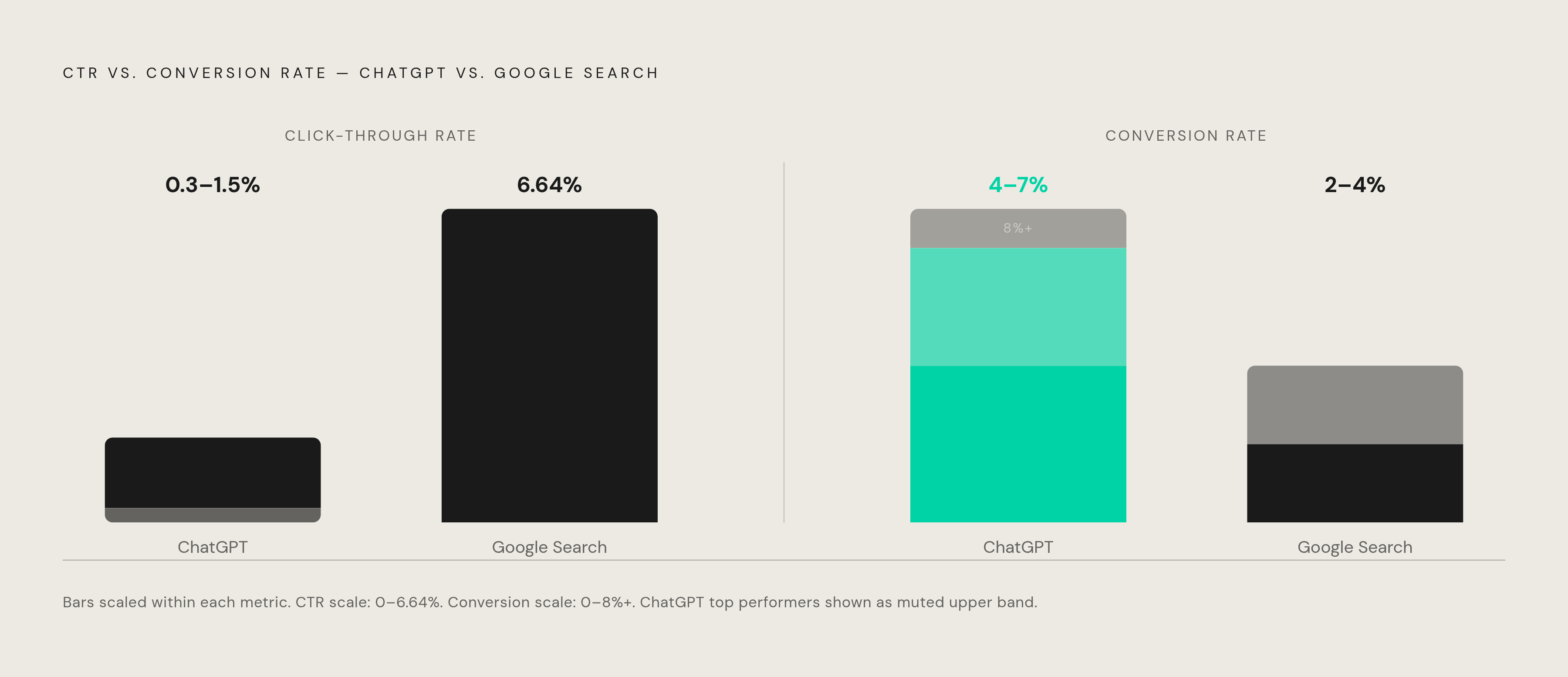
ChatGPT ads produce a click-through rate of 0.3% to 1.5% in early 2026 data, against a cross-industry Google Search benchmark of 3.52% to 6.64%. That gap shrinks in practical terms once conversion is factored in: ChatGPT ads convert at roughly 4% to 7% in commercial verticals, with top performers clearing 8%, while matched Google Search campaigns run 2% to 4%. Google Search CPCs, meanwhile, rose 12% year-over-year to $2.96 in Q1 2026, and paid CTR on queries without an AI Overview citation is running 91% below CTR on queries where a brand does get cited, compressing the efficiency case further. ChatGPT shows one ad per response with no ad-rank stack competing for the same placement, so the lower CTR reflects placement scarcity rather than weak relevance, and cost per acquisition can hold up against Search even when the per-click price looks higher on paper.
The price side confirms it. Average Search cost-per-click rose 12% year-over-year to $2.96 in Q1 2026, up from $2.64 in Q1 2025. Advertisers are paying more for less: fewer clicks, higher prices, a shrinking pool of users who bother clicking a paid result at all. Google Ads is still projected to pull in over $248 billion in advertiser spending in 2026, up from an estimated $224 billion in 2025, so money keeps arriving even as the unit economics of buying on the platform get worse. Rising spend paired with falling efficiency is the profile of a maturing surface.
Here is the question that should worry anyone still building a media plan around Search as a default: if CTR keeps falling and CPC keeps climbing, at what point does the efficiency case stop holding up for advertisers who are not sitting in Google's top spending tier? For most advertisers outside that tier, that point has already passed. Search still works, but it no longer works the way it used to, and pretending otherwise carries real risk.
The citation effect — and why organic authority now shapes paid performance
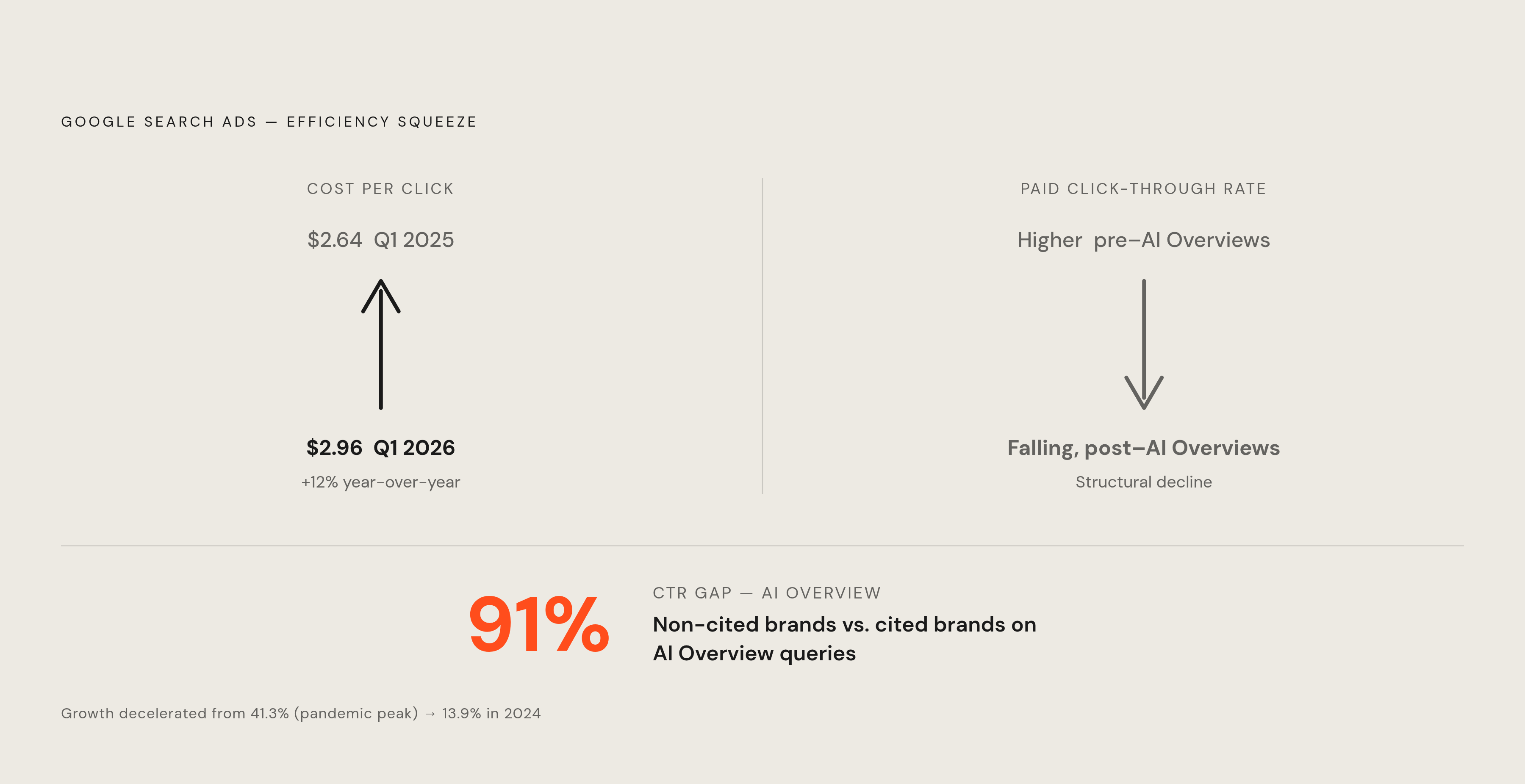
Seer Interactive's Q3 2025 data shows paid CTR running 91% higher on queries where a brand gets cited inside an AI Overview than on queries where it does not. Paid and organic used to be levers an advertiser pulled independently. They are locked together now, and the AI layer sitting on top of the results page decides who gets the lift.
That is a real problem for anyone still running Search as a standalone channel with a standalone budget, because the Overview functions as a filter, and the filter favors whoever it already trusts: established authority, deep backlink profiles, long publishing histories. None of that can be bought or built quickly. A newer entrant loses organic visibility to the Overview first, then loses the paid CTR bump riding on top of it, so the disadvantage compounds instead of leveling out over time.
Brands stuck on the wrong side of that gap should stop waiting for it to close. It will not close on its own. The smarter move is toward surfaces where being new does not disqualify a brand, where relevance to the moment beats years of domain authority. Search rarely offers that anymore, and treating it as though it still does is the mistake most media plans are quietly making right now.
What Google Search ad CTR benchmarks actually look like in 2026, stripped of the disruption narrative
Strip out the AI Overview story and Search still looks strong on paper. Cross-industry average CTR for Google Ads Search campaigns sits at 3.52% to 6.11% in 2026, a range that has trended upward, helped by responsive search ads and AI-generated assets that make copy more relevant on average.
Automation runs most of the platform now. Roughly 78% of all Google Ads spend flows through AI-powered bidding, with Smart Bidding and Performance Max carrying the bulk of it. Advertisers using these strategies report cost-per-conversion running 22% lower on average than manual CPC campaigns, once an account has enough conversion volume to give the algorithm something to learn from.
Search remains the largest intent-capture surface in advertising, and a 3.52% to 6.11% CTR range is genuinely strong for a channel this mature. But the ceiling forming on specific query types sits directly on top of the queries that used to introduce brands to people who had never heard of them. The headline CTR range leaves that part of Search's story out, and it is the part that matters more than the average.
What conversational AI advertising is, and what it is not
Conversational AI advertising means paid, targeted commercial messages placed inside an AI assistant or LLM interface, matched to the intent of the conversation happening in real time rather than to a webpage, a keyword, or a static profile built from past browsing.
The term gets stretched to cover things that do not belong in it, so precision matters here. Conversational marketing, the chatbot-driven sales flows brands have run since around 2016, uses owned channels rather than paid third-party placements. AI-generated ad creative is a production tool with no bearing on where an ad gets placed. A Search ad sitting next to an AI Overview is still triggered by a keyword and still competes adjacent to AI content rather than living inside the dialogue. Meta's approach treats a conversation as a downstream signal, something that retargets someone on Instagram or Facebook later; the conversation feeds the system but never becomes the placement surface itself.
The signal is what actually separates these categories. In Search, a keyword stands in for intent: a word or short phrase the user typed. In conversational AI advertising, the whole exchange is the signal: what the user asked, how they phrased it, what they said they are trying to figure out. Ads show up contextually within or beside the AI's response, clearly marked as sponsored, built to sit inside the answer format rather than compete above or beside it the way a Search ad does.
Microsoft's Copilot offers the clearest documented example of this in practice. Its "Showroom ads," launched in April 2025, insert rich sponsored content (images, product details, pricing) at the bottom of a Copilot answer specifically when the user's language signals buying intent. The ad shows up because of what the person just said they want to do, and no matching keyword is involved at all.
How targeting logic works inside an LLM versus inside a search auction
A Search auction runs on a rigid structure. An advertiser bids on a keyword, the auction ranks eligible ads by bid multiplied by quality score, and placement gets decided before the user ever sees a page of content.
An LLM auction works differently by design, not by degree. The system reads the conversation as it unfolds, works out the semantic context of what is being discussed, matches eligible advertisers to that context, and picks a placement, all without a keyword typed into a box. OpenAI's own documentation describes ChatGPT's approach as contextual: matching based on the current conversation's topic, past chat history, and prior ad interactions. It explicitly rules out keyword targeting and third-party-style user profiling.
The privacy design underneath this is deliberate, not incidental. Genre-based decoupling frameworks group conversations into coarse semantic clusters before bidding happens, rather than matching ads to fine-grained individual prompts, which sidesteps cookie-based tracking entirely instead of patching around it. On the mechanism-design side, OpenAI runs a relevance-weighted second-price auction designed to keep the system incentive-compatible for advertisers.
For buyers, the job itself changes. There is no keyword list to build and no negative-keyword taxonomy to maintain; the unit of targeting is conversational context, so the work shifts from keyword architecture toward writing a message and an audience brief that hold up across a range of phrasings. The feedback loop is also less stable than in Search, since an LLM can generate a different response to the same underlying question every time. CTR becomes harder to predict and harder to learn from systematically. That instability is a fact of the environment, not a bug waiting to get patched out.
How does ChatGPT ad CTR compare to Google Search ad CTR in 2026?
Here is the number that looks alarming until it gets unpacked: ChatGPT ad CTR runs 0.3% to 1.5% in early advertiser data, well under Google Search's 6.64% benchmark average and under Meta's 1.71%. Anyone reading only that line might call the channel a dud. That reading misses two structural facts.
ChatGPT shows one ad per response. There is no ad-rank stack, no above-the-fold competition among five or six sponsored links, so the lower CTR reflects scarcity of placement rather than a lack of relevance. The user also reaches that single ad after working through a conversation, which means the population that sees it is pre-filtered in a way no Search click ever is.
The conversion numbers add important context. A solid conversion rate for ChatGPT ads in 2026 runs roughly 4% to 7% for commercial verticals, with the strongest performers clearing 8%, against 2% to 4% on Google Search in matched verticals. Fewer people click, but the ones who do are far more likely to buy, so cost per acquisition can hold up, and sometimes beat Search, even when the per-click cost looks higher on paper. CTR alone makes ChatGPT ads look weak; conversion tells a fuller story.
One caveat belongs here, stated plainly: ChatGPT only opened advertising in February 2026, and the conversion figures come from an early, invitation-only pilot self-selected toward advertisers with the budget and sophistication to get in early. These numbers will move as access broadens. Still, the scale behind them is not trivial. ChatGPT processes 2.5 billion prompts a day and OpenAI holds 73% market share among AI chatbots, though that volume still lags well behind Google's 8.5 billion daily searches. OpenAI generated $100 million in advertising revenue in its first six weeks running ads. That kind of advertiser demand does not happen by accident.
What prompt-level intent signals reveal that keywords cannot
A keyword tells an advertiser what someone typed. A conversation tells the advertiser what that person is actually trying to decide, what they have already ruled out, what budget or constraint they are working within, and how close they are to choosing.
Take the kind of prompt these systems see every day: "I'm renovating a 200-square-foot bathroom on a modest budget, which fixture brands should I prioritize?" That single sentence carries purchase stage, category, budget, and decision criteria all at once. No keyword, however long-tail, packs in that much. The gap between the two systems is a difference in what kind of information ever reaches the advertiser at all, more than a marginal difference in match quality.
A growing share of users now start their shopping journey with an AI assistant rather than a search engine. That puts the conversational surface at the beginning of the funnel instead of after someone has already typed a query into Search. A Search ad intercepts a query that has already formed; a conversational ad can show up while someone is still reasoning through the decision, earlier and in a far less crowded moment.
Multi-turn dialogue sharpens the signal further. Each exchange adds context, and the third message in a conversation carries more information than the first, more than any single keyword ever could. Because the signal comes from what the user chose to say, in the moment, it does not depend on third-party cookies, cross-site tracking, or demographic guesswork. That makes it both more accurate and easier to defend on regulatory grounds.
How the market is pricing this shift — and where spending is actually going
The dollar figures are still small relative to Search, but the trajectory is steep. Projections point to AI search advertising spend growing rapidly from a small base in 2025 to a significant share of all search ad spending within a few years.
Most of that money, for now, goes into placements adjacent to AI-generated content rather than into chatbot conversations directly; the majority of AI advertising in 2026 shows up this way. Chatbot-native ad spending is widely expected to climb through the year, and generative AI ad spend has grown rapidly in early 2026, as OpenAI and Anthropic compete hard for users. That competition is building out ad inventory faster than it would grow on its own.
Capital is following the same signal. Significant acquisition activity and venture funding flowed into AI-in-advertising companies in 2025, a sharp jump from 2024. Pricing on ChatGPT's ad product tells its own story about pace: it launched with CPMs around $60 and a minimum spend of $200,000 to $250,000, dropped within weeks to CPMs as low as $25 with a $50,000 minimum, and by May 2026 opened self-serve access with no minimum spend at all. Most ad platforms take years to reach that kind of market opening. This one took months.
None of this rivals Google's $224 billion advertiser ecosystem yet, not by a wide margin. But the direction, the speed of the buildout, and where intent is actually forming all point the same way, toward the conversational surface rather than back toward Search.
What the comparison means for how performance marketers should think about budget allocation
The more useful question is not whether Search still works. It is which queries are already being lost to AI Overviews, and where that intent goes once it disappears from the results page.
Informational and discovery-stage queries, historically the cheapest and most reliable way to introduce a brand to someone who had never heard of it, are exactly the queries losing the most paid CTR. That is not a coincidence, and it is not a temporary dip that corrects itself once Google retunes an algorithm. The page has changed structurally: what used to be an ad slot sitting above ten blue links now competes with a generated answer that absorbs the query before an ad ever gets the chance.
For a performance marketer, that makes the top of the funnel a portfolio problem, not a Search problem. The budget that used to buy awareness through informational keywords needs a second home, and conversational AI advertising is the clearest early candidate: earlier in the decision process, richer in signal, and, for now, far less crowded than an auction where the ad rank stack runs five names deep. Waiting for the CTR gap to close before moving budget is the wrong instinct, and it is the instinct most media plans are still following.
Read next to conversion rates, funnel position, and the structural decline already visible in Google's own numbers, that low CTR looks like the first real signal of where advertiser attention goes next. The marketers who wait for it to close on its own will be buying in after the price has already moved.