Keyword-to-Prompt Translation for Search Advertisers Entering AI Channels
Search advertisers must learn to target conversations instead of keywords in AI channels.

Search advertising runs on a single assumption: a short string of typed text tells you what someone wants. That assumption breaks completely inside conversational AI interfaces, because there is no keyword layer to bid on in the first place. ChatGPT ads have no keyword bidding mechanism. The control that replaces it is a context hint, a freeform block of natural language written at the ad group level, capped in length, and matched against the live back-and-forth of a conversation as it unfolds. A keyword captures what someone typed into a box. A context hint has to answer a different question: what is this person trying to accomplish, and is the offer useful to them right now? That's a real change in the skill being exercised: it requires writing to answer what this person is trying to accomplish, not filling out a new form for an old one.
Some of the oldest headaches in keyword management simply stop applying. Anyone who has managed a search account knows the defensive bidding required around a word like "apple," where the same string points to a consumer electronics company and a piece of fruit, forcing advertisers to pile on negative keywords just to keep their ads out of recipe searches. That ambiguity resolves itself automatically in a conversation, because the surrounding dialogue already tells the system which "apple" is meant. There's no static page to crawl and no keyword density to calculate. The material being matched against is the conversation itself, generated turn by turn, and relevance has to be reassessed continuously as that conversation moves, something a fixed keyword list is structurally unable to do.
A ported keyword habit performs badly in practice, and that is the clearest evidence of this gap. If a team writes context hints the way they'd write a keyword list, as a string of comma-separated topics, they consistently get weak matching back. That failure pattern is the whole argument in miniature: the old skill, applied in the new surface, produces worse results than learning the surface on its own terms.
What search advertisers know that transfers
None of this means search advertisers are starting from nothing. Habits built over years of account management carry over directly into AI ad channels: intent-first thinking, auction literacy, and landing-page discipline.
Search advertisers already think in terms of what a person is trying to do before they think in terms of the words that person typed, they just express that thinking through match types and keyword hierarchies. In a context hint, the same reasoning gets expressed as a sentence instead of a match-type setting, but the underlying discipline of asking "what does this person want" doesn't change, only its output format does. The auction itself rewards a familiar kind of skill. ChatGPT runs a relevance-weighted, second-price auction, so if you target sharply on a modest budget, you can beat a vague advertiser who spends far more. That's the same structural reward that a well-organized search account has always had over a sloppy one: precision beats scale when the auction is built to favor relevance.
The auction evaluates three things: the context hint, the ad's title and body copy, and the landing page it points to. Search advertisers have spent years on exactly those three disciplines. Landing-page relevance isn't a new concept being introduced for this channel, it's a known discipline being applied to a new surface. Copywriting for a constrained format, matching the words a customer actually uses, and building headline-and-description pairs that earn a click all transfer closely enough that you can apply existing copy frameworks to the headline-and-description structure of a sponsored card. A well-built search account groups tightly around a single, well-defined intent instead of dumping unrelated keywords into one bucket, and that same discipline is what it takes to write one precise context hint rather than a sprawling one.
How a prompt differs from a query
What's genuinely new is the richness of the signal itself. A typical Google search runs three or four words. A ChatGPT prompt is frequently a full paragraph, and that paragraph can contain the budget, the constraint, the shortlist of options already considered, and what the person has already ruled out. Instead of reconstructing someone's purchase situation from a sparse string, the advertiser gets the full context surfaced directly in the text.
A search marketer is used to inferring intent from very little. A query for "running shoes" tells you almost nothing about budget, brand loyalty, or where in the buying process someone stands. A conversation routinely removes that guesswork, because a user will often name the competitor they already tried, state a price ceiling outright, or specify a feature they require, none of which a keyword could ever carry. Consider a conversation that opens with a question about a two-week trip, then narrows across several exchanges to a specific region, a stated budget, and a particular travel style, and finally turns to comparing two or three specific itineraries. Each exchange refines what came before it. The first message signals interest. The later messages signal evaluation and near-term decision-making. A targeting system built for this channel has to track where in that arc a conversation currently sits, because comparison language, narrowing constraints, and pivot points are distinct phases, not one flat signal.
That phase recognition can work on meaning, not on specific vocabulary. A lengthy exchange about coordinating a distributed team across time zones, tracking deadlines, and managing remote collaboration friction reads as a strong signal for project management software, even if the phrase "project management software" is never typed. The match depends on recognizing a problem, not a product name, so no keyword list could catch that conversation.
This architecture changes what advertisers need to build in order to target well. Relevance comes from what's happening in the conversation now, not from a browsing history built up over weeks, so AI contextual targeting doesn't need persistent user identifiers or tracking someone across different sites. Each conversation stands as its own self-contained targeting context. That changes how an advertiser has to think about audience building. Instead of constructing a list of people based on past behavior, the task is constructing language that correctly identifies a type of conversation whenever it happens to occur.
Writing a Context Hint
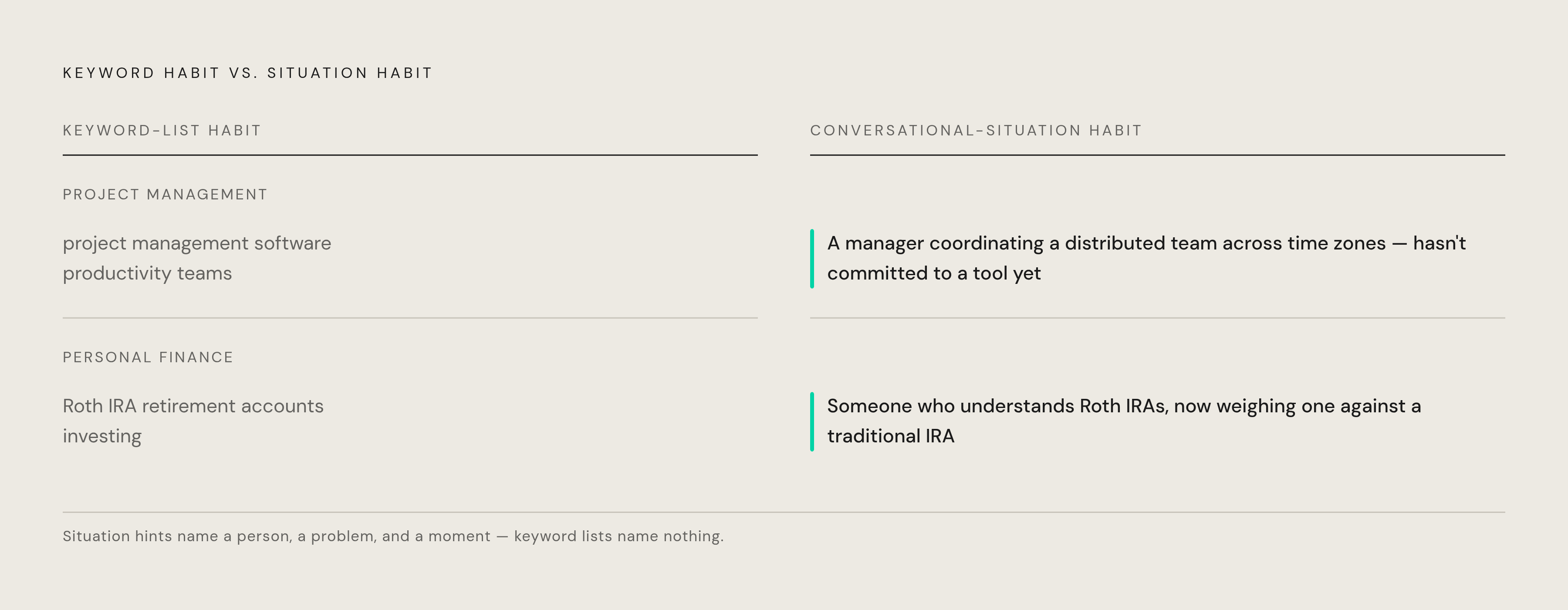
Everything above points to one practical task: writing the context hint. It is the single highest-leverage decision in an AI ad campaign, and it has to describe a conversational situation rather than list a topic.
The character limit punishes vagueness far more than it punishes length: a 280-character cap rewards specificity over topic coverage. A hint that names a specific problem, describes the user's situation, and identifies the moment an offer becomes relevant will beat a hint that reads like a pile of topic words, because the auction is scoring relevance to the actual conversation taking place, not coverage of a subject area.
A keyword-list habit produces a hint like "project management software productivity teams." A conversational-situation habit produces something like "a manager asking how to coordinate a distributed team across time zones who hasn't committed to a tool yet". The first is a label. The second describes a person, a problem, and a moment.
The same shift applies in finance. A topic-list habit produces "Roth IRA retirement accounts investing." A situation-based hint written for the comparison stage of that same topic reads closer to "someone who already understands what a Roth IRA is and is now weighing it against a traditional IRA". As a conversation moves from "what is a Roth IRA" to "what's the difference between a Roth IRA and a traditional IRA," the signals shift toward consideration-stage intent, and the hint needs to be written for that second phase specifically rather than left generic enough to cover both.
Travel follows the same logic. A situation-based hint reads "a traveler asking how to spend two weeks in a specific region on a defined budget with a particular travel style in mind," which targets the planning and comparison phase directly rather than the broad awareness phase that comes before it.
A simple test separates good hints from disguised keyword lists. Read the hint back and ask whether it answers three questions: who is talking, what they're trying to accomplish, and where they stand in the decision. A hint that fails to answer all three is a topic list wearing a sentence's clothing. You don't write hints like this from assumed search behavior. It comes from actual prompt patterns, pulled from the questions customers ask in support conversations, sales calls, and community forums, all of which sit closer to the structure of a prompt than a search query ever does. Conversational phase also shapes the hint: a hint written for someone comparing options and asking about differences between products needs to differ from a hint written for someone asking what to buy for a specific, named use case, because the same ad rarely belongs in both moments.
Which AI surfaces are open for buying today
The surfaces currently open for paid placement differ enough in mechanics and reach that treating them as one interchangeable channel will produce campaigns that fit none of them well.
ChatGPT: self-serve buying opened through Ads Manager at ads.openai.com on May 6, 2026, and daily budgets now start at a low minimum, well below the high threshold that applied during the earlier pilot phase. Ads show up as clearly labeled sponsored cards beneath the AI's response, never folded into the answer text itself, because the model's actual response is not something advertisers can buy. Reach is limited to logged-in adults on the Free and Go tiers in the US, Canada, Australia, New Zealand, and 31 European markets. Every paid tier, Plus, Pro, Business, Enterprise, and Education, is ad-free. Business buyers are considerably more likely to sit on a paid tier than on Free or Go. A sizable share of the audience a B2B advertiser most wants to reach simply isn't exposed to ads on this surface at all. Buying runs through the context hint, with Reach (CPM), Clicks (CPC), or Conversions (oCPC) as the available objectives.
Google AI Overviews and AI Mode: Shopping, Performance Max, and AI Max for Search campaigns are all eligible, and broad match Search campaigns were automatically upgraded to AI Max in September 2026. Smart bidding is required, and ads appear either below the AI response or integrated into it, but not both in the same auction. Reporting isn't segmented for AI Overviews or AI Mode, so you need extra measurement work if you want to isolate performance on this surface. Several sensitive verticals, including adult, alcohol, gambling, finance, healthcare, and politics, remain excluded from AI Overviews ads. AI Max for Search extends reach beyond a keyword list by drawing on keywords, ads, landing pages, and other contextual signals to find relevant searches and route them to better-matched landing pages.
Microsoft Copilot: Every eligible campaign and ad type is automatically opted into serving inside Copilot, you can't opt out, and even if you're eligible, there's no guarantee it will display. Targeting here reads the entire session, not just the most recent message, which puts it structurally closer to conversational intent matching than to keyword matching. Reach extends to every Copilot user above age 13, subject to regional minimums that can run higher in some markets, and users between 13 and 18 see only non-personalized, contextual ads. Copilot's position inside Microsoft 365 workflows makes it a structurally relevant surface for business audiences specifically.
Perplexity: not currently a buying option. It stands as a useful counterexample for why trust architecture matters in this channel at all.
Claude: Anthropic's published policy keeps Claude ad-free, and it is not a buying option.
How vertical intent patterns should shape context hint strategy
The craft of writing a good context hint plays out differently depending on the vertical, because the phase of conversation and the specificity of the language people use both vary by category.
Travel conversations contain detail that a search query almost never reaches: trip duration, budget, family composition, past destinations, and specific constraints, often stated right in the opening message. The right context hint targets the planning and comparison phase, something closer to "asking how to spend two weeks in a region with a specific budget and a specific travel style," rather than the broad awareness phase that precedes it, because the specificity already present in travel prompts rewards an equally specific hint.
Healthcare and pharma advertisers put most of their total digital ad spending into search, one of the highest concentrations of any category, and people already turn to AI assistants heavily for health-related questions. Hints here work best when they focus on information-seeking and symptom-to-solution phases rather than direct product promotion, because the multi-turn nature of a health conversation gives a clear signal the moment someone shifts from general information toward a specific product or provider.
Retail and e-commerce still command the largest absolute search ad budget of any category, but its share of ChatGPT ad impressions fell sharply as the platform matured: it moved from a dominant position down to roughly a fifth of total impressions as other verticals recognized the channel's value. The early-mover advantage retail held in ChatGPT has narrowed, so now the edge comes from targeting specific product-comparison conversations instead of claiming an entire category.
Financial services moved the opposite direction, growing nearly eightfold in ChatGPT impression share over the period tracked, a sign that the category recognized the value of consideration-stage financial conversations quickly. Finance conversations inside AI assistants tend to move from definitional questions like "what is a Roth IRA" to comparison questions like "Roth versus traditional IRA" and finally to product-selection conversations, and each of those stages is its own distinct opportunity for a context hint built specifically for it.