Zero-Click AI Answers and Their Impact on Paid Search ROI
AI Overviews are slashing paid search click-through rates in half while driving up costs.
Zero-click AI answers are not shrinking organic traffic alone. They are breaking the basic transaction that paid search was built on, where an advertiser pays for intent, a user clicks, and a brand gets a visit it can measure. That exchange is failing at the structural level now, not the campaign level, and the numbers behind the failure are large enough that no amount of bid optimization fixes them.
Similarweb's clickstream panel, shared with Rand Fishkin of SparkToro, found that 68.01% of US Google searches ended without a click between January and April 2026, up from 60.45% in 2024. That's a 7.5 percentage point jump in two years, a sharp acceleration by any measure of the trend. The climb to 68% is the shape of search now. It's the shape of search now.
Similarweb draws a useful line between zero-click search, the behavior of a results page answering the query itself, and zero-click marketing, the strategic response of treating that results page as the placement rather than the road to your website. Billboards don't send anyone to a website either, and nobody measures billboard return in clicks. The click was always a stand-in for value, never the value itself. AI Overviews just made the stand-in obvious.
Why AI Overviews hit paid search harder than they hit organic
Zero-click gets filed as an SEO problem, something organic teams worry about while paid keeps its placements and its measurable funnel intact. That framing doesn't survive contact with the data.
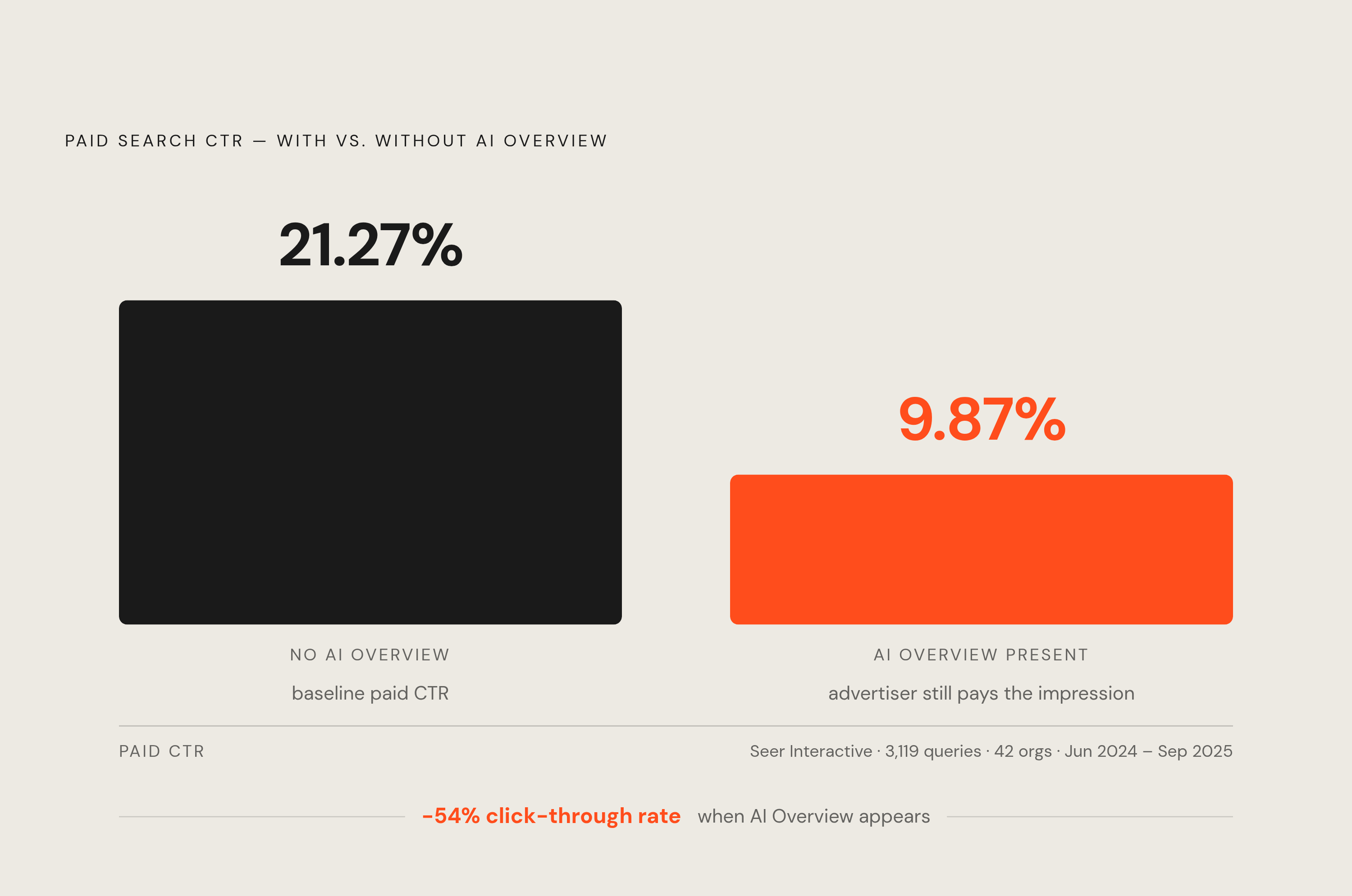
Seer Interactive tracked 3,119 queries across 42 organizations from June 2024 through September 2025: a substantial volume of organic impressions, far outnumbering the paid impressions. When an AI Overview shows up on the page, paid click-through rate falls from 21.27% to 9.87%. That's a drop of more than half. Out of every 100 users who would have clicked a paid ad before AI Overviews existed, fewer than 50 do now, and the advertiser still pays for the impression and still fights through the same auction for it. What's gone is the conversion surface on the other end.
Paid takes the disproportionate hit because of where AI Overviews are on the page. On mobile, a full AI Overview can push every paid ad below the fold entirely. The high-visibility inventory has shrunk while the number of advertisers bidding for it hasn't moved. Supply is down and demand is flat, and the Seer and Realize.com analysis shows that setup lets cost per click climb even as the return on that click falls. Advertisers are bidding harder for a prize that keeps getting smaller.
AI Mode makes the problem sharper still. Semrush measured a 93% zero-click rate inside AI Mode, close to 19 in 20 queries resolving without anyone clicking anywhere. Referral rates out of AI Mode are 1.6% to 2.5% of queries, against the 17% to 19% referral rate traditional Google search has run for years. The one thing holding this back from being an emergency today is scale: Similarweb and SparkToro data show AI Mode was only 0.34% of all Google searches in the January to April 2026 window. A 93% zero-click rate on a sliver of traffic is a warning shot. The same rate on a meaningful share of search volume is a different conversation, and Gartner's 2024 forecast, that traditional search volume would fall 25% in 2026 as users move to conversational AI, was already tracking as of a recent research brief.
The double hit: falling CTR meets rising costs
ROI compression here runs in two directions at once, and that's what makes it worse than a normal downturn. Campaigns that used to clear healthy ROAS now need meaningfully more budget to produce the same revenue, as the Seer Interactive and Realize.com work on falling CTR and rising auction pressure shows. That's one side.
The other side: visible ad inventory at the top of the page has contracted while advertiser demand hasn't eased off at all, so auction pressure pushes CPCs up. Advertisers end up paying premium prices for placements that convert worse than they used to. Falling returns and rising costs, arriving together, are what actually erode ROAS. Neither one alone would be nearly as damaging.
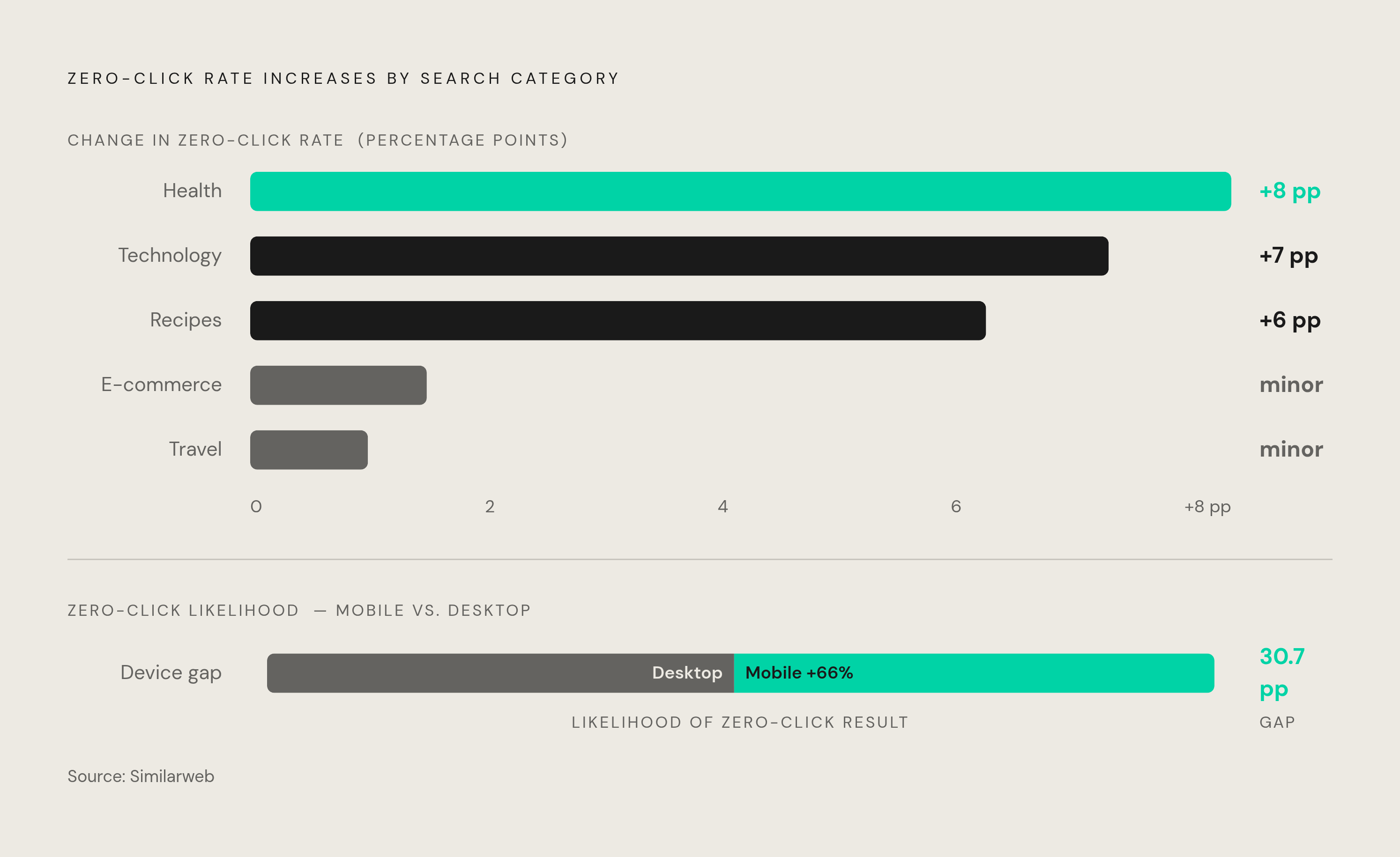
The damage isn't even across categories. Health searches saw zero-click rates climb 8 percentage points, technology 7 points, and recipes 6 points, Similarweb found. These are categories where an AI system can synthesize a confident, complete-feeling answer without sending anyone anywhere. E-commerce and travel show smaller increases, because a user who wants to buy a jacket or book a flight still has to land on a site to do it. Mobile users are 66% more likely to hit a zero-click search than desktop users, a 30.7 percentage point gap, and mobile is where most e-commerce search now happens, so device matters. Put those two facts together and the advertisers most exposed are the ones running mobile-heavy campaigns in categories AI can answer directly, health, tech, recipe content, and anything else driven by information rather than a transaction.
Google needs its ads to stay valuable to advertisers, and Google also has a product incentive to make AI Overviews as useful and complete as possible, which by design keeps users from clicking anywhere. Those two goals work against each other, and the Realize.com framing shows advertisers are the ones absorbing the cost of that conflict. Whatever counted as a healthy ROAS benchmark before AI Overviews existed isn't a fair yardstick anymore. Holding campaigns to it now is measuring against a market that no longer exists.
What the click data hides: the citation premium and surviving-click quality
The picture isn't uniformly bleak, and the data that complicates it deserves equal weight, not a footnote.
Brands that get cited inside an AI Overview see 35% more organic clicks and 91% more paid clicks than brands that don't get cited, Amsive's 2025 research found. Being named inside the AI-generated answer functions as a trust signal, and it appears to lift action downstream rather than replace it. For branded queries specifically, Amsive found CTR actually rises 18.68% when an AI Overview appears. The overview is confirming the brand is legitimate there. It's confirming the brand is legitimate, and the user clicks through to finish something rather than to go discover something new.
Research adds another layer: clicks that survive an AI Overview carry meaningfully higher conversion rates than clicks that didn't pass through one. Users clicking after reading a summary already know roughly what they want. They're higher intent than a casual browser skimming ten blue links, which means raw click volume, on its own, is turning into a misleading number. Fewer clicks, more valuable clicks. A measurement setup built entirely around volume will undercount what's actually working.
Research suggests the share of users who click through when an AI Overview appears is substantially lower than when one doesn't, but those who do click are closer to the users a brand actually wanted in the first place. Zero-click hasn't dented Google's own ad revenue at all: Similarweb data shows paid results were among the biggest winners in click distribution as zero-click rates have risen. Google is pulling more value out of fewer clicks. It is not suffering the same squeeze it's putting on advertisers.
That sets up the real strategic shift: getting cited inside an AI Overview is now a paid and organic objective at the same time. The results page is the placement. Showing up inside the AI-synthesized answer is the new fight for position one.
Where the ad money is beginning to flow: the emerging AI advertising landscape
eMarketer projects US AI search ad spending will go from $1.1 billion in 2025 to $26 billion by 2029. The money is moving toward a different surface inside search. It's moving toward a different surface inside it.
Google is moving fastest because it has the most to protect. Ads now show up in 25.5% of AI Mode results, up from just 5.17% in early 2025. Direct Offers, a retailer promotions pilot, launched inside AI Mode in January 2026, and Google has been developing new ad formats designed for AI-driven, multi-turn search experiences. None of this is surprising once you look at scale: Google pulled in roughly $198.1 billion in search ad revenue in 2024 alone. A company generating that kind of money from search will find a way to monetize whatever form search takes next.
OpenAI moved second. Ads went live in ChatGPT on February 9, 2026, with Adobe, Ford, and other launch partners, and WPP, Omnicom, and Dentsu buying early inventory. The starting price was steep: roughly $60 CPM with a $200,000 minimum buy-in. Within about twelve weeks that shifted to a self-serve, cost-per-click auction with a $50,000 minimum, opening the door to a much wider set of advertisers. By August 2026 the program covered more than 40 countries, and ChatGPT ads hit a $1 billion annualized run rate in under 200 days. Ads carry a clear "sponsored" label and stay visually separate from the actual answer, and paying subscribers on Plus, Pro, Business, Enterprise, and Education plans don't see them at all. Criteo signed on as OpenAI's first ad-tech partner for the test phase, and Kargo announced its own ChatGPT integration in May 2026.
Microsoft's approach through Copilot looks different again. Showroom ads started as a pilot with select clients in April 2025: rich sponsored content with images and product detail, shown at the bottom of an answer when a user signals buying intent, with a default max CPM bid of $60. Microsoft has plans for brand agents, letting a user talk directly to a virtual brand representative inside the ad unit itself, and dynamic filters that let someone refine a search by clicking inside the ad rather than typing a new query.
Not everyone is betting on ads. Perplexity tested sponsored follow-up questions from late 2024 through 2025 and dropped the whole approach in February 2026, citing concerns about user trust, and it's now leaning on subscriptions instead. That's a real signal about how much tolerance users have for advertising inside a pure AI answer, not a footnote to skip past. Other AI platforms are exploring monetization models at varying stages. Still others are weighing how advertising might fit into their AI products, though no commitments have been announced.
eMarketer expects AI chatbot ad spending to jump 1,641% in 2026, but off a small base, landing well under a billion dollars in absolute terms. More telling: the bulk of AI advertising spend in 2026 is expected to sit adjacent to AI-generated content, think Google AI Overviews, rather than inside a chatbot conversation itself. The near-term money is AI-adjacent, not chatbot-native. The audience is already enormous either way: ChatGPT runs around 800 million weekly active users, and Google AI Overviews reach a vast global audience given Google's scale. The users showed up first. The ad infrastructure is still catching up to them.
How advertising inside AI conversations works: targeting, bidding, and measurement
Advertising inside an AI conversation runs on a different stack than the one built for the legacy search auction, with four working parts: the auction that decides where an ad shows up and what it costs, the targeting that matches an ad to a conversation, the creative built for that specific surface, and the measurement that ties spend back to results. Each layer works on different logic than what search advertisers spent two decades learning.
Targeting shifts the most. The basic unit is no longer a keyword or a demographic bucket but the conversational intent inside the prompt itself. A user typing out a full question, working through a real problem in real time, hands over more precise signal than any two-word keyword search or age-and-income bracket ever could, because the prompt carries the whole context of what someone's actually trying to do. Verve Group expanded its audience intelligence in March 2026 to pull conversational intent signals from major LLM environments into programmatic targeting, built without cookies or IDFA, and describes itself as the first open-market ad platform to operationalize that kind of high-fidelity intent data from AI chat for programmatic buying. As third-party cookies keep fading, the conversation itself becomes the targeting signal. The future of the cookie, in effect, is context.
Bidding logic is still being worked out in real time. Microsoft Copilot runs a relevance-weighted, second-price auction, aiming to serve the ad that fits the conversation best rather than the one tied to the highest-value keyword, with the goal of balancing what the advertiser wants against what the user actually finds useful. OpenAI's jump from a flat CPM to a self-serve CPC auction within twelve weeks of launch says the market hasn't settled on which pricing model actually fits a conversational surface yet.
Nobody has solved measurement. Advertisers can't run their legacy tracking tools across LLM surfaces the way they can across a normal web page, and OpenAI's ad partnerships haven't produced a public, per-user attribution path inside the model itself. That gap sits above the LLM layer, and the industry is still working on it rather than shipping a fix. Creative work is unsettled too: OpenAI requires that ads match the conversational tone of the surface and carry a clear sponsored label. Sponsored product cards under a ChatGPT answer are one format. Copilot's Showroom units, with clickable filters built into the ad, are another. Neither has become the standard yet, and it's too early to say which one will.
Even inside Google's own ecosystem, the human-run keyword auction is losing ground to machine optimization. Google Performance Max now drives 58% of paid search campaign optimization as of 2025, SQ Magazine reports, and Zebracat AI found that AI-driven bid management cuts wasted ad spend by 37% compared to manual management. The shift toward machine-run advertising is happening inside the search engine advertisers already know. It's happening inside the search engine advertisers already know.
What a rational paid media response looks like when search stops sending clicks
If the results page has become a destination instead of a doorway, and paid clicks on informational queries have been cut roughly in half, the real question is where intent-based advertising still does its job. Everything laid out above points toward the same three-part answer.
First: budget has to follow the citation premium, not fight it. Given that cited brands see 91% more paid clicks and 35% more organic clicks per Amsive's 2025 numbers, getting named inside an AI Overview functions as a paid media objective now, not just an SEO one. That means structuring content and product data so an AI system can cite a brand confidently, treating that citation the way an advertiser used to treat the top organic slot.
Second: spend has to start moving toward the AI-native surfaces where auctions are still forming, ChatGPT's CPC model, Copilot's Showroom units, while auction dynamics are still cheap relative to where they'll land once demand catches up to the audience already there. Early CPMs and minimum buy-ins on these platforms have already dropped once, from OpenAI's $200,000 floor down to $50,000 within twelve weeks. Waiting for the measurement layer to mature completely means arriving after the pricing already has.
Third: reporting needs to stop treating click volume as the primary success metric and start weighing conversion quality per click, given that surviving clicks convert 23% better per DigitalApplied's 2026 findings. A campaign that generates fewer clicks with a higher conversion rate is operating inside a search environment that filters harder before it ever lets someone click. It's operating inside a search environment that filters harder before it ever lets someone click.
None of this reverses the zero-click trend. The trend is structural, and Google's own product incentives guarantee it continues. The advertisers who adjust their measurement, their targeting, and their budget allocation to match the new shape of the exchange will still find intent worth buying. The ones who keep waiting for the click volume to come back are budgeting for a version of search that already stopped existing.