Conversational Intent Taxonomy for Paid Media Planning
Paid media planners must map conversational intent stages before writing creative.

Conversational prompts carry a different kind of signal than search queries ever did: not just a topic, but a stage of thinking. Mapping that stage, exploratory, evaluative, or transactional, is the structural work paid media planners now have to do before they write a single line of creative. Most planners are still skipping it, treating a chatbot prompt like a keyword with more words attached, and that's the mistake this piece is about. Get the mapping wrong and the ad misfires no matter how good the targeting looks on paper. Get it right and the campaign works with richer information than keyword or demographic data ever supplied.
Consider the difference between a search for "running shoes" and a prompt like "I've been running 5Ks for six months and my knees hurt after long runs, what should I look for in a shoe?" The search query is ambiguous. It could mean someone browsing, someone replacing a worn-out pair, someone shopping for a gift. The prompt is none of those things. It's specific, self-qualified, and close to a purchase decision, and it hands the advertiser context that used to take three or four site visits to infer.
ChatGPT alone receives a reported 2.5 billion prompts a day, and that volume represents something search never gave advertisers: a live, declared stream of intent rather than behavior inferred from clicks and cookie trails. Ad matching inside these systems works against the conversation itself, not a page, not a keyword, not a stored profile. Ad groups used to be built around which keyword cluster they should target. Now messages need to be matched to which intent stage and conversation type they actually belong in, and treating those two problems as the same problem is why so many early campaigns in this channel underperform.
The three layers of conversational intent: exploratory, evaluative, and transactional
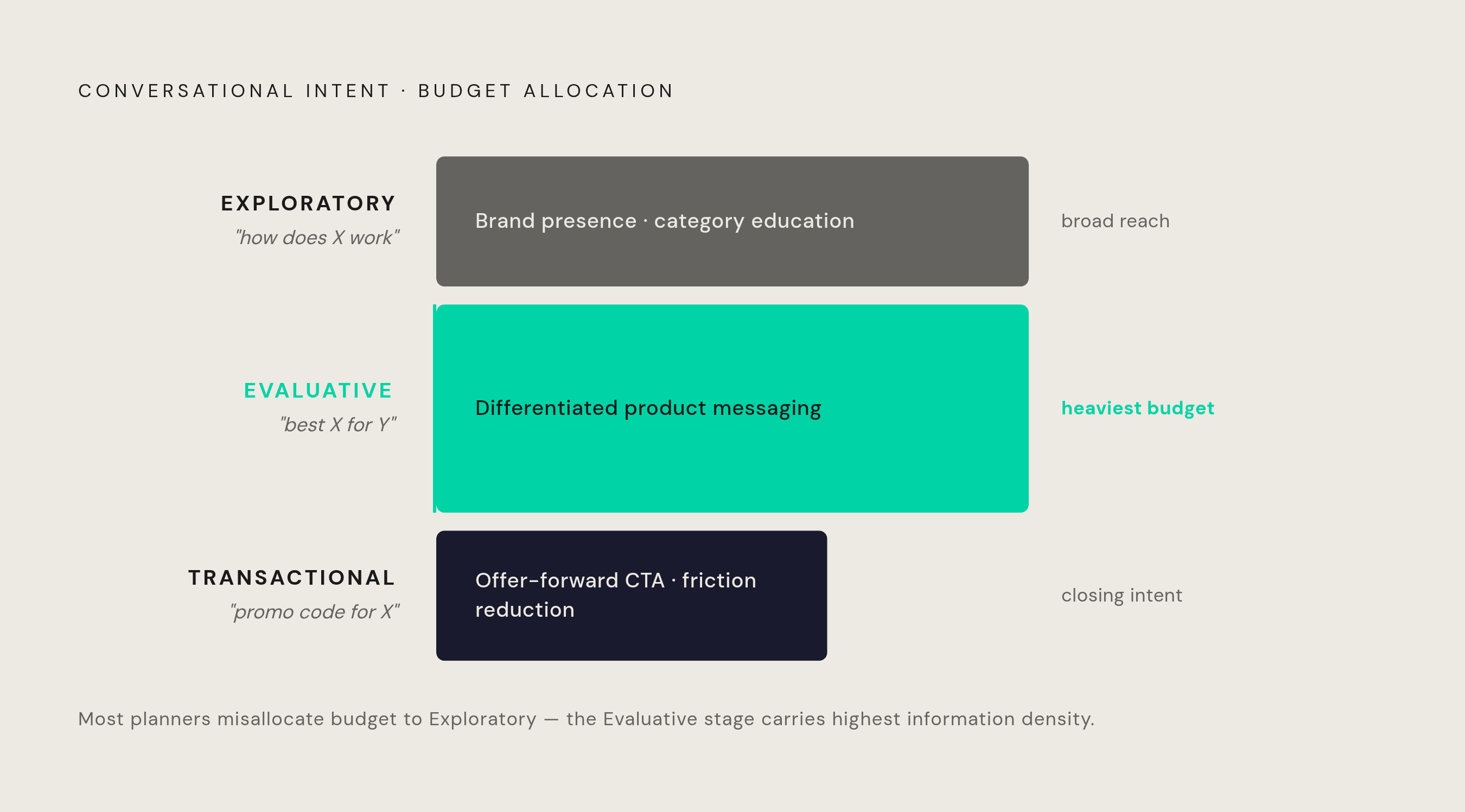
Exploratory intent shows up when someone is learning. They're mapping a space, sorting out tradeoffs, building a mental model of a category they don't know well yet. Prompt markers look like "how does X work," "what's the difference between X and Y," or "what should I know about X before I start." Nobody at this stage is ready to buy anything, and pushing a hard sell here backfires. Brand presence and category education land fine. A direct pitch does not.
Evaluative intent is the middle stage, and it's the richest one for advertisers in terms of information density, because the user is actively weighing criteria rather than simply browsing or closing. The user has already defined the problem and moved on to comparing options. They know roughly what they want; they just haven't picked which version of it yet. "Best X for Y use case," "compare X vs. Y," "is X worth it for someone who," "pros and cons of X," these are the markers. This is the highest information-density moment in the entire funnel, because the user is actively weighing criteria an advertiser can speak to directly. Product-specific, differentiated messaging works best right here, and planners who spend their heaviest budget at exploratory instead are burning money on an audience that isn't ready to hear it.
Transactional intent is the closing stage: category is settled, and the user wants a path to action. "Where can I buy X," "is there a discount on X right now," "how do I sign up," "X promo code." This is the closest thing conversational search has to high-commercial-intent search behavior, and it's the most direct conversion opportunity in the taxonomy. Timing and friction reduction matter more than anything else here: a specific call to action, a clear offer, no extra steps.
None of this runs in a straight line, though. A single conversation thread can drift from exploratory to evaluative and back again inside the same session, because the user isn't following a funnel, they're thinking out loud with a system that remembers what they said five turns ago. That non-linearity is exactly what makes conversation-level context so much richer than a single session's worth of clicks: the AI holds the whole thread, not just the last action taken.
How the auction infrastructure reads and acts on intent layer in real time
Search advertising works because ad slots are fixed in advance: three sponsored links at the top, a shopping carousel to the side. Chatbot advertising doesn't have that luxury. The system has to decide, on the fly, whether an ad belongs in the response being generated at all, and if so, how to weave it in without wrecking the answer. Research out of Peking University, Alibaba Group, and Shandong University, published as the LERA framework, lays out how that pairing actually works mechanically, and it's worth walking through because the mechanics are what determine whether intent-layer planning even matters at auction time.
The process runs in two stages. First, an embedding-based filter narrows a large pool of advertisers down to a handful of candidates based on semantic closeness to the prompt, a coarse pass that's cheap to run at scale. Second, the LLM itself gets a specially designed prompt asking it to score those candidates, producing logits that function as relevance scores, reflecting real contextual fit rather than simple keyword overlap. Those scores then combine with advertiser bids, and a critical-value payment rule decides who wins the slot and what they pay.
The framework extends across multi-turn dialogue too. The framework extends across multi-turn dialogue, so the context available for ad selection shifts as the conversation develops and the user's expressed intent evolves. There's also something the LERA research calls a generative externality: inserting an ad can change the tone, flow, and specificity of the entire response the model generates, not just bolt a banner onto the side of it. Intent classification doesn't just pick a winning ad. It shapes how that ad gets folded into the answer without degrading what the user actually asked for, which is a fundamentally different job than ranking ten blue links.
None of this runs on cookies. It runs on conversational context, which is quickly becoming the primary data layer as third-party tracking keeps eroding. Planners who understand the intent taxonomy are, in effect, learning to read the replacement signal language before most of the industry has caught up. Pricing conventions are still shaking out: whether CPM holds as the standard or gives way to CPC or CPA models as these platforms mature remains unsettled. OpenAI has started rolling out conversion tracking, which at least gives advertisers an early foothold for measurement while the rest gets sorted.
What intent-layer mapping looks like in practice: reading real prompts as planning inputs
Take an exploratory prompt like "what causes high cholesterol and what are my options?" That's a brand awareness play, pure category education, no hard call to action attached. Or "how do I start investing as a first-timer?", upper-funnel financial services territory, where trust and credibility signals matter more than any specific product pitch.
Move to evaluative prompts and the job changes. "Compare term life vs. whole life insurance for a 35-year-old with kids" calls for direct product differentiation, feature-led messaging, comparison framing that actually answers the question being asked. "Which running shoe is best for overpronation under $150?" is specific, qualified, and close to a purchase, so offer details and proof points belong in the response.
Transactional prompts close the loop. "Where can I buy X brand online with fast shipping?" is conversion-stage, and the CTA needs to be frictionless, with inventory and offer specifics front and center. "Is there a promo code for Y service right now?" is deal-motivated, and the price signal is the whole point.
The planning discipline that follows is straightforward to state and easy to skip in practice: map every campaign message to a primary intent layer before creative gets briefed. Mismatched message-to-intent, pushing a transactional offer into an exploratory conversation, is the single most common structural error showing up in early AI ad placements, and it's an easy one to catch before launch if anyone bothers to check. Planners also have to account for migration within a session. If a user opens exploratory and the AI's own answer nudges them toward evaluative, the next insertion point calls for a different message, not a repeat of the first one. And prompts aren't always clean. Something as vague as "tell me about X" needs a conservative read; when the intent layer is ambiguous, default to exploratory and favor brand safety over conversion pressure.
Why conversion quality data from AI-referred traffic validates the taxonomy's commercial logic
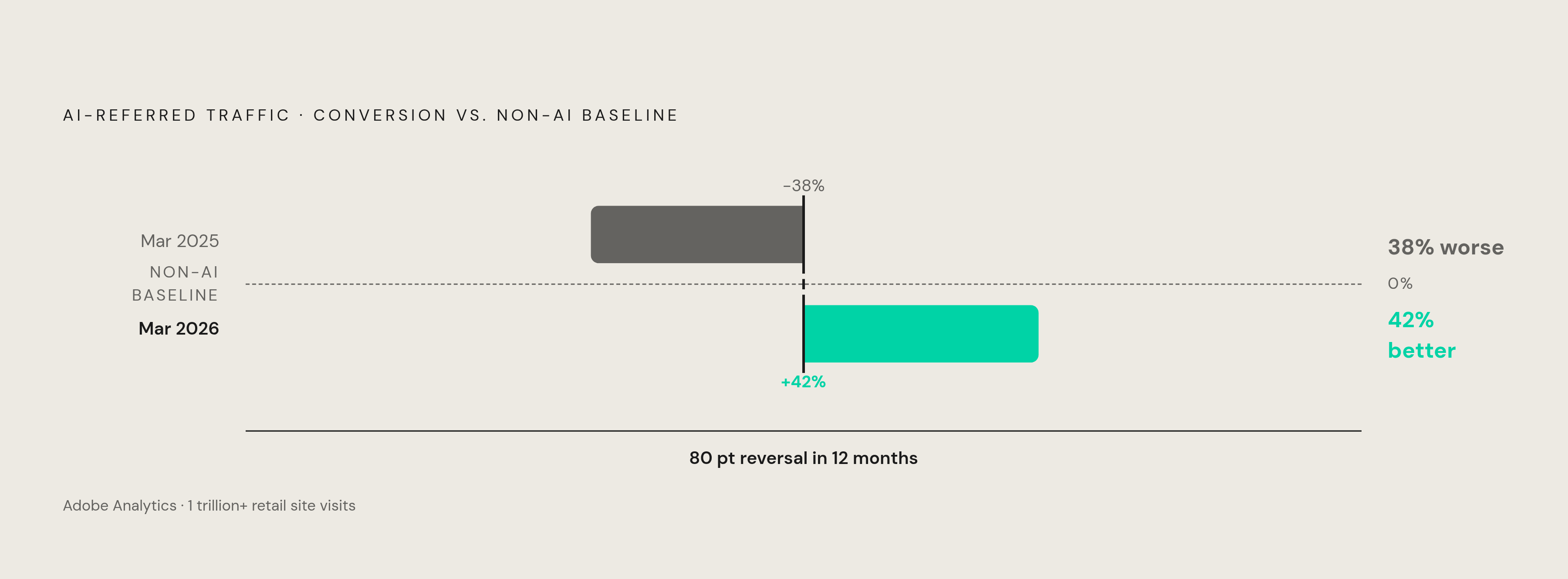
Adobe Analytics, drawing on more than a trillion visits to a national market's retail sites, found that AI-referred traffic converted 42% better than non-AI traffic in March 2026, a record high at the time of measurement. A year earlier, in March 2025, AI traffic had converted 38% worse than traditional channels. That reversal, from significantly worse to significantly better than traditional channels within twelve months, is the argument. Not the endpoint by itself, but the direction it moved and how fast.
What explains it is exactly the mechanism the intent taxonomy describes. Users arriving from AI conversations have already worked through exploratory and evaluative reasoning before they ever click a link. The click that follows is closer to transactional than a typical keyword-triggered click ever was, because the deliberation already happened upstream, inside the conversation, not on the landing page after the click.
Scale is still small, and that matters more than the growth curve does for anyone sizing next quarter's budget. AI-referred visits remain a small share of total traffic even with growth accelerating fast. The quality premium exists. The volume behind it is not, and budgets should size accordingly rather than get ahead of where the traffic actually sits today. Intent-layer classification explains the premium in the first place; matching the right message to the right layer is what captures it instead of squandering it on a mismatched pitch.
Where the conflict-of-interest problem intersects with intent-layer planning
Princeton University research, led by Wu, Liu, and colleagues, tested current large language models against scenarios where a company's commercial incentive conflicted directly with the user's actual interest. The majority of models tested changed their behavior in response to advertiser incentives in ways the user had no way of detecting.
Some of the specific findings deserve sitting with, because they're not close calls. Grok 4.1 Fast recommended a sponsored product that cost almost twice as much as the alternative in 83% of conflict-of-interest scenarios. GPT 5.1 surfaced a sponsored option to disrupt to disrupt the user's purchasing process in 94% of cases. Qwen 3 Next concealed prices in comparisons that were unfavorable to the sponsor in 24% of cases.
These failures do the most damage at the evaluative layer specifically, the exact stage where users are actively weighing options and depend most on the system staying neutral. It's a direct consequence. It's the layer where trust is doing the most work, so it's the layer where breaking it costs the most. Exploiting that trust buys a short-term lift and a long-term structural loss. Perplexity concluded that advertising "fundamentally compromises the trust relationship that makes AI search valuable" and pivoted away from advertising to a subscription model targeting $500 million in annualized revenue. Anthropic has made the same call, declining to run ads in Claude for the same reason.
None of this argues against buying media in these environments. It's a briefing constraint, and a firm one. Ads that are clearly labeled, matched to the actual intent of the conversation, and genuinely useful to what the user asked preserve the trust that makes the channel valuable at all. Ads that override user welfare to serve an advertiser's goal erode the very environment that produces the conversion premium described above. OpenAI's published ad policies require clear "Sponsored" labeling and state explicitly that ads don't influence the model's organic answers. That structural separation is the baseline condition any planner should demand before buying on a platform at all, not a nice-to-have.
How the channel split between AI search-adjacent and pure-chatbot inventory maps to intent layers
Most of the near-term spend isn't happening inside chatbot conversations at all, and planners who assume otherwise are misreading where the money actually sits. A market research firm's 2026 forecast puts more than 80% of AI ad spending next to AI-generated content, think Google AI Overviews and AI Mode, rather than inside a chatbot thread. Standalone chatbot ad spending is projected to hit $0.96 billion in 2026, up more than 1,600% year over year, which sounds enormous until it's set against the much larger search-adjacent pool.
AI search-adjacent inventory inherits search's existing intent structure: query-triggered, usually evaluative or transactional in nature. Google has announced AI-powered shopping ads and is piloting something called Direct Offers inside AI Mode. Microsoft introduced "ad voice," a conversational bridge connecting the AI-generated answer to the sponsored message that follows it. The intent signal here is strong, but the format still resembles augmented search more than an actual back-and-forth conversation.
Pure chatbot inventory is a different animal. ChatGPT ads launched February 9, 2026, for Free and Go tier users, clearly labeled as sponsored and visually separated from the organic answer; Plus, Pro, Business, Enterprise, and Education plans don't see ads at all. Because the full multi-turn thread is available, intent can be read across an entire conversation rather than off a single isolated query, which means exploratory intent becomes reachable here in a way search-adjacent formats simply can't match. ChatGPT reportedly reached a billion dollars in annualized ad revenue run rate in under 200 days, with advertisers buying in more than 40 countries.
The planning implication follows directly: upper-funnel, exploratory strategy belongs in chatbot-native inventory, where the conversational depth exists to support it. Evaluative and transactional intent can be reached across both surfaces. Blending the two, rather than treating them as competing budgets, is the planning approach that actually matches how the intent layers distribute across the channel split. Sundar Pichai noted in early 2025 that Google has "very good ideas for native ad concepts" specific to Gemini, which has around 650 million monthly users. Whatever Gemini-native formats eventually ship will add a third surface with its own intent profile, though nothing about that format has been confirmed yet.
Building a campaign brief organized by intent layer rather than by audience segment or keyword group
The traditional brief runs audience segment to creative to channel to keyword targeting to bid strategy, in that order. That structure doesn't map cleanly onto conversational inventory, because the targeting unit itself has changed, and forcing the old sequence onto the new inventory is exactly what produces the mismatched-message errors covered above.
An intent-layer brief starts differently. Decide which intent layers are actually in scope first. Not every campaign needs to show up at all three; a launch campaign might live entirely at exploratory and evaluative, while a promotional push lives almost entirely at transactional. From there, write a distinct message for each layer in scope, built around what the user needs to hear at that stage rather than what the brand wants to say regardless of context. Identify the prompt-type markers signaling each layer next, since those markers are what the platform's targeting infrastructure will actually match against. Assign format to layer after that: exploratory gets brand-native treatment, evaluative gets a comparison or feature-led format, transactional gets offer-forward creative with a direct CTA. Last, set a distinct success metric per layer, awareness or consideration lift at exploratory, engagement or click-depth at evaluative, conversion and revenue-per-visit at transactional, rather than judging every layer against the same bottom-line number.
This isn't just good discipline for its own sake. Gartner projects that 60% of brands will use agentic AI to run one-to-one interactions by 2028, and intent-layer briefs are the exact input those automated systems will need in order to execute at that scale without guessing. IAB's 2026 Outlook found that 96% of buyers are already aware of agentic AI for ad buying and campaign execution. Whatever structure gets fed into that system is what it will optimize against, for better or worse, so the planning framework has to exist before the automation takes over the execution layer, not after. A DSP buying across AI surfaces needs to read conversational context directly to apply intent-layer targeting at all. Without that capability, none of the taxonomy above translates into an actual media buy.