DSP and SSP platforms built for AI and LLM advertising inventory
Legacy ad infrastructure can't handle prompts as the actual unit of targeting and sale.

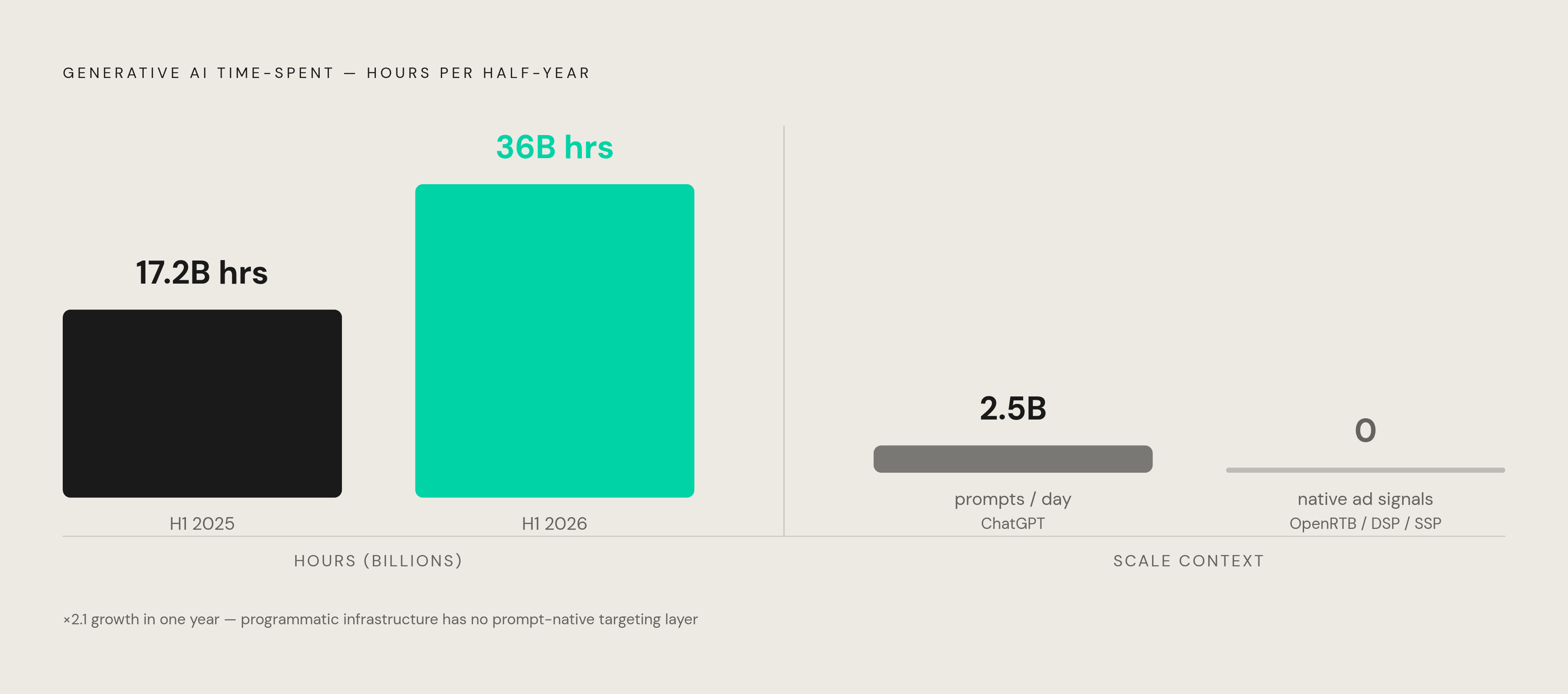
Global time spent inside generative AI apps is set to hit 36 billion hours in the first half of 2026, up from 17.2 billion hours a year earlier. That growth is a new media channel forming in real time, and the DSP and SSP infrastructure built over the last fifteen years has no native way to sell into it. The pipes were built for pages, cookies, and fixed ad slots. Conversational AI has none of those things, and the current retrofitting effort, bolting chatbot inventory onto OpenRTB, faces fundamental limits, because the protocol was never built to carry what a prompt actually is.
ChatGPT users now spend around 215 minutes a month inside the app, Gemini users about 100, Claude users about 120. That's substantial engagement depth, not a novelty search box. With roughly 2.5 billion prompts submitted to ChatGPT every day, the surface is already throwing off ad-relevant signal at a scale most publishers would kill for, and the current programmatic stack has no native way to handle a prompt.
What legacy DSPs and SSPs were actually built to do
A DSP buys ad space programmatically across publishers and exchanges. It takes advertiser criteria, cross-references audience data, and bids in real time for impressions that match. An SSP sits on the other side, aggregating publisher inventory and running auctions designed to get the highest price per impression across as many demand sources as possible.
The handshake between them is mechanical, and by now almost boring in its familiarity. A user loads a page, the SSP fires an ad request to an exchange, DSPs bid against each other in milliseconds, and the winning creative drops into a slot defined before the user ever showed up. That last part matters: the slot exists first. The auction just decides who fills it.
Every piece of targeting logic assumes that structure. Page URLs and on-page keywords tell the system what content category it's dealing with. Cookies, device IDs, and third-party audience segments tell it who the user probably is. Ad formats, banner, pre-roll, interstitial, get locked in advance. Brand safety works by blocking domains and URLs at crawl time, a decision made about a page long before any specific user sees it. Measurement counts impressions, tracks clicks, and attributes conversions back through a rendered ad unit.
None of that survives contact with a generative response. There's no page, no slot, no URL to crawl or block. The entire apparatus assumes a fixed container that conversational AI simply does not produce, and no amount of clever routing changes that.
The new targeting primitive: conversation intent rather than page context or user profile
Inside a chatbot, the only signal that matters is the prompt itself, the actual words a person types when they're actively trying to solve something. That's a categorically different object than a keyword or a segment. A keyword matches a string. An audience segment is a probabilistic guess built from past behavior. A prompt is a live declaration of present need, often with reasoning attached: someone typing "best waterproof hiking boots for wide feet under $150" has told an advertiser more in one sentence than a decade of cookie-based inference ever could.
Academic work on auction design for conversational-agent advertising has framed the point directly: the auction problem in chatbot advertising cannot be separated from the language understanding problem. Deciding which ad is relevant and understanding what the conversation actually means are the same task, not two tasks stacked on top of each other. A DSP that can't parse the semantics of a live dialogue has no input for the one variable that determines relevance in this channel, the variable the whole business depends on.
That's a structural gap, not a feature gap, and it's worth being blunt about which side of the industry is further behind on closing it. Generalist DSPs built around keyword and segment matching have no slot in their architecture for "the meaning of this conversation," because nothing in their history required one. Closing it means the SSP side has to expose prompt-level context to the exchange in a form bidders can actually use, and OpenRTB, the specification most of the industry still runs on, was built for display and video inventory bid requests, not that kind of payload. Extending OpenRTB with a few new fields will not fix this. The bid request itself has to change shape.
The auction mechanics problem: bidding inside a generative response stream
Standard real-time bidding resolves before anything renders. The ad drops into a pre-existing position, and the page around it doesn't change because of that decision. An LLM response works the other way around: the auction has to resolve during, or immediately before, the generation of text that will carry the ad. There's no legacy equivalent for that timing problem, and it isn't a small one.
Researchers studying LLM ad auctions have described this as a "generative externality." Insert an ad into a response and you don't just add a line, you change the flow, tone, length, and specificity of the entire generated answer. The ad isn't placed into a container, it's woven into a narrative the model is composing on the fly. That changes what the auction is actually optimizing for.
Three parties have stakes in the outcome, and legacy auction design was only ever built to balance two of them. Advertisers want clicks and return on spend. The platform wants revenue without losing users. Historically, those were the only variables in the equation. Conversational advertising adds a third: the user, who values a coherent, genuinely useful answer, and who will simply stop using the assistant if that quality erodes. Response quality sits outside the set of variables RTB was designed to handle, and it has to be built in from the start here, not bolted on once the platform notices users leaving.
Researchers have proposed frameworks that evaluate relevance across candidate ads and combine those scores with bids under payment rules designed to stay truthful for advertisers, extending to multiple ad insertions across a long, multi-turn dialogue. Whether or not that specific framework wins out, the shape of the problem is fixed: a bid request in this environment can't just carry a slot size and a segment ID anymore. It has to carry enough conversational context for the bidder to judge relevance on the fly.
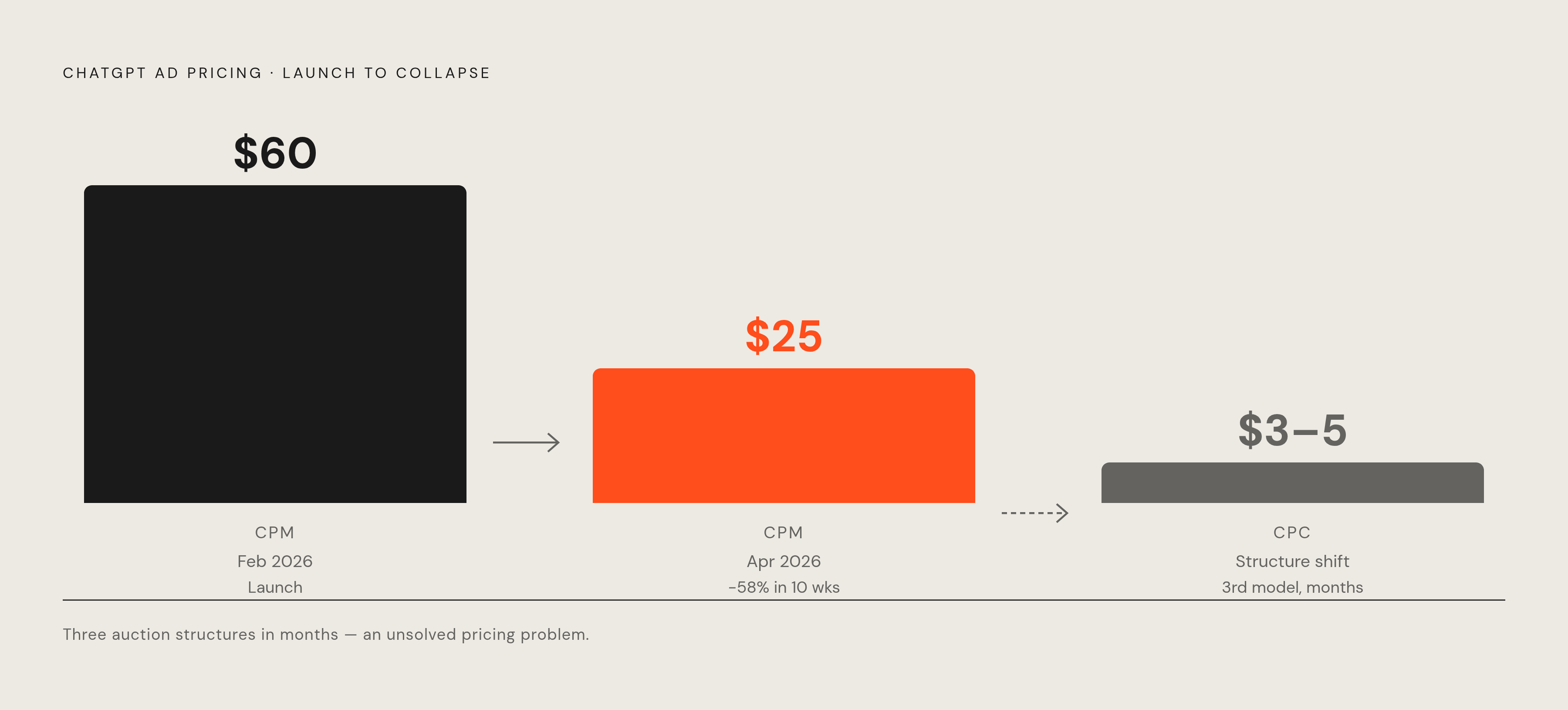
How unsettled the pricing side remains is visible in OpenAI's own record. Ads inside ChatGPT launched at a $60 CPM in February 2026, eroded to as low as $25 CPM within ten weeks, then shifted again to cost-per-click pricing in the $3 to $5 range. Three different auction structures in a matter of months is not iteration, it's a company that hasn't figured out how to price attention that doesn't behave like a page view. There's no evidence yet that anyone else has either.
What the SSP layer must rebuild for conversational inventory
A conventional SSP aggregates inventory, runs yield optimization, connects to exchanges, enforces price floors, and screens for ad quality. Every one of those jobs assumes something the conversational surface does not have.
Inventory itself is no longer a slot with fixed dimensions. It's a position inside a response generated fresh with every query, varying in length and structure depending on what was asked and how the conversation has unfolded so far. Yield optimization built around CPM floors breaks down when the value of a placement depends entirely on the intent expressed in that specific prompt, which shifts from one exchange to the next. Ad quality control can't run on a blocklist of URLs when there's no URL, only a live evaluation of whether a given ad fits coherently inside a specific generated answer.
Some of the industry's early moves show how much retrofitting is happening in place of native design. Partnerships bringing chatbot inventory into the programmatic ecosystem through an SSP, routed through the existing OpenRTB protocol, mark a genuine first step. They're also a workaround, closer to fitting a new engine into an old chassis than building the car from scratch. It'll get supply moving in the short term. It won't hold up once volume scales, and anyone treating it as the long-term architecture is going to have to rebuild twice.
The IAB Tech Lab's decision to stand up an AI Content Monetization Protocols working group in August 2025 (formerly known under a different working name tied to LLM content ingestion) is itself an admission that no adequate standard exists yet for publishers to expose AI-generated content, including any ad placements inside it, to the wider programmatic ecosystem. Meanwhile the supply problem isn't staying still: industry surveys point to near-universal business intent to use AI in customer communications. Publisher referral traffic is already shrinking as AI experiences intercept queries that used to land on a website, and the conversational surface is growing faster than the monetization layer underneath it.
How brand safety and ad quality controls work differently when there is no page to crawl
Brand safety in display advertising is fundamentally a pre-screening exercise. Crawlers categorize a page before an ad ever serves against it, and DSPs apply domain and URL blocklists at bid time based on that categorization. In a generative environment, that page doesn't exist until the model writes it, in direct response to whatever the user just asked, at the exact moment of the conversation. There's nothing to crawl in advance.
So safety has to move from pre-auction classification to real-time evaluation of the response itself. Content around an ad can't be pre-screened because it doesn't exist yet. A dialogue that starts in safe territory can drift in tone six exchanges later. An ad appropriate for one prompt can be flatly wrong for a nearly identical one asked five minutes earlier, depending on where the conversation went in between.
Perplexity's pullback from advertising is a useful data point here, and it should settle an argument the industry keeps having politely. Ads risked eroding trust in AI-generated answers, and sponsored content sitting near an AI response makes the whole answer feel bought, even with clear labeling, precisely because answer quality is the product being sold. Anthropic took the opposite position, keeping Claude ad-free, and saw an 11% increase in daily active users following a Super Bowl campaign that went after ChatGPT's move into advertising directly. Anthropic is betting that trust in response integrity sells more subscriptions than an ad slot ever would, and on the numbers so far, that bet is paying off. Trust in response integrity is a competitive weapon here, not a compliance checkbox, and platforms treating it as the latter are going to lose users to the ones that don't.
Building safety infrastructure for this environment means real-time semantic evaluation of the generated response, coherence checks that catch when an ad format is disrupting an answer badly enough to damage trust, and transparency labeling built into the response itself rather than bolted on like a banner-era "Ad" tag. OpenAI's early technology partnerships, including ones with Adobe, Kargo, and Criteo as an initial technology partner, suggest that brand safety and format coherence are, for now, being solved through careful partner selection almost as much as through platform-level tooling. That's a reasonable early strategy, and it's also an admission that the underlying tooling hasn't matured yet. Partner selection is not a substitute for infrastructure.
The measurement gap: what attribution looks like when there is no click path to follow
Standard attribution is a chain: impression served, click recorded, landing page loaded, conversion logged, credit assigned back to the campaign. Conversational AI breaks that chain in more than one place at once.
A user can act on a recommendation without clicking anything at all, carrying the information from the conversation into a separate search or a direct purchase somewhere else entirely. There's no landing page referral to track, because the assistant is mediating the interaction, not gatekeeping it through a traceable URL. In a multi-turn conversation, the moment the "impression" happened may sit several exchanges before the moment the user actually decided to act.
OpenAI's move from CPM to cost-per-click pricing, landing in that $3 to $5 range, is a pragmatic response to this problem, not a fix for it. If view-through outcomes can't be attributed reliably, price against the one action that can still be observed: the click. Everyone pricing this way knows it's a workaround, not an answer.
Some measurement tooling is starting to point toward where this has to go. Viant's ViantAI suite includes an automated measurement and analysis layer alongside automated decisioning meant to optimize campaigns in real time. Measurement needs to become automated and conversational in its own right, folded directly into the bidding loop instead of sitting downstream as a reporting exercise that happens after the campaign is already over.
What remains genuinely unresolved is harder to wave away. Assisted conversions, where an AI conversation shaped a decision but left no trackable signal behind. Cross-surface attribution, when someone sees an ad inside ChatGPT and converts somewhere else entirely. Incrementality testing in an environment where holding out a clean control group risks degrading the very experience being tested. Measurement is the least developed layer of this entire stack right now, and it isn't close. The fix will not be an adaptation of last-click or view-through models, whatever vendors selling "AI-enhanced attribution" are currently claiming. It has to be built from scratch for a channel with no click path at all, and nobody has shipped that yet.
The platforms building AI-native infrastructure now, and what choices they are making
A handful of platforms are already placing bets on what this infrastructure should look like, and the bets differ in ways worth paying attention to, because not all of them are betting on the same time horizon.
PubMatic launched what it calls AgenticOS on January 5, 2026, an agent-to-agent advertising operating system where advertisers set goals, guardrails, brand-safety requirements, and creative parameters through their preferred LLM interface, and coordinated agents handle planning, execution, and optimization inside those boundaries. It's an SSP-side wager that agentic infrastructure, not manual campaign management, becomes the default way advertisers interact with the buying process at all.
Viant Technology has built out its ViantAI suite across four pieces: AI Planning for campaign design, AI Bidding for automated bid adjustments aimed at lowering effective CPMs, AI Measurement and Analysis through a chat interface, and AI Decisioning for autonomous real-time execution. That suite underpins Outcomes, described as Viant's first fully autonomous advertising product. The bet here runs differently than PubMatic's: apply AI-driven decisioning on top of the programmatic pipes that already exist, rather than replace the underlying plumbing. It's the more conservative bet of the two. This is a different theory about how fast the old pipes can be repurposed, one that may turn out to be more durable if conversational volume takes longer to materialize than the AI-native pitch decks assume.
Yahoo's DSP has taken a more open architectural stance, letting buyers bring their own agents, use Yahoo's native agents, or combine both in custom agent-to-agent flows. That's a bet against locking advertisers into a single agent stack, which matters given how early and how fragmented agentic tooling still is.
Demand-side momentum is showing up independent of any single DSP, too. MiQ has built a trading agent called Sigma, NBCUniversal has started selling media through AI agents, and Omnicom has confirmed it's running live agentic media buying using agent-to-agent infrastructure. None of that adoption waited for the DSP layer to fully mature, which says something about how much pressure is building on the buy side.
On the supply side, one approach monetizes through sponsored prompts embedded directly inside AI conversations, on-site, while separately licensing content off-site, and extends inventory across publisher networks through identity partnerships. It's a distinct model from the exchange-based supply approach used by another vendor, and it reflects how unsettled the supply-side playbook still is.
Some platforms fall into this same category of infrastructure built specifically for this problem rather than adapted from display, running both a DSP and their own SSP with direct AI publisher supply, which means their bidding systems have built-in access to prompt-level signal that single-surface ad networks and generalist buying platforms, built around keywords and cookies, simply cannot read at any meaningful scale. That structural access, demand and supply operated together rather than bolted on after the fact, is close to what this channel actually requires: a targeting layer that understands conversation as the unit of relevance, not the page.
None of these approaches has settled into an industry standard yet, and none of the underlying protocols, whether OpenRTB extensions or entirely new specifications from bodies like the IAB Tech Lab, have caught up to what conversational inventory actually demands. Patched-together solutions bolted onto fifteen-year-old programmatic pipes will not carry this channel much further, no matter how many partnerships paper over the gaps in the short term. The infrastructure has to be rebuilt from the targeting layer up, and the platforms doing that rebuilding now, not the ones retrofitting OpenRTB and calling it done, are the ones that will define how this entire category works once it settles.
Sources
- Agentic AI in Advertising: A 2026 Field Guide (Media Buying & AdOps) — AdTech Lab Research | TensorOps
- What Is LLM Advertising? The New Ad Layer for AI-Powered Search | GenDiscover
- Signals of Safety: Brand Integrity for the AI-Driven World
- The New Realities of Brand Safety in 2026
- verve.com
- arxiv.org
- segwise.ai