Cost Per Acquisition Benchmarks for AI Chat Ad Campaigns
ChatGPT ads measure ROI differently than search or social do.
Cost per acquisition in AI chat advertising cannot be read the way marketers read it on Meta or Google, because the mechanism that produces a conversion is built differently at nearly every stage. This piece lays out what CPA actually measures inside ChatGPT Ads, how the platform's bidding infrastructure got to its current state in 2026, what the cost and conversion data honestly supports, and why you need a different frame than the one you already carry from performance marketing.
What CPA measures in an AI chat context, and why it does not transfer cleanly from search or social
Cost per acquisition is supposed to answer a simple question: how much did it cost to turn attention into a customer. On search, that ratio is built on keyword-level intent meeting a click. Someone types "best running shoes," an advertiser bids on that phrase, and the resulting cost per click rolls up into a cost per acquisition once a share of those clicks convert. On social platforms, the input is different but just as concrete: a behavioral profile, built from past likes, follows, and purchase signals, gets matched to a scroll, and CPA reflects how well that targeting predicted a buyer.
Neither of those inputs exists inside a ChatGPT conversation. There is no keyword being bid on, because the user isn't typing a query into a search box. There is no behavioral profile being matched, because the ad isn't interrupting a feed built from months of tracked behavior. What exists instead is the live conversation itself: the actual words a user is exchanging with the assistant, read in real time. In ChatGPT Ads, the advertiser's main lever is what's called a context hint, a freeform, natural-language description, capped at 280 characters, of the kinds of conversations where the ad belongs. That hint gets matched against the live dialogue through a relevance-weighted, second-price auction, not a keyword list, not a demographic filter, not a cookie.
The auction works on a familiar principle, but applies it to unfamiliar material. It reads the context hint, the ad's title and copy, and the landing page together, and a more contextually relevant ad on a lower bid can beat a higher bid that fits the conversation less well. That's the same relevance-over-raw-bid logic that defined Google's first decade of search advertising, now applied to the content of a conversation instead of the text of a query.
Placement changes what a click even means. A ChatGPT ad shows up as one or more sponsored placements after the assistant has already delivered its complete answer, clearly labeled "Sponsored" and visually set apart from the response above it. The user has already gotten what they came for before the ad appears, so clicking it is a choice made after satisfaction, not a redirect away from an unfinished task the way a search result or a feed interruption often is.
That sequencing also makes attribution harder to pin down than marketers are used to. Academic research into AI brand recommendations has found that direct click-through from inside an AI response accounts for only a small share of the visits that follow, with the much larger share coming later: the brand gets named inside the answer, and the user converts afterward through a plain search or a direct visit, outside any click window a pixel can register. If you measure CPA last-click, the way search and social campaigns do, you will undercount the influence ChatGPT ads actually have. If a marketer reads a raw CPA number out of ChatGPT Ads without accounting for that delayed path, they will misjudge the channel's real economics, often concluding it performs worse than it does.
How ChatGPT Ads' bidding infrastructure evolved in 2026, and what the current stack supports
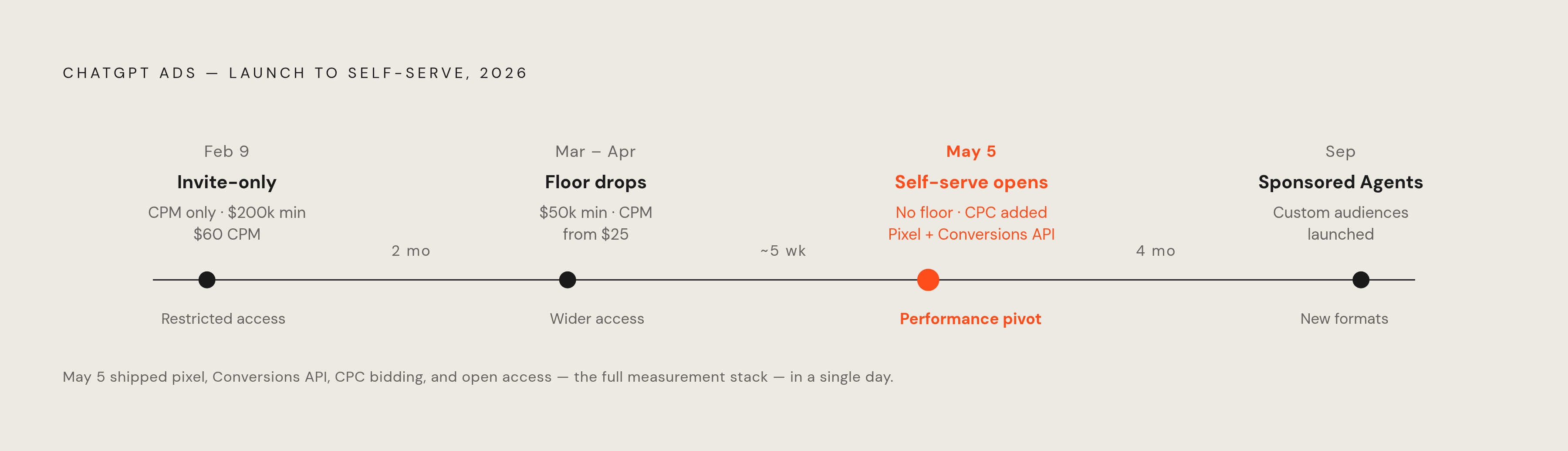
OpenAI spent years saying advertising would never appear inside ChatGPT, then launched ads on February 9, 2026, as a managed buy: invitation-only, CPM-only, with a $200,000 minimum spend, serving ads only to Free and ChatGPT Go tier users. Plus, Pro, Business, and Enterprise subscribers saw no ads, which told advertisers that OpenAI was testing the model carefully before opening it up.
The opening happened fast. Through March and April 2026, the minimum spend dropped to $50,000 as OpenAI scaled up inventory, and CPMs fell as low as $25 in some pilot categories, down from the $60 launch price. On May 5, 2026, OpenAI removed the spend floor. A self-serve Ads Manager opened to every US business that day, and alongside it OpenAI shipped the measurement tools that make performance bidding possible at all: CPC bidding next to the existing CPM option, a JavaScript pixel, and a server-side Conversions API, all in the same release. Four months in, the platform had moved from a closed, CPM-only pilot to an open, self-serve system, and it now gave performance marketers the measurement backbone they expect.
By September 2026, the platform moved further into format territory with Sponsored Agents, which let a user chat directly with a brand's sponsored agent after clicking an ad rather than simply landing on a webpage. OpenAI also announced a custom audience feature built on email addresses, phone numbers, hashed emails, and Google Advertising IDs, reported by AdExchanger. Neither development is the center of this story, but both point toward a platform building out audience and engagement tools well beyond where it started in February.
The pixel-plus-Conversions-API setup will look familiar to anyone who has run a Meta campaign: a client-side pixel and a server-side API work together, linked by shared event IDs so the same conversion doesn't get counted twice. That architectural choice matters, because it signals that OpenAI built its measurement stack to slot into workflows marketers already know, instead of asking advertisers to learn something foreign.
What it doesn't yet have is time. Google launched Smart Bidding in 2016, and its algorithms now draw on a decade of auction-time signals, including device, location, time of day, remarketing list membership, browser, language, and operating system, across every campaign type Google runs. ChatGPT's conversion-tracking infrastructure went live on May 5, 2026, and CPA bidding opened to advertisers about 33 days after that. The algorithm behind ChatGPT's CPA bids has had weeks of conversion data to learn from, not years. Targeting on the platform is also contextual only: it matches what's being discussed in a given conversation, producing no cross-session behavioral history and no third-party verification layer to draw on. The kind of optimization quality that builds up over years of accumulated conversion data on Meta or Google simply hasn't had time to compound here yet.
What the available cost and conversion data from ChatGPT Ads shows
The cost figures available for ChatGPT Ads are directional rather than settled. CPM and CPC ranges have enough reporting behind them that you can treat them as reasonably solid, but CPA figures remain thin, so read them as early signals about where the channel might land, not as category benchmarks you can build a budget around yet.
CPM launched at $60 in February 2026, and by mid-2026 the range runs $25 to $60, with competitive categories sitting toward the top of that band and less contested categories clearing closer to $25. For comparison, LinkedIn's CPM runs around $39, and Meta's all-industry average is $14.19 in 2026. On a raw cost-per-thousand-impressions basis, ChatGPT is more expensive than Meta, though that comparison gets complicated fast once you consider what an impression actually represents in each case: one appears after a user has read a complete, personalized answer to their own question, and the other interrupts a scroll.
CPC varies by vertical. eCommerce and retail run $3 to $6, travel and education run $4 to $8, SaaS and software run $8 to $18, finance runs $15 to $25, and legal services run $12 to $20. If you bid below $3, you frequently fail to get impressions at all, so there's a delivery floor the algorithm enforces no matter how precisely you set up targeting.
The most useful signal on conversion quality so far comes from Criteo, which runs campaigns into ChatGPT Ads through its own API connection, and it reports AI-referred conversion rates now approaching roughly double those of traditional search, up from a smaller multiple earlier on. It's a meaningful data point, but it remains one vendor's findings from a single integration, not an industry-wide measurement, so you should weight it accordingly until more integrations report similar patterns.
One self-reported practitioner case offers a narrower, more concrete look: a 15-day campaign produced a blended ROAS of 1.49x at roughly $1.72 CPC, on about $60,000 in spend that generated about $89,000 in revenue, with a conversion rate around 2.35%. It's a single campaign result, not a category norm, so you should read it strictly as one data point among the few currently available.
A parallel data point from Microsoft adds useful context, even if it comes from a different product. BusySeed's 2026 analysis reports Microsoft's own data showing that search ads on Copilot deliver 69% stronger click-through rates and 76% higher conversion rates than traditional search ad placements, though Microsoft's own official research had cited smaller gaps of 73% higher CTR and 16% stronger conversion rates. Both sets of numbers point to multi-turn session context as the driver, the same mechanic that does the work inside ChatGPT's targeting system.
Legacy channel benchmarks in 2026, and why a direct CPA comparison misleads
Meta's 2026 CPA benchmarks give marketers a genuine reference point, built on a mature, heavily instrumented system, but those conversions get produced so differently from ChatGPT Ads that lining the two numbers up side by side leads you to the wrong conclusion more often than the right one.
RedClaw's Q1 2026 data, drawn from a managed portfolio of more than 200 accounts and over $50 million in spend, puts finance applications and sign-ups at a $65 median CPA, SaaS trial sign-ups at $85, eCommerce purchases at $28 (the one vertical in RedClaw's data showing a year-over-year decrease), local services leads at $12, and iGaming first deposits at $45, with the highest median ROAS in the entire portfolio at 8.5x. Ryze AI's broader data shows just how wide the spread gets across Meta as a whole, from roughly $8 in education up past $187 in legal services. "Meta CPA" isn't one number; it's a range stretched across verticals with very different buying cycles and margins, the same way "ChatGPT CPA" won't be one number once the channel has enough history behind it.
A direct comparison misleads because each number is built from a different kind of underlying system. Meta's CPA is the output of a decade of behavioral profile data, lookalike audience modeling, and conversion signals accumulated across billions of users, refined continuously by a Smart Bidding system that has been compounding its own learning for years. ChatGPT's CPA bidding, by contrast, has weeks of conversion data behind it. Setting those two figures next to each other treats them as though they came from equivalent systems, when one has had a decade to learn and the other has had a matter of weeks.
The attribution window compounds the problem. Meta's pixel catches most conversions inside a clean click-to-purchase window, because the user is already in a browsing context when the ad appears and the purchase tends to follow quickly. ChatGPT-influenced conversions often happen outside that window entirely: the user researches the purchase in conversation with the assistant, then converts later through an unrelated search or a direct visit to the brand's site. Meta CPA and ChatGPT CPA carry the same label, but they're measuring different things, and a media planner who treats them as interchangeable inputs to a budget allocation decision is going to misallocate spend based on a false equivalence.
Conversational intent and the buyer it produces
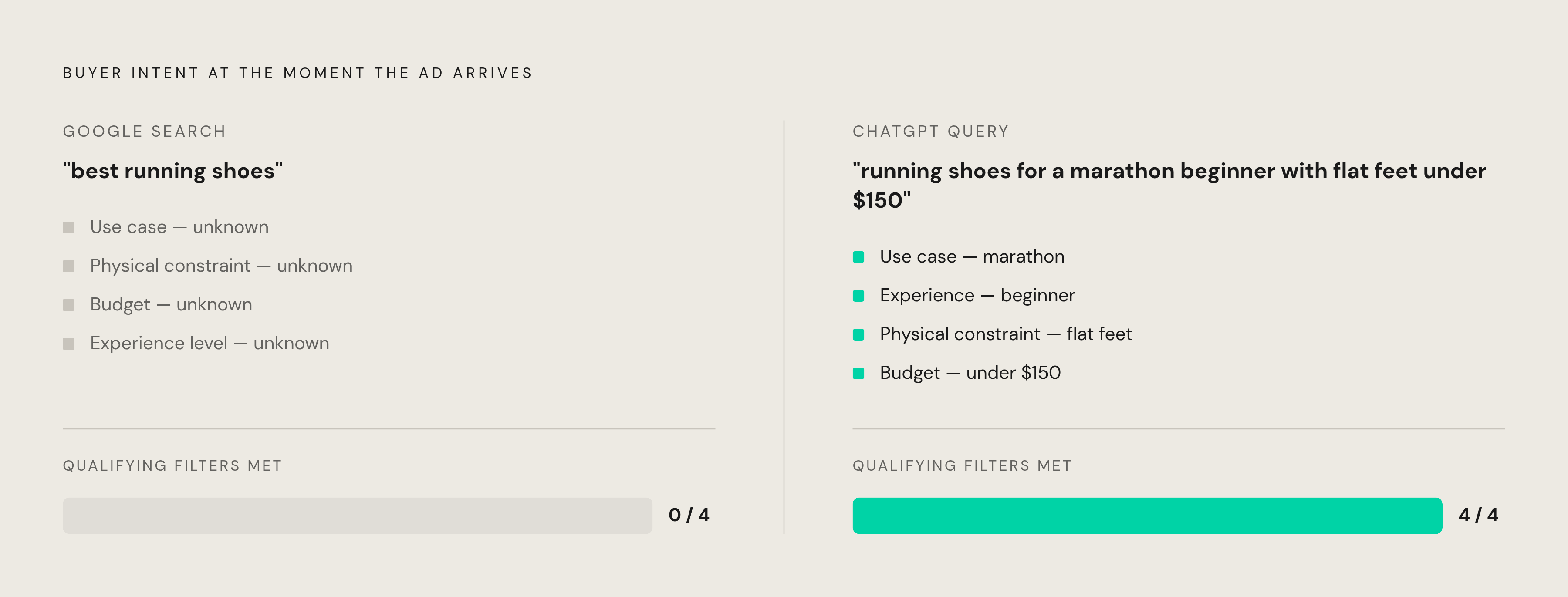
The conversion-rate advantage visible in early ChatGPT Ads data looks like a platform effect, but you should understand it as an intent effect. If a user asks an AI assistant a detailed, multi-turn question about a purchase, they have already moved further down the consideration funnel than a user who typed a few words into a search bar, before either one ever sees an ad.
The gap between those two users is easiest to see side by side. Someone who types "best running shoes" into Google is at the very top of a funnel, holding a category but little else. Someone who asks an AI assistant to "recommend running shoes for a marathon beginner with flat feet under $150" has already narrowed the category, filtered it by use case, applied a physical constraint, and set a budget, all in the process of asking the question. An ad served after that exchange is reaching a buyer who has done most of their own qualifying work already, at a moment far closer to a purchase decision than the equivalent search query would suggest.
Meetergo's analysis of B2B buyer behavior found that roughly half of B2B software buyers now use conversational AI tools somewhere in their research process before making a purchase decision, which places AI chat squarely inside the consideration stage of B2B buying cycles rather than at its edges. That matters for reading CPA honestly: a lower cost per acquisition, or a higher conversion rate, out of ChatGPT Ads doesn't necessarily mean the platform's auction or targeting system is outperforming Meta's or Google's on its own mechanical terms. It can just as easily mean the platform is reaching people later in their decision process, after they've already done the narrowing that a keyword or a behavioral profile can only approximate from the outside. Reading a ChatGPT CPA number without accounting for where in the funnel that conversation sat will produce a judgment about the channel's performance that has little to do with how the channel's advertising mechanics actually worked.
Sources
- webfx.com
- ChatGPT Ads Cost 2026: CPM, CPC & Budget Guide
- ChatGPT Ads Benchmarks: ROAS, CPC, and Cost From 15 Days of Real Spend
- Meta Ads Benchmarks 2026: CPM, CPC, CPA & CTR by Industry
- ChatGPT Ads CPA Bidding: Should You Shift Budget Now?
- Meta Ads Benchmarks 2026: CTR, CPC, CPA & ROAS by Industry (Real Data)