Real-Time Intent Data Applications in Programmatic AI Advertising
Advertisers can now target shoppers based on what they type into AI assistants.

Programmatic advertising is being rebuilt around a signal it has never had access to before: what a person actually types into an AI assistant while figuring out what to buy. That's a live prompt, shaped by the exact words the user typed in that moment. It's the live, in-progress narration of a need, and how that signal moves from prompt to auction to placement is the operational question the ad industry is working through right now.
Where conversational intent sits in the purchase journey and what that means for timing
Programmatic has always run on proxies. Keyword data tells you what someone typed. Behavioral data tells you what someone did last week or last month. Demographic data tells you who the system assumes someone is, based on a bucket they got sorted into somewhere upstream. Every one of these is an inference made after the fact, at a distance from the actual decision moment. None of them capture what advertisers actually want: what a person needs, right now, in their own words.
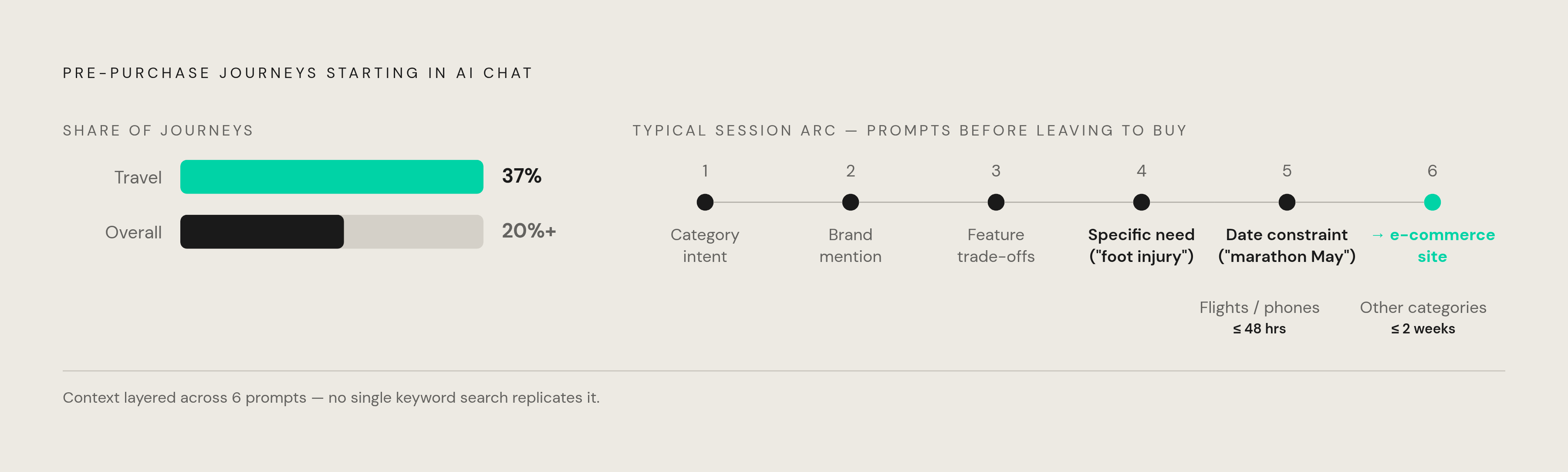
That's what makes conversational intent different in kind, not degree. According to Verve's analysis of over one billion daily signals, more than 20% of pre-purchase journeys now start inside AI chat rather than a search bar or a marketplace app. For travel queries, that share climbs to 37%, and travel also produces some of the sharpest intent signals in the data, since someone planning a trip tends to volunteer dates, budget, and destination without being asked twice.
Users typically work through around six prompts before they leave the chat and land on an e-commerce site to buy something. That's six turns of context piling up, including a running shoe brand mentioned in prompt two, a foot injury in prompt four, and a marathon date in prompt five. No keyword search builds that kind of layered picture. The clock varies by category, too. Flights and new phones tend to convert within 48 hours, while other categories stretch the window to two weeks.
The structural implication is straightforward: a brand showing up at prompt one or two is reaching someone before the consideration set has narrowed at all. That's the moment advertisers have chased for decades and rarely gotten, before a category is locked in, let alone a brand. A flat CPM bid treats every impression the same way, which is exactly the wrong instinct here. Prompt position, how deep into the session the user is, and category type should all shift how a bid gets priced, not just whether it clears. And as zero-click search compresses organic traffic and auction pressure piles onto a shrinking set of high-value keywords, early-funnel conversational placement looks comparatively uncontested, and likely cheaper for the intent it delivers.
How a conversational intent signal is extracted from a prompt and prepared for auction
A prompt is a search phrase typed into a chat interface, not a bid term. It's an unstructured block of natural language carrying topic, sentiment, how specific the ask is, everything said earlier in the session, and often an implied sense of urgency, none of which an auction system can use directly. Before any bidding happens, that language has to get parsed and turned into something structured.
In sequence: the system classifies intent (informational, transactional, or navigational), tags the topic against categories advertisers actually buy against, pulls in earlier turns from the same session to weight what the current message means, and scrubs anything personally identifiable before it goes near an auction. The publisher-side pattern sends prompt context along with a session token, not an identity. What comes out the other end and enters the auction is a semantic intent vector, or a compatibility score. Not a keyword.
Some of the more interesting research sits in the auction design itself. The LERA framework (arxiv.org/abs/2605.16474) proposes folding the LLM's own judgment of relevance into the auction as an organic compatibility score, so the model's read on whether an ad actually fits becomes part of how price gets set, not an afterthought bolted on post-auction. Related approaches treat relevance ranking as a prior that shapes which ads even get considered for a generated response.
None of this is free computationally. Scoring every candidate advertiser with large-language-model-level relevance judgments at the moment of inference is expensive, and that expense is a real throughput bottleneck, which is why production systems tend to approximate the step rather than run the full version of it. There's an upside buried in the architecture, though. Because the signal is semantic and scoped to a session rather than tied to an identity, it sidesteps the third-party cookie problem by design, not as some patched-together workaround.
The auction mechanics inside an LLM environment and how they differ from standard RTB
Standard real-time bidding is fairly mechanical. An impression opportunity fires a bid request, DSPs check it against audience and contextual rules, a second-price or first-price auction clears in milliseconds, and the winning creative drops into a slot that was already defined before any of this started.
None of that holds inside an LLM environment, and treating it like standard RTB with a new coat of paint is the mistake to avoid. There's no predefined slot to drop anything into. The ad has to get woven into a response the model is generating, which makes placement a decision made during generation rather than a rendering step tacked on after. That creates what's effectively a generative externality, since slotting an ad into a response changes the flow, the tone, the length, and how specific the whole answer turns out to be. The winning bid doesn't just buy visibility, it changes the actual product handed to the user. Platforms generally limit the number of ad placements per session, so each opportunity carries more weight than a single display impression or search click ever did.
Researchers working on auction design here are testing mechanisms that fold relevance scores in alongside bids while keeping the auction truthful, meaning bidders still have an incentive to bid what they actually think an ad is worth rather than game the system. Some proposals give higher bidders more placement weight in the generated output while using the relevance score as a gate on eligibility in the first place. Under a hard gate like that, a highly relevant low bid can beat an irrelevant high bid outright, since relevance functions as a floor, not a tiebreaker.
Latency is the other constraint shaping all of this. Publisher-side integrations are targeting sub-250 millisecond p95 latency for the full round-trip, covering signal extraction, the auction itself, and the ad object coming back. That budget is tight, and it caps how much heavy machine-learning-based scoring can realistically happen in-flight versus being precomputed or approximated. None of this is happening in a vacuum. Agentic systems are being designed to learn from past placement outcomes to refine future bids, extending optimization logic into this new layer. Call it an extension of programmatic infrastructure, not a replacement of it. What a buyer gets back at the end is a structured ad object (title, body, call-to-action, advertiser URL, disclosure string), which the publisher then renders in its own interface with its own styling, while the network behind it handles demand aggregation and brand-safety filtering.
How dynamic audience models built on conversational signals differ from static intent segments
Legacy intent segments are files. Fixed, built on historical behavior, describing who a user was rather than what they're doing right now. Personas like "holiday moms" or "Gen Z gifters" are inferences drawn from the past and frozen into a label, and that label gets applied to every future decision whether or not it still fits.
Dynamic audience models refresh against live signal instead of sitting still, and that distinction matters more than the industry's marketing around "AI-powered audiences" usually lets on. Inuvo's IntentKey platform rebuilds its models every five minutes, which turns audience composition into something closer to a living system than a static file sitting in a data warehouse. Verve sources a version of this by processing over one billion events a day across three million websites and apps representing two billion users, pulling conversational signals from users who've opted in to share their AI chat sessions. That's a route into intent data derived from an AI model that doesn't require a direct integration deal with an AI platform itself.
A discovery layer operates here too. Agentic systems doing what's sometimes called autonomous audience discovery analyze contextual signals to build high-intent audiences on the fly, without leaning on third-party cookies, and reinforcement learning lets the system sharpen its own audience definitions based on what actually converts. The result can be associations no demographic bucket would ever produce, illustrating how far this can drift from assumption-based targeting.
The practical upshot for media buyers: access to conversational intent targeting doesn't require a direct deal with OpenAI or Google. Third-party signal aggregators already provide a way in. A comparison from B2B is instructive here: intent data adoption there is already close to universal among marketers, yet only a minority report exceptional ROI from it. That gap is an activation problem as much as a data problem, and conversational intent's tighter link to an expressed, present need should close that gap faster in consumer contexts than it has in B2B.
Where AI platforms currently stand on advertising and what that means for inventory access
The platforms are split, and split hard, on whether to run ads at all. Anyone treating "AI advertising" as one unified category is missing the actual shape of the market.
OpenAI announced advertising in ChatGPT on January 16, 2026, with ads appearing at the bottom of responses in the free tier and in the ChatGPT Go subscription tier, labeled and visually separated from the answer itself. OpenAI has said ads don't shape ChatGPT's answers. The monetization pressure behind the move isn't subtle: compute costs have been running at roughly $700,000 a day. Google has signaled it's building native ad concepts specific to Gemini, and given that advertising is Google's core business, deeper integration there looks close to inevitable, though detailed specifics haven't been laid out yet. Microsoft's Copilot and Bing Chat got there earliest, running conversational AI advertising before OpenAI's announcement and effectively setting the pattern everyone else is now working from.
Perplexity ran a different experiment, and its reversal is the more instructive data point. From late 2024 through late 2025, it tested sponsored follow-up questions and paid sidebar placements with select brand partners. Then in February 2026, Perplexity abandoned advertising entirely in February 2026. Its executives cited the corrosive effect advertising has on the trust relationship that makes AI search useful, and Claude has stayed ad-free throughout, and after OpenAI's ad announcement, Claude's daily active users rose 11%, according to BNP Paribas data reported by CNBC and covered by Forbes. That's not a coincidence worth waving away.
Real ad inventory exists today at ChatGPT and Copilot. Gemini's scale is available, but its ad product hasn't shipped. Two of the more trusted AI search brands have chosen, deliberately, not to run ads at all, at least for now, and that choice is a business strategy, not a placeholder. For AI apps and smaller LLM products outside these major platforms, the way in is the publisher-side SDK pattern: install the SDK, send prompt context plus a session token, get a structured ad object back. That's how inventory outside the big four gets created and aggregated. The platforms with the biggest user bases are moving toward ads while the platforms with the strongest trust positioning are moving away from them, and that split will shape both how much scale is available and how advertisers think about brand safety here.
What the zero-click shift in AI search means for where programmatic pressure concentrates
Google's AI Overviews now show up in a large share of all searches, and AI Mode has crossed 75 million monthly active users. Ads now appear alongside a growing share of AI Overview results, a trend industry tracking treats as substantial.
Zero-click searches, where the user gets an answer and never clicks through to a site, reached around 60% in 2025, and that's already dragging down organic traffic across a lot of categories. Some analysts project that a quarter of organic search traffic will have shifted to AI chatbots and voice assistants by the end of 2026.
Anyone still allocating budget by last year's playbook should worry that, as AI Overviews increasingly resolve exploratory queries right on the results page, the auction pressure that used to spread across a full search session concentrates instead around a narrower set of bottom-funnel, revenue-dense keywords. That's a big part of why CPC volatility has picked up in margin-sensitive categories. Budget allocation hasn't caught up. Exploratory and consideration-stage intent is migrating into conversational interfaces faster than ad infrastructure has followed it there, and that gap, between where preferences are forming and where the ad dollars are still flowing, is the opportunity conversational inventory is trying to capture. Retrofitting old display units into a chat window isn't going to close it. Building formats purpose-made for conversation is the only version of this that actually works.
How measurement and attribution work, and where they remain genuinely unsolved, in conversational placements
Some of this is measurable today. Click-through from the structured ad object is trackable. Downstream conversion is trackable if the advertiser's site carries a pixel or a conversion tag. Session-level engagement is trackable if the publisher chooses to share it.
What isn't measurable, at least not cleanly, is the harder question: how much did an ad shown in prompt three actually influence a purchase made two weeks later, after six more prompts spread across several separate sessions? That's a multi-turn, multi-session attribution problem, and nothing in the standard measurement toolkit was built for it. Conversion windows only complicate things further. High-intent categories like flights or new phones convert within 48 hours, while other categories stretch to two weeks, and attribution windows tuned for search simply don't map onto a journey shaped like that.
View-through and assisted-conversion measurement has always been a soft spot in digital advertising, but conversational interfaces make it worse. There's no persistent cookie to lean on, the session itself is ephemeral, and the ad is a fleeting response woven into the conversation rather than a discrete, trackable impression sitting in a container. It's embedded inside a generated response that won't exist in the same form again. Practitioners are borrowing what they can from adjacent formats for now: brand lift studies, post-campaign search volume uplift, matched-market testing pulled over from CTV and upper-funnel display. None of it was designed for this. The same measurement-to-revenue gap shows up in B2B intent data, where a large majority of marketers use it but only a minority report exceptional ROI, a pattern that tends to appear whenever a new signal type outpaces the attribution systems meant to prove its value.
Session-level conversion modeling, publisher-side outcome reporting, and probabilistic attribution are the most promising directions the field is working through, though none of them fully close the gap yet. The honest framing here: conversational AI advertising offers a real advantage at the targeting layer and a real, unresolved challenge at the measurement layer, and both things are true at once. Plans built on the assumption that measurement here will match search anytime soon are going to be disappointed, and building those plans anyway is the more common mistake than sitting the channel out.
What brands and programmatic buyers need to build now to be ready for conversational inventory at scale
The scale trajectory points in one direction even with the platform split intact. Informational queries make up the largest share of prompts, transactional ones a smaller but meaningful share, and even the informational prompts carry richer purchase-adjacent context than a search keyword ever offered. That's reason enough to start building now rather than after this is already mainstream, and waiting for the measurement problem to resolve first is the wrong call.
Operationally, this means a few concrete things. Buyers need bidding logic that accounts for prompt position and session depth rather than treating every conversational impression like a flat-rate display placement. They need measurement plans that assume a real attribution gap exists rather than papering over it with search-style dashboards never built for multi-session, cookie-less journeys. They need relationships with third-party signal aggregators now, since direct platform deals remain limited to a handful of players while access through aggregation is already live. And they need creative built around what a compatibility score actually rewards, specificity and genuine relevance to what's being asked, not a repurposed banner ad wedged into a chat window.
The platforms are still sorting out whether ads belong in this environment at all, and that argument will keep playing out over the next year or two. But the underlying signal, real-time, self-narrated, multi-turn intent, is already being captured at scale by aggregators processing billions of daily events, and it behaves nothing like the keyword and behavioral proxies programmatic has been built on for the past two decades. Buyers who treat it as a faster keyword are going to miss what makes it valuable. Buyers who build for the semantic state underneath it are the ones who'll be ready when the inventory question resolves itself.