Contextual Targeting Accuracy Compared Across In-Response Ad Networks
Ad networks read conversations differently, affecting where billions in ad spend actually lands.

Contextual targeting inside an AI conversation is not the same product as contextual targeting on a webpage, even though the ad industry keeps using the same word for both. It reads a live, multi-turn exchange rather than a static page or a search string, and billions of dollars in new ad spend now land on real intent or on noise depending on the accuracy of that read. ChatGPT alone crossed 1 billion monthly active users by May 2026, the fastest any consumer app has reached that mark, and its share of the AI assistant market still slipped below 50% for the first time that March, falling to 46.4% by May against Gemini's 27.7%. The market is enormous and already splitting across surfaces, which means the mechanics behind "contextual accuracy" are no longer a footnote. They're the whole argument.
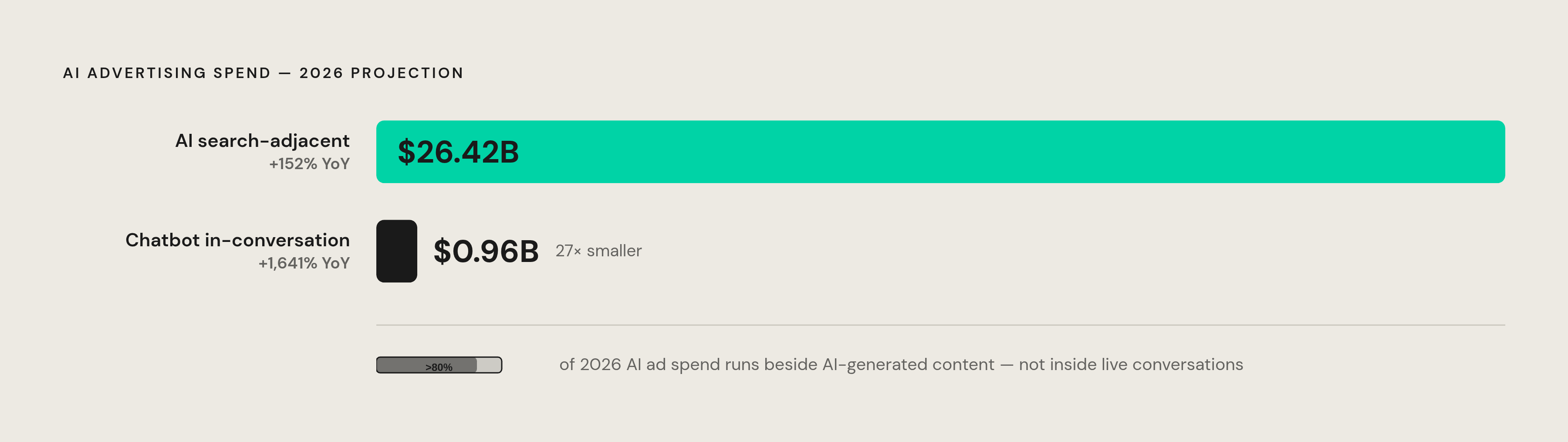
eMarketer projects standalone chatbot ad spending will jump 1,641% in 2026 to reach $0.96 billion, a number that sounds almost like a rounding error next to the $26.42 billion forecast for AI search-adjacent ads, up 152% for the year. Yet more than 80% of AI advertising in 2026 still runs beside AI-generated content, things like Google's AI Overviews, rather than inside the back-and-forth of a conversation itself. The in-response channel, the one this piece is actually about, is still the smaller, stranger cousin. OpenAI's own ad business reached a $1 billion annualized revenue run rate in under 200 days across more than 40 countries, proof the inventory is real and not a slide deck. But real inventory doesn't mean uniform quality. Each network reads context differently, and buyers who assume otherwise are pricing risk they can't see.
What contextual targeting inside a conversation means, and why it differs from page-level and keyword targeting
Page-level contextual targeting reads a URL or the words sitting on a page. Keyword targeting matches a query string. Both signals are frozen in place before the user has said much of anything, and both were built for a web made of static documents, not exchanges.
A conversation is a different animal entirely. The signal isn't a page, it's the prompt, often a multi-turn statement of what someone is actually trying to decide right now. Take a prompt like "compare CRM platforms for a 20-person sales team with a Salesforce integration requirement." That single sentence carries a product category, a use-case detail, a stack constraint, and an implied budget tier, all at once. A keyword string never gets close to that kind of density.
Four things separate one network's targeting from another's. Prompt parsing: what the system actually reads in a turn, and how deep it goes. Intent classification: how it decides a prompt is commercially worth acting on, and at what level of granularity. Match latency: how fast that decision gets made relative to the response streaming out. Signal fidelity: whether the ad that gets served actually reflects what the user meant, or just a broad topic bucket that happens to contain it.
Search ads bolted onto an AI-generated summary read the query that triggered the summary, not the conversation that produced it. That's a lower-fidelity signal by design, closer to keyword matching than to anything a chat interface can offer.
The mechanics of prompt parsing and intent classification: how networks turn a conversation into a targeting signal
Inside ChatGPT's targeting setup, the work isn't done by the model that's writing the response. A separate set of transformer models, tuned for classification and relevance scoring rather than generation, reads the conversational context and turns it into an embedding vector, a numerical stand-in for what the exchange actually means. Advertiser campaigns are matched against that conversational signal through a semantic similarity process within the same embedding space.
That classifier is trained to distinguish high-intent prompts from low-intent ones and to improve match quality over time.
No third-party cookies or cross-site tracking feed ad serving inside ChatGPT chats. That said, OpenAI's April 2026 privacy policy update turned on marketing cookies by default for free users and opened the door to sharing cookie IDs and device IDs with marketing partners for ad targeting elsewhere. Personalization inside the chat stays limited to what can be inferred from that same user's own conversation history, nothing pulled in from outside it.
Advertisers write short paragraph descriptions, called context hints, describing the kinds of conversations their ad ought to appear next to, and that detail matters more than it should. The model uses those hints to find semantically similar prompts. That means targeting accuracy is partly a copywriting problem on the buyer's side, not purely a machine-learning problem on the platform's side. A vague context hint produces a vague match, no matter how good the classifier is.
Verve Group takes a different architectural stance. Rather than sitting inside a model's inference pipeline, it aggregates signal from across conversational AI ecosystems, reportedly processing over 1 billion daily signals, and folds zero-party data, search intent, and pseudonymized AI chat activity into one intelligence layer sitting outside the conversation itself. That's a genuinely different fidelity profile from a network matching inside the chat turn by turn.
Every network, regardless of architecture, runs into the same wall. LLMs are stateless and produce text, not auditable transactions, so grounding a product mention in a live catalog, attaching a trackable click ID, routing attribution, and enforcing a frequency cap all require deterministic infrastructure built outside the model. That's a structural constraint the category broadly acknowledges, and it's hard to argue with: a model that generates language has no native concept of "this specific SKU, in stock, at this price."
Hallucination sets a floor under all of this. Published benchmarks on grounded summarization tasks show that even leading models produce errors at a non-trivial rate, with harder tasks pushing error rates higher. Any network that lets a model generate ad copy or product mentions on the fly inherits that error rate. It doesn't go away because the use case is advertising instead of summarization.
Match latency and the sub-250ms constraint every in-response network has to solve
The plumbing behind a well-built integration works as follows: the server takes in a user's message, runs a cheap classifier or heuristic to check for commercial intent, then fires two calls in parallel, one to the LLM for the response stream and one to the ad system for a match, and renders the ad once the response finishes streaming.
Speed and accuracy pull against each other here. A deeper intent classifier catches more nuance but costs more compute and more time. A fast heuristic hits the latency target but will misread a subtler prompt more often. Running the ad request in parallel with generation, rather than after it, is one way to hold onto both, but only if the matching infrastructure underneath is actually fast enough to keep up.
Jutera documents this choice openly: ad requests run in parallel with generation specifically to keep latency down, one of the few networks willing to state the approach explicitly.
The bidding layer around these decisions has gotten more dynamic too. Broader AI optimization stacks now track 200-plus signals and reallocate budget every 15 to 30 minutes. That's the moving backdrop against which each individual targeting call has to resolve in a fraction of a second.
How placement surface shapes what context the network can read
Where the ad sits changes what the network is even allowed to see. A sidebar panel sits outside the conversation column entirely. It refreshes with each turn but isn't tied to any specific piece of the prompt, so its contextual fidelity is lower by design, and it tends to carry ordinary display economics, CPMs in the low single digits.
Sponsored follow-up chips are the more interesting case. Perplexity shipped a version of this, then pulled it back, citing concerns about user trust. A chip that looks like an assistant's own suggestion but is actually paid blurs a line users didn't agree to have blurred structurally, and that damages signal fidelity in a way that's hard to measure but easy to feel. The interaction itself starts to feel steered.
Response-grounded brand mentions, woven directly into the model's answer, are the opposite extreme: the highest possible contextual fidelity, since the ad and the answer are the same text, but also the highest hallucination risk and the steepest cost to user experience. These remain early-stage experiments.
A network that only operates one surface type runs into a ceiling it can't engineer its way past. A sidebar-only network never sees where a prompt actually resolves. A chip-only network is exposed to the same trust problem Perplexity walked back. Latency budgets shift with the surface too: an inline card sits beside an answer the reader is already processing, while a chip or a brand mention has to resolve faster, since it's shaping or interrupting the response stream itself rather than sitting beside it.
A network-by-network reading of how each major player approaches contextual accuracy
ChatGPT's ad platform, run through ads.openai.com, matches on embedding-vector similarity between the conversation and campaign-level semantic clusters, with advertiser-written context hints doing much of the practical work of steering that match. No cookies and no third-party data feed the matching itself; personalization draws only on that user's own history. Self-serve access opened in May 2026, doing away with the old $50,000 minimum, and campaigns can now start at $25 a day. Ads run only for logged-in users 18 and over on the Free and Go tiers, across the US, Canada, Australia, New Zealand, the UK, Japan, and South Korea; Plus, Pro, Business, Enterprise, and Edu users see none. Dentsu, Omnicom, Publicis, and WPP came in as launch agency partners. A future bidding option aimed at optimizing for conversation depth and multi-turn paths to conversion has been floated; whether that has actually shipped by the time this runs should be confirmed rather than assumed.
Verve Group positions itself as the first open-market platform to operationalize high-fidelity AI chat intent for programmatic buying, running on that same aggregated signal layer described earlier, over 1 billion daily signals drawn from conversational AI ecosystems. Because it sits outside the model rather than inside a live conversation, its fidelity profile reads closer to a data platform than to an inline ad unit.
Jutera, run by Austin-based Bajaar LLC, builds itself as an advertising layer for conversational AI and LLM systems generally. It caps sponsored content at 20% of any given response, requires disclosure, and is designed to keep ad requests from adding meaningful latency to the response. It supports multiple pricing and placement models suited to conversational AI environments. That 20% cap is a deliberate trade: fill rate given up in exchange for match quality and user trust, which is not a decision every network in this space has been willing to make.
Dappier operates across both conversational ad placements and a content licensing business. Disclosed CPMs run $5 to $15, with HomeLife Brands, at 25 million monthly users, as its flagship case. Partnerships with Sovrn and LiveRamp extend its inventory with identity activation layered on top, which introduces off-platform data into what would otherwise be a purely conversational signal.
AgentVine and Adgentic both aim at a different target altogether: autonomous AI agents, not chat conversations. AgentVine builds intent matching directly into agent decision logic; its context reading happens inside an agent's reasoning chain, a different signal type entirely from prompt-level matching. Adgentic runs a managed affiliate platform with an MCP server built for agent frameworks, and because it's affiliate-based, its version of "accuracy" gets measured against task completion, not conversational intent.
Taboola is extending its native ad infrastructure into LLM environments with AI-assisted campaign tools, though the specific mechanics of how it reads conversational context aren't yet well documented publicly. That's legacy infrastructure being adapted to a new environment, not yet a fully native build.
Microsoft's Copilot, through Microsoft Monetize, gives advertisers conversational access to performance metrics and ad operations. According to flow-agency.com, measuring Copilot ad performance is notably easier than measuring ChatGPT's or Perplexity's, because Microsoft hasn't made the same strict privacy commitments those two have. That's a genuine trade-off: more measurement transparency for buyers, at the cost of the tighter privacy posture users get elsewhere.
A buyer trying to reach commercial intent across several AI surfaces at once, rather than committing to one, runs into a real structural choice: a single-surface network with deep fidelity on that one surface, or a cross-surface platform built to read conversational context across environments. That gap is exactly what purpose-built conversational AI demand-side platforms exist to close, since operating across multiple AI surfaces at once means treating the sub-250 millisecond matching window as a hard constraint from day one rather than a limitation inherited from ad infrastructure that was never built with a live model response in mind.
What buyers and publishers should
Each network can be asked what it reads, whether that is the raw prompt, an embedding of the prompt, an advertiser's context hint, or some signal aggregated from outside the conversation entirely. Those are four different products wearing the same label, and the difference in performance appears whether or not the vendor's sales deck mentions it.
Latency numbers deserve the same scrutiny as targeting claims, since a network that can't resolve a match inside the response window will fall back on something cruder, and rarely says so out loud. Publishers should treat surface choice, sidebar versus chip versus inline mention, as a trust decision first and a revenue decision second; Perplexity's pullback from sponsored follow-up chips in February 2026 is the clearest public data point yet that getting that sequencing backward carries a real cost. Buyers writing context hints should treat that copy with the same care given to a search campaign's keyword list, since it functions as the input the matching engine actually runs on.
Sources
- How to Build an LLM Advertising Stack: Tools, Workflow, and Budget (2026) | Lapis
- Ads Inside AI: The Next Media Channel Marketers Can’t Ignore – Beet.TV
- LLM Advertising: Your Chance to Be an Early Adopter
- Verve Group launches industry-first targeting capability activating conversational intent signals from major LLM environments