Brand Awareness Metrics for Native AI Chat Sponsored Placements
Measure AI chat ads on engagement depth and downstream behavior, not clicks.

Native sponsored placements inside AI chat work on different mechanics than search, social, or display, so you need a different way to measure them. ChatGPT turned on sponsored placements on February 9, 2026, and the format it chose decides almost everything that follows if you are trying to measure brand awareness inside the channel.
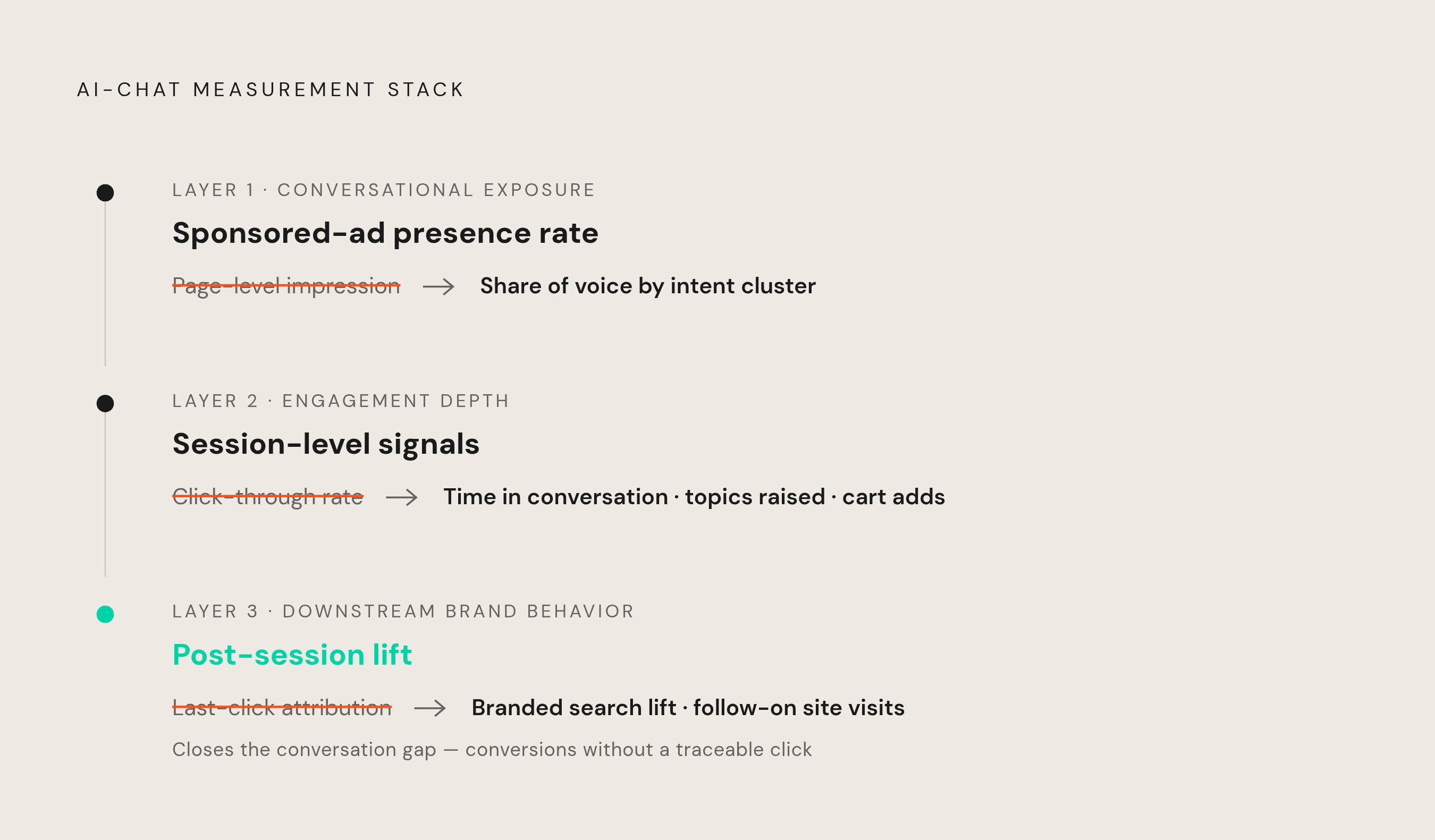
Measuring brand awareness for sponsored placements inside AI chat requires organizing metrics across three layers: conversational exposure, engagement depth within the session, and downstream brand behavior after the session ends. For exposure, sponsored-ad presence rate by topic or intent cluster replaces the page-level impression, tracking how often a placement appears within conversations about a given subject and functioning as the AI-chat equivalent of share of voice. Within the session, time spent in a brand-agent conversation, topics the user raised unprompted, and items browsed or added to a cart replace click-through rate as the primary engagement signal, because large language models operate as a largely clickless environment where depth of engagement is the real indicator. Downstream, branded search lift following an AI session, follow-on site visits traceable through geo splits or holdout tests, and the conversion rate of users referred from AI platforms capture the brand-awareness effect that survives when a user leaves a chat session and converts later without a traceable click.
Sponsored placements in AI chat and their measurement problem
The ChatGPT ad unit renders as a labeled sponsored card below the assistant's answer; it is not folded into the answer text itself. The model's response stays unsold, and the commercial unit occupies its own space next to it. That separation is the central design decision of the whole system, putting a paid unit directly beside an organic AI answer the user already trusts, without making the ad part of that answer. No prior ad format, not search, not social feed advertising, not display, has put a commercial unit in that exact relationship to the content around it.
Targeting runs on different logic too. Instead of keywords, advertisers buy against a context hint that describes what a person is trying to accomplish in a given conversation, and the system matches placements to that intent rather than to a typed string. Microsoft's Copilot goes a step further: its targeting model reads the entire session, not just the most recent message. The ad a user sees can depend on turns several exchanges back.
You buy through two separate paths, and each one needs its own measurement job. A Reach objective buys on a CPM basis, with a default maximum bid of $60 per thousand impressions, the flat rate set during the original pilot, but observed CPMs have since moved depending on category. A Clicks objective buys on CPC. These are two distinct purchasing philosophies, one oriented toward exposure volume and one toward action, and they carry different measurement implications from the moment a campaign is set up.
A newer format pushes this further still. A user can click a sponsored agent ad and land in a direct chat with a brand-controlled agent, built on a knowledge base the brand itself sets. The ad unit stops being a static card, because now it is a conversation a user can actually hold.
Put these pieces together: the structural problem comes into view. There is no page to measure viewability against, no fixed keyword to report against, and no stable creative to hold constant across an exposed and unexposed group. Every measurement proxy built around those three things breaks here. The rest of this piece works through what has to replace them.
Measuring purchase intent in AI chat
The same conversational design that makes the ad format novel also makes the signal flowing through it richer than almost anything marketers have had access to before, and harder to trace to an outcome. A user does not type three keywords and click a result. A user asking an AI assistant about running shoes for flat feet, under a stated price ceiling, has handed over specific, structured purchase intent that no keyword or demographic segment could approximate. That value is hard to follow to a conversion.
Sessions in AI chat tend to run deep, around six prompts, before a user ever leaves for the open internet to buy something, and that whole stretch of conversation creates exposure but never produces a traceable click at any single step along the way. Intent shifts shape as the session goes on too, moving from informational questions early, through comparison, toward something transactional or problem-solving later. A sponsored card that appears while a user is still comparing options does not carry the same weight on brand recall as one appearing once the user has moved into a transactional frame of mind, but a standard impression count treats both occurrences identically.
Conversion timing varies by category on top of that. Flights and electronics tend to convert soon after a session ends, while other categories take much longer, and standard attribution windows were never built with that kind of spread in mind.
Last-click attribution handles none of this well. A user can run through six follow-up questions inside a chat session, leave without clicking anything, and convert later through a direct visit, and the chat session that did the actual persuading gets credited with nothing. It is how people actually use AI chat, and any measurement framework that ignores it will consistently undercount the channel's real contribution to brand awareness and purchase intent.
Where legacy brand-lift frameworks break
Traditional brand-lift measurement was built around a page-level signal to measure against, a fixed piece of creative to hold constant, and a clear line between the ad and the editorial content around it. None of the three survive inside AI chat.
Start with the page itself. Viewability tools, share-of-voice tools, and brand-safety tools all need to know what page an ad sat on. A chat interface has no page in that sense, only a conversation turn, so there is no stable unit to attach those measurements to.
Fixed creative fares no better. A standard brand-lift study compares an exposed group against an unexposed group, and the creative has to stay the same between them. Sponsored agents and context-adaptive placements make that impossible by design, because what a user sees depends on how the conversation unfolded, not on one piece of creative that stayed the same for everyone in the study.
The ad-editorial boundary assumption breaks for a related reason. Display and social brand-lift studies assume a clean separation between the paid unit and whatever content surrounds it. Inside AI chat, the sponsored card sits right next to an answer the user already trusts, and that adjacency changes brand perception in a way no existing brand-lift instrument was built to isolate or even detect.
Reporting granularity compounds all of it. Advertisers in many AI-assisted environments still cannot see which prompt actually triggered their placement, so controlling for conversational context inside a brand-lift study becomes a much harder problem than it ever was in search. Zéa Hirsh, performance media supervisor at Collective Measures, told Adweek that advertisers lack search-level or prompt-level reporting and so cannot see what users were asking when their ads were served. That is a design constraint built into the channel itself.
Brand safety runs into a parallel wall. Keyword blocklists, the standard tool for the job in search and display, assume static, retrievable pages that can be scanned and flagged in advance. A generative model produces new text on the fly, so a hallucinated pricing claim, a fabricated compliance statement, or an invented product feature will not show up on any list-based blocklist, because nothing like it existed before the model generated it.
What metrics should replace impressions and clicks for measuring brand awareness in AI chat sponsored placements?
Given all of that, measuring brand awareness here means organizing metrics across three layers at once: conversational exposure, engagement depth within the session, and downstream brand behavior after the session ends. No single layer tells the full story on its own.
The first layer replaces the page-level impression. Sponsored-ad presence rate by topic or intent cluster tracks how often a brand's placement shows up within conversations about a given subject, so it works as the AI-chat version of share of voice. Comscore's AI Intelligence product builds this out using prompt-and-response pairs, cited domains, conversation identifiers, and event timestamps drawn from an opt-in panel, which lets brands see where and how often their sponsored placements turn up inside ChatGPT by topic. Because a brand can earn an organic citation in an AI answer and also buy a sponsored card underneath it, a full picture of exposure needs both signals together: a brand that shows up organically but skips sponsoring a competitive conversation sits in a weaker position than one doing both at once. Comscore's tool is also built to answer a related competitive question, whether rival brands are winning visibility organically or through paid placement around the same prompts and consumer interests.
The second layer, engagement depth within the session, replaces click-through rate as the main engagement signal, though it does not throw CTR out entirely. CTR still means something real under a Clicks objective buying on CPC, because that is literally what the advertiser pays for. But for sponsored agent formats especially, the more telling signals are time spent in the brand-agent conversation, topics the user chose to raise unprompted, and items added to a cart or browsed during the session. Dappier's Miku brand agent is a useful illustration: users spent more time on Miku's site, actively browsed products, and added items to a cart rather than bouncing off the homepage, which is a qualitatively different engagement signal than a click ever was. Anudit Vikram, Channel Factory's Global Chief Product and Technology Officer, frames the shift directly: large language models are likely to stay a clickless environment in which getting selected for inclusion in a response, and how deeply a user engages with that response, becomes the real marketing signal. CTR becomes a secondary proxy under that framing, useful, but it is not the metric the whole program should organize around.
The third layer connects AI exposure to the outcomes brand-lift measurement was always trying to reach in the first place. Comscore's approach tracks when visibility inside an AI platform leads to downstream engagement such as a follow-on site visit, so it closes the conversation gap described earlier, where a user leaves a chat session and converts later without a traceable click. If users who saw a sponsored placement inside an AI session show more branded search activity in the sessions that follow, that is a real, measurable brand-awareness effect that survives the clickless nature of the channel. Geo splits, time-based holdouts, and budget-in and budget-out tests do more useful work here than last-click reporting alone, and they work whether or not the platform ever exposes prompt-level data. Where direct attribution is available, users referred from ChatGPT convert at a substantially higher rate than other referral channels, capturing the intent premium built into the channel rather than just counting how many people came through. Survey-based instruments for purchase intent and brand affinity still have a place too, but you need to run them against conversationally-exposed cohorts, not page-exposed ones; the instrument itself is not the problem, the old sampling frame was.
Reading paid and organic brand presence together, not apart
A brand's measured awareness inside AI chat is a composite of paid placement and organic citation, so treating them as separate channels leaves you with a systematically incomplete picture of brand presence. Search trained marketers to treat organic and paid as distinct line items that sit in different positions on a results page. AI chat does not offer that separation: a single response can cite a brand organically in the answer text while showing a competitor's sponsored card directly underneath it, and the user takes in both at the same moment.
Comscore's framework asks the right organizing question because of this: how does a brand's paid visibility compare to its organic presence as a cited source. Comscore's analysis found that sponsored-ad presence in hotel-related ChatGPT prompts reached 24% in May 2026. That figure matters less as a standalone statistic and more as a demonstration that paid and organic visibility are two expressions of one underlying brand-awareness signal, not two separate KPIs sitting in two separate reports.
The strategic consequence is direct. A brand that earns organic citation but skips sponsored placement in that same conversation is leaving a reinforcement opportunity on the table: the organic mention establishes presence, and the sponsored card beneath it can either deepen that impression or hand the moment to a competitor's card instead. A brand that buys sponsored placement without earning organic citation has the opposite problem: it is paying for exposure in an environment where user trust is anchored partly to the organic answer, a weaker position than earning both at once. Any serious brand-awareness measurement program for this channel needs to track organic citation share next to sponsored presence rate, in the same dashboard, rather than splitting media spend and SEO into separate reports that never talk to each other. This is not a nice-to-have refinement. The structure of the channel makes it a requirement.
Weighting metrics by category and intent stage
The metric stack above is not meant to be applied with equal weight everywhere. Which metrics should carry the most weight shifts by industry category and by where in the conversation a placement appears, picking up the intent progression described earlier, informational, comparative, transactional, problem-solving, and turning it into something a measurement program can actually act on.
High-consideration, long-cycle categories, financial services, health, B2B software, education, behave differently from everything else. If you are comparing mortgage options or researching a health condition, you are sharing intent signals far richer than any keyword search ever produced, but the actual conversion sits weeks or months away, so last-click metrics turn especially misleading in these categories. Programs here should weight downstream brand behavior signals, branded search lift and follow-on site visits, more heavily than session-level engagement metrics, and they should lean on holdout tests as the most reliable attribution tool you have. Health and financial services also carry heavier reputational exposure than most categories, so hallucination liability belongs in the measurement plan itself, not off to the side as a brand-safety afterthought: tracking whether the AI environment represents a brand's claims accurately is part of what awareness measurement means in these categories.
Short-cycle, transactional categories, e-commerce, travel, consumer electronics, run on a different clock. If a user asks about running shoes for flat feet under a stated price ceiling, that shows specific purchase intent with a short window to conversion, and some of these sessions convert within days. Programs in these categories should weight sponsored-ad presence rate and the conversion-rate quality of referred users more heavily, and CTR keeps more of its traditional meaning as an engagement proxy here than it does in longer-cycle categories. The stack stays the same across categories. What changes is which layer of it does the most explaining.