Return on Ad Spend Modeling for AI Advertising vs Meta Ads
Conversational AI ads demand a ROAS model built from intent signals, not audience profiles.

Conversational AI advertising stopped being a side experiment on February 9, 2026, when OpenAI began testing ads inside ChatGPT. That date matters because it turns a channel marketers could previously ignore into one that now needs a working return-on-ad-spend model, built from scratch rather than borrowed from the platforms advertisers already know.
Why ads inside AI conversations force a ROAS rethink
A user talking to an AI assistant is having a conversation that can move in fifteen turns from a general question about home renovation to contractor pricing to a request to compare financing options. Whatever "signal" an advertiser is trying to match against at any single moment barely means anything without the full arc of that conversation behind it. That's a different starting point from a search query, which arrives as a discrete, bounded request, and different again from a social feed, where the user is simply scrolling rather than asking something.
The rest of the industry is reacting to this shift at different speeds and in different directions. Google has folded its AI answer surfaces into the ad infrastructure advertisers already run: AI Mode with Direct Offers, and AI Max for Search campaigns. Microsoft does something similar inside Copilot. Grok has announced plans to put ads inside its responses. Claude's maker, Anthropic, has taken the opposite position: it rules out advertising entirely and funds the product through enterprise contracts and subscriptions instead. The result is a fragmented landscape moving on several timelines at once, and an advertiser trying to plan a budget across it has no single playbook to follow.
None of this means the underlying math of ROAS has changed. Revenue divided by spend is still revenue divided by spend. What's changed are the inputs that feed that equation: the signal that determines who sees an ad, the moment in the user's intent that the ad arrives at, the way clicks behave, and even what counts as a conversion. Each of those is structurally unlike its Meta equivalent, and that's the gap this piece sets out to close.
What Meta's ROAS model is built on
Meta's ROAS framework rests on three foundations that feel like universal truths of digital advertising but are actually specific to how Meta's platforms work: targeting built on audience profiles, creative built to interrupt, and a CPM pricing structure that assumes reaching enough people will reliably produce some share of buyers.
The signal driving a match on Meta is a profile: demographics, stated interests, behavioral history built up over time. It has nothing to do with what the user is actually doing in the moment the ad appears, by design. The ad appears inside a feed the user is scrolling for other reasons, so it interrupts a moment rather than entering one where the user is already deciding something. None of this is a flaw in Meta's approach. It is simply the mechanism, and the benchmark data shows it working as intended within its own terms.
Varos data (via Superscale) shows Meta ROAS spread across a wide range by category: automotive parts leads the field, while telehealth sits near the bottom. That split tracks a clear pattern: categories where visual discovery drives the purchase decision do well on Meta, while categories where considered intent drives the purchase favor search instead. Meta CTR over the same period shows strong top-of-funnel engagement, but conversion rates reflect the interruption dynamic directly: the people clicking were merely interested. Triple Whale data puts CPM growth at over thirteen percent year over year, so the old assumption that reach itself is getting cheaper no longer holds. Advertisers are recovering efficiency through better creative and conversion optimization now, not through cheaper inventory.
The break-even logic on Meta is anchored to margin: break-even ROAS equals 1 divided by gross margin, a formula that holds regardless of platform. What advertisers rarely stress-test is a quieter assumption, that the funnel running from CPM to conversion will behave the same way when the audience signal comes from a profile instead of from active intent. That assumption holds up fine inside Meta's own environment. It breaks the moment the signal shifts to a live conversation, which is exactly the environment conversational AI advertising operates in.
How the intent signal works inside a conversation
A user entering a conversation with an AI assistant engages in a dialogue that can shift across research, comparison, and decision within a single session, and that pattern demands infrastructure built specifically to read and act on it rather than adapted from a keyword auction or a profile match. The signal driving ad match in this environment is the live semantic content of the conversation itself, which carries intent at a level of detail no demographic profile or search query can reach.
Four distinct intent types appear inside these conversations, and each one carries different implications for how you should model ROAS. Informational intent describes a user who is researching: useful for awareness, lowest in conversion probability, and not a fair candidate for direct-response benchmarks. Comparative intent describes a user evaluating specific options, a moment well suited to competitive positioning, with conversion probability higher than the informational stage. Transactional intent describes a user ready to act; it is the closest equivalent to high-intent paid search and the strongest for direct response. Problem-solving intent describes a user working through a specific challenge, a moment that rewards solution-oriented messaging and performs particularly well in B2B and service categories.
A user might never type the phrase "project management software" into a search bar, but could spend several exchanges describing team coordination problems, missed deadlines, and the friction of remote collaboration. A system reading the full conversation recognizes that as high-intent behavior relevant to project management tools, even if the category name never appears. A keyword system has no way to see that. Microsoft Copilot's targeting draws on the entire session, not just the most recent query, a real architectural break from both keyword auctions and profile-based matching. Because conversational context carries intent at a granularity no profile or keyword can match, platforms built to read that context directly hold a structural advantage in matching and measurement. Demand-side platforms that run their own exchange with direct supply from AI publishers can read conversational signal as it happens, rather than depending on generalist buying platforms that have reach but no way to parse intent out of dialogue.
The auction is a relevance-weighted second-price auction. Targeting gets expressed as a natural-language hint attached to an ad group, and a more contextually relevant ad can win placement over a higher bid, with the winner paying just above the next-closest bid rather than the full amount bid. The bid logic that works on Meta, maximizing reach inside a set CPM budget, doesn't carry over cleanly to an auction built this way.
The CTR trade-off: fewer clicks, hotter buyers
A lower click-through rate in conversational AI advertising reflects a structural feature of a format where the AI's own answer often resolves the user's informational question on the spot, leaving only the users with real commercial intent to click through.
ChatGPT's overall CTR runs lower than Google Search's, though it climbs in verticals like SaaS and finance. The raw number looks weak until you look at the behavior after the click. Criteo, OpenAI's first ad-tech partner, reports that ChatGPT ad traffic converts at one and a half times the rate of other referral channels. That fewer-clicks-higher-conversion pattern isn't a theory applied after the fact. It appears directly in early campaign data.
The modeling consequence follows directly: a ROAS model that treats CTR as a leading indicator of channel health, the way most Meta models do, where CTR predicts conversion volume, will undervalue conversational AI placements by design. You need to weight conversion rate and cost per acquisition instead, because conversational platforms can tell when a user clicks out of curiosity versus with real commercial intent, since the AI's own response has already answered part of the question, making fewer, higher-intent clicks the norm here rather than a warning sign.
That upside case needs a counterweight built into the model rather than tucked into a footnote. An independent B2B agency test, run by Windmill Strategy, spent over a thousand dollars, generated tens of thousands of impressions and hundreds of clicks, and produced zero conversions. The channel clearly does not perform the same way across every vertical and offer type. A hotel-focused practitioner separately reported modest click-through rates at competitive cost-per-click levels, a result suggesting that fit between vertical, offer, and channel matters as much as the channel itself. The responsible way to build around this is to set a pilot budget that assumes a mixed outcome: the conversion upside is real in high-consideration categories, but nothing in the current data supports treating it as universal.
Early ROAS data from AI ad placements
Early ROAS data from conversational AI advertising is promising, but it's thin. It's enough to build a working model from, but not enough to treat as a settled benchmark the way years of Meta or Google data can be treated.
A few figures establish the shape of what's known so far. More than four-fifths of ad-driven ChatGPT traffic for one technology partner came from new customers, a customer-acquisition signal that raw ROAS doesn't capture on its own but that a fuller return model should account for. Amazon reports that roughly a fifth of shoppers who interact with a sponsored prompt go on to continue the conversation about that brand, and that approximately seven in ten people who buy after clicking a sponsored prompt are new to the brand. Both figures point to new-customer rate as an input a complete model needs.
The cost side of the picture is less flattering on a raw basis. Early ChatGPT cost-per-acquisition figures sit above those from Google Shopping and Meta catalog ads, because CPMs remain elevated while inventory is still early, though you can expect them to compress as it scales. The break-even case improves once new-customer rate and lifetime value get folded into the model, which lowers the effective CPA bar in categories where acquiring net-new customers matters more than hitting the lowest possible CPA on repeat buyers. Varos and Superscale's 2026 ROAS benchmarks for Meta and Google give the comparison points a conversational AI model should be calibrated against, not a bar the new channel must clear to justify the spend, but the opportunity cost the spend is being weighed against.
Some of these figures carry more weight than others. The early CPA and traffic-composition numbers come from OpenAI's own reporting and belong in the model as self-reported early data rather than independently audited results. Criteo's conversion-rate figure carries more structural weight, because it comes from an ad-tech partner with direct access to attribution data, not from the platform marking its own performance.
Categories and intent moments to treat as high-probability versus speculative
You can't cover every category in a conversational AI ROAS model with one set of assumptions. The channel's strongest performance is concentrated in high-consideration categories, the kind where research, comparison, and deliberation happen before a purchase, not after.
Several categories deserve tighter, higher-confidence ranges in the model. Early campaign data shows particularly strong engagement in B2B software, financial services, education, travel, and health and wellness, categories where users tend to arrive at AI platforms already in a comparative or transactional state of mind. Travel stands out specifically: consumers who use AI before visiting a travel site show a substantially lower bounce rate than those arriving from non-AI sources, putting them further along in deciding by the time they land. Travel services run a 7.71x ROAS on Google Ads, the second-highest category on that platform behind hotels, which supports the idea that the demand behind this intent moment is genuine rather than inflated. Shopping and retail also belong in the high-confidence tier: shopping already accounts for the largest share of ChatGPT ad impressions by category, and return-policy and purchase-protection messaging have become unusually strong-performing ad components, since users can ask immediate follow-up questions about returns and warranties in a way a static text ad never allowed.
Other categories call for wider error bars and smaller pilot budgets until more data accumulates. Impulse and low-consideration purchases, the same categories where Meta's visual-discovery format performs well, show no structural advantage in a conversational format, and the Windmill Strategy test with zero conversions stands as a direct warning for any category where the offer doesn't reward research. Categories built around very low order values may struggle to recover the elevated CPMs still present in early inventory, so the model should treat CPA compression as something that develops as the channel matures, not assume today's CPM levels hold steady.
Constructing the ROAS model
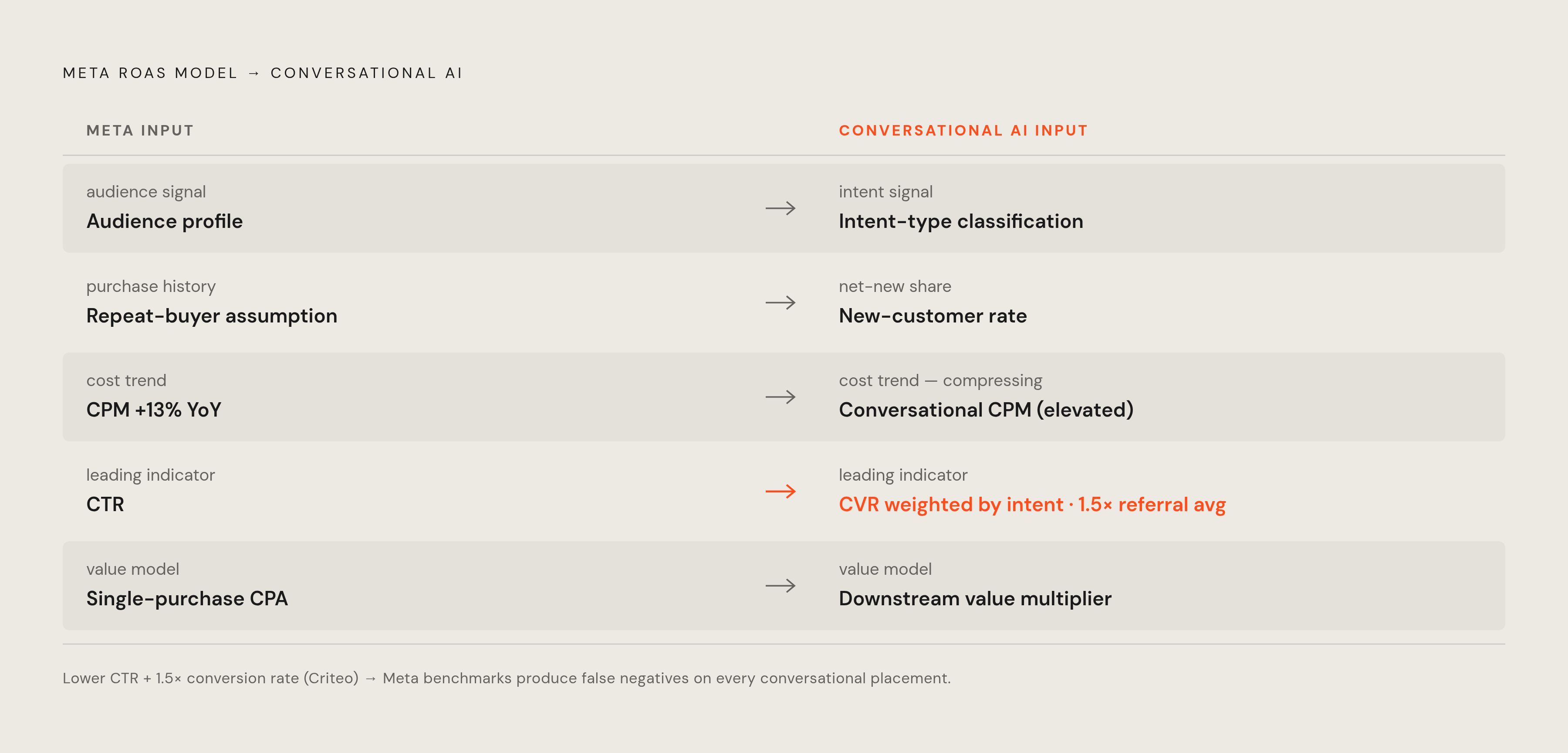
A conversational AI ROAS model needs five inputs that either don't exist in the Meta model or behave differently inside it: intent-type classification, new-customer rate, conversational CPM (elevated now, expected to compress as inventory scales), post-click conversion rate weighted by intent type, and a downstream value multiplier for categories with high new-customer rates.
The break-even formula itself stays at 1 divided by gross margin. What changes are the variables that feed it, and two replacements matter most. First, keyword-bid CPM logic needs to give way to context-hint relevance scoring: because a more relevant ad can beat a higher bid inside a second-price auction, the real lever to pull is the quality of the creative and the context hint, not the bid floor by itself. Second, CTR needs to stop functioning as the leading indicator of efficiency, replaced by post-click conversion rate and CPA. The lower CTR native to this channel is a feature of how it works, not a flaw in execution, and measuring it against Meta's CTR benchmarks produces a false negative every time.
Meta's model rests on the assumption that a profile-based audience and enough reach will yield a predictable share of converters at a known CPM, an assumption that holds up fine inside an interruption-format environment but breaks down completely once the signal driving the match is live conversational intent rather than a demographic profile. That's the structural reason a conversational AI ROAS model has to be built from first principles rather than adapted from the social playbook: the inputs aren't the same, the auction isn't the same, and the moment at which the ad meets the user isn't the same. Intent-type classification, new-customer rate, conversational CPM, weighted conversion rate, and a value multiplier for new-customer categories give an advertiser the pieces to run that math honestly, category by category, instead of a framework built for a different kind of attention.