Consumer Behavior Insights Derived From AI Chat Prompt Patterns
AI chat prompts reveal consumer decision-making in ways search keywords never could.

AI chat prompts are turning into the most detailed record of consumer intent that marketers have ever had access to. A single search query is a fragment; a prompt session is a running conversation with context, hesitation, and stage of decision-making already built in. That shift changes what "intent data" means, and it's happening faster than most measurement systems can track.
The signal hierarchy that marketing has relied on for two decades runs from keyword to demographic to behavioral to, now, conversational. Each rung up that ladder has offered a slightly clearer picture of what a person wants. Conversational data is a different instrument entirely from that ladder. It's a different instrument, not a variation on the same one.
Consumer adoption speed of AI chat as a decision starting point
Consumer use of generative AI tools grew from 45% to 73% between early 2024 and 2026 across every market Prophet surveyed, in a study covering 2,015 AI users. It's a behavior becoming default in under two years. That's a behavior becoming default in under two years.
OpenAI's figures show ChatGPT alone crossed 1 billion weekly users. At that volume, prompt data becomes a legitimate behavioral dataset, large enough to support the kind of pattern analysis that used to require years of search-log history.
Verve's analysis of more than a billion daily signals, pulling from LLM chat environments, search activity, and zero-party polling, found that for more than 20% of users, the digital journey toward a purchase now begins inside an AI chat window, not a search bar. Verve found that travel has moved fastest: 37% of travel-related queries now start in an LLM, well above the cross-vertical average. That suggests travel has already crossed a tipping point other categories are still approaching.
None of this is a research sample anymore. It's a mainstream record of how people think before they buy, and it reads differently than anything search data has produced.
What prompt patterns look like across the consumer journey
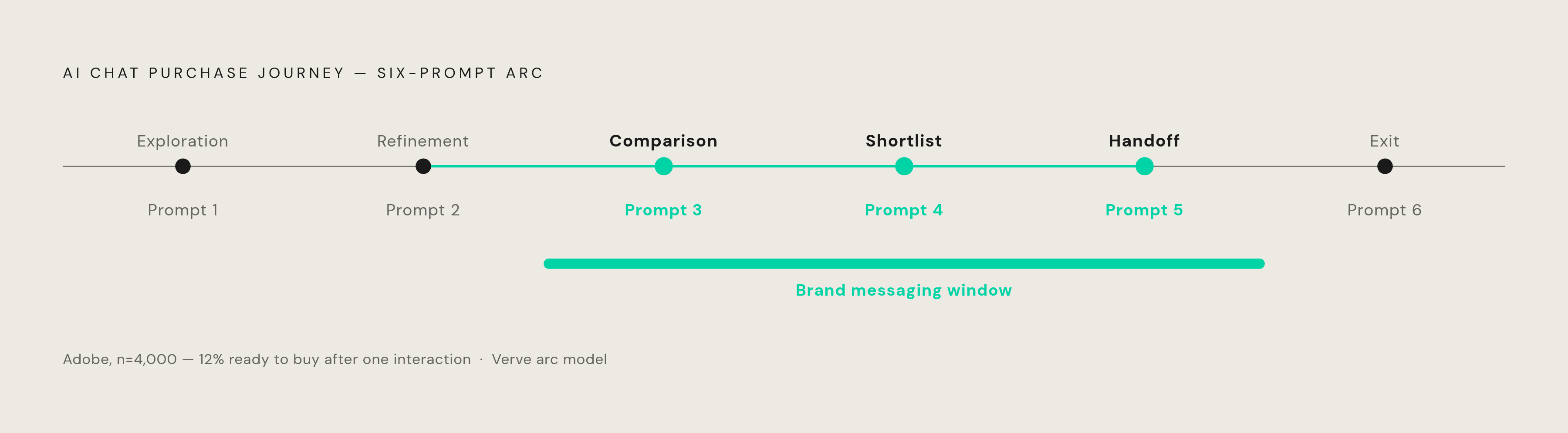
Verve's data shows a discoverable shape to these sessions: users go about six prompts deep on average before they leave the chat environment and head to the open web to actually convert. That arc has structure, and the structure is learnable.
Sessions tend to start unbranded. A consumer asks "what should I look for in a running shoe?" Research into these sessions shows consumers ask this long before they ask about a specific brand. That opening question shapes what happens next, because it's the moment the consideration set is still wide open.
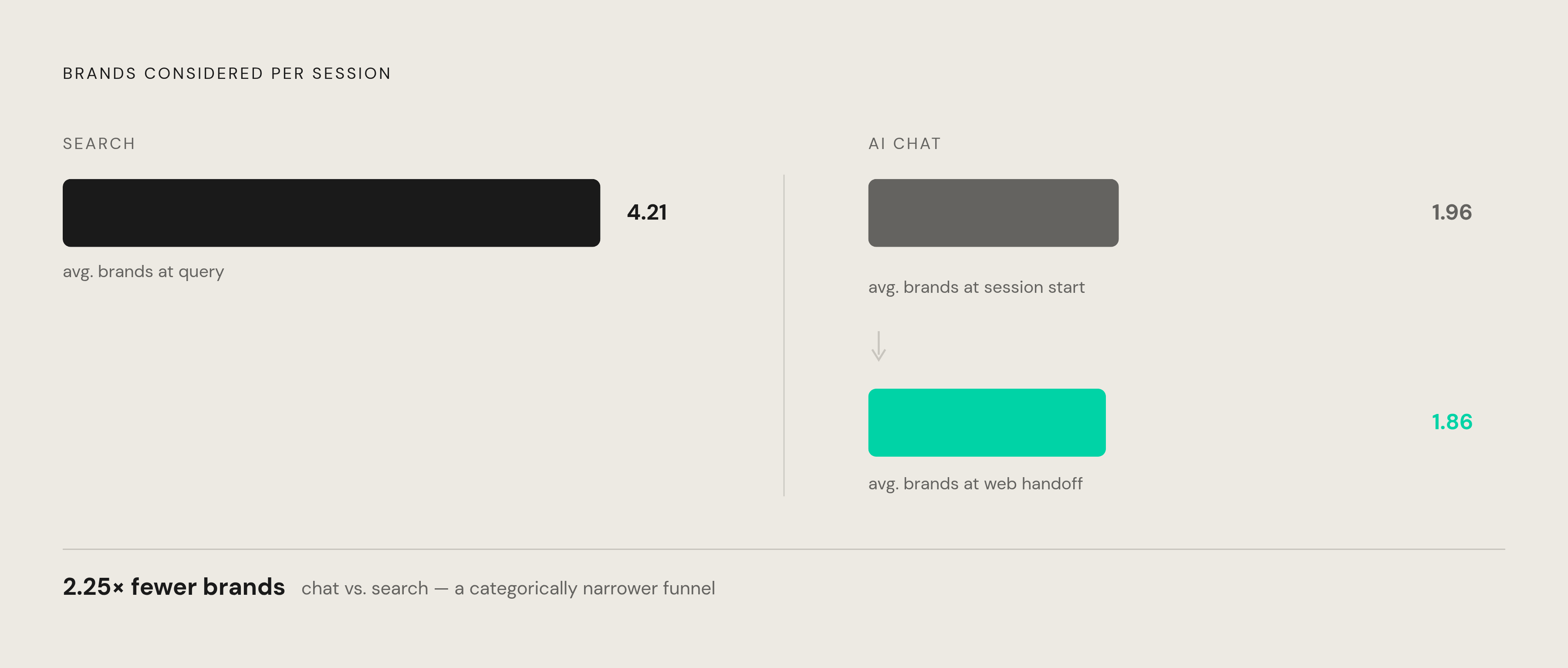
And that set narrows fast. A user who starts their journey in chat ends up considering just 1.96 brands on average, versus 4.21 brands for a user who starts in search. As the AI curates toward a shortlist, that number tightens further, down to 1.86 brands, before the handoff to the open web happens. Chat is a narrowing environment, unlike the discovery environment search offers. It's a narrowing set, and brands absent from those early unbranded prompts risk never entering it.
Timing varies by category, sometimes sharply. Category timing varies, with some purchases resolving quickly while others stretch the six-prompt arc across a longer window. Either way, the rhythm holds: exploration, refinement, comparison, shortlist, handoff. Each stage carries its own vocabulary, and that vocabulary is what makes prompt data readable in a way keyword strings never were.
The specific behavioral signals embedded in prompt language
Question type alone reveals journey stage. "What is X" signals awareness. "X vs. Y" signals active consideration. "Best X for [specific use case]" signals someone close to deciding. "Where to buy X" signals someone ready to convert. No keyword string carries that kind of built-in staging.
Prompts also name use cases with a specificity keywords never approach: "will this moisturizer work for rosacea-prone skin in dry climates?" is a product-fit question no search box has ever seen phrased that precisely, because the search box trained people out of asking that way.
Budget appears in plain language too. "Under $200." "Not worth paying more than." That's willingness-to-pay, stated outright, not inferred from browsing behavior or purchase history.
Objections appear the same way. "I'm worried about..." or "is it safe if..." is the kind of friction data that normally takes a focus group and a moderator to extract, and here it arrives unprompted, mid-conversation. Prompts frequently disclose who the purchase is for as well: "for my dad who..." or "for our team of 12" hands over audience and occasion data no demographic model could reliably guess. Competitors get named directly in comparison questions, exposing exactly which alternatives are alive in a shopper's head at the moment of decision.
The common thread across all of it is candor. A person asking an assistant for help isn't performing an identity the way they might on social media. There's less self-presentation bias baked into the language, because the goal is getting an answer, not being seen.
Divergence between prompt signals and search data
Search captures what someone is willing to type into a box. A prompt captures what they're willing to explain to something that sounds like it might actually help. That's a different task, and it produces a different kind of honesty.
Search intent is also a snapshot: one query, one moment. Prompt intent is a sequence, and the movement between prompt one and prompt six inside a session is itself a signal. Momentum, confusion, refinement: all of it is visible in how the questions change turn to turn, something a single search query can never show.
Keywords carry a layer of translation that prompts skip. A searcher converts their real need into terms they guess the engine will understand. A prompt writer just states the need. That gap between the 4.21-brand consideration set in search and the 1.96-brand set in chat isn't a difference of degree, it's a difference in cognitive mode: search users are browsing, chat users are asking an expert to narrow the field for them.
Luke Jinu Kim, CEO of the AI search engine Liner, made the distinction in comments to AdExchanger: user intent, he said, "is expressed much more clearly than in traditional search." As the outlet paraphrased him, prompts sit inside a "specific and ongoing conversation," while social media and connected TV "only provide fragmented signals" about what a person actually wants. The gap is a different kind of data, and the metrics built for keyword match, click-through, and demographic reach are simply the wrong instruments to read it with. It's a different kind of data, and the metrics built for keyword match, click-through, and demographic reach are simply the wrong instruments to read it with.
The prompt arc, purchase readiness, and the actionable window
Adobe's AI and Digital Trends Consumer Report, based on a sample of 4,000 customers, found that just 12% feel ready to purchase after a single personalized message or recommendation. The real tipping point sits at multiple interactions, a threshold that meaningfully influences buying decisions for a significant share of customers.
Laid over the six-prompt arc Verve documented, that puts the actionable window squarely at prompts three through five. Enough context has accumulated by then for a brand's message to land as relevant, and the user hasn't yet exited to the open web to convert. Missing that window means the conversation moves on without you.
Expectations have shifted accordingly. Prophet's findings show two-thirds of consumers say they want AI that anticipates their needs without being asked. That's a proactive standard, not a reactive one, and it puts pressure on brands to show up before the ask, not after.
Category timing still matters here. Flights and electronics can convert inside 48 hours, so early presence in the arc isn't optional, it's the whole game. Longer-consideration purchases give brands a wider window, up to two weeks in some cases, but the narrowing to under two brands by shortlist still happens before that open-web handoff. Waiting it out doesn't buy safety.
That narrowing creates what amounts to a compression problem for late movers. Because the consideration set tightens so aggressively inside chat, absence from the early unbranded prompts is far harder to recover from than absence from a search results page ever was. The practical shift this demands: stop targeting keywords and start reading session-stage. A system that can tell where in the arc a user sits can time a message with a precision no keyword-triggered campaign has ever managed.
Requirements and infrastructure gaps for reading prompt patterns at scale
Reading these patterns systematically requires session-level conversational context, and no single brand holds that on its own. The data lives inside the platform, turn by turn, and getting a usable signal out of it requires infrastructure built specifically for that purpose.
Verve Group has taken a run at this by activating conversational intent signals from LLM ecosystems into a unified layer that processes more than a billion daily signals, blending zero-party data, search intent, and pseudonymized AI chat activity. It's the first announced capability of its kind, and it points to where this infrastructure category is heading.
OpenAI's own targeting model shows the tension clearly. ChatGPT can show ads based on the topic of a conversation, and, when ad personalization is switched on, based on past chats and past ad interactions too. But advertisers don't receive that underlying data directly. The signal stays on the platform side, which means brands get the benefit of targeting without the raw material to build their own models on top of it.
Attribution remains genuinely unsolved. A user who spends six prompts working through a decision and then opens a browser tab to buy doesn't leave behind a clean chain connecting the two. Last-click measurement gets it wrong almost by definition, and session-level attribution at scale doesn't exist yet, not in any standardized form.
There's a signal-quality risk driving all of this too. Models that generate product recommendations without a grounding source document introduce noise into the very data brands are trying to read. The prompt itself might be a clean, high-quality signal, but the response that follows it can be unreliable, which complicates any system trying to learn from the full exchange rather than just the user's half of it.
Privacy architecture is tightening in parallel. FTC guidance on AI disclosure has gotten explicit, and state-level AI disclosure laws keep accumulating. Any infrastructure built to read prompt patterns has to be pseudonymized and built for a regulatory floor that's rising, not holding still.
What's left unresolved is not small: linking two separate prompt sessions from the same person, scoring confidence on which stage a given prompt actually represents, and standardizing reporting that ties prompt-level events back to real business outcomes. None of that is close to solved industry-wide.
Practical uses of prompt-pattern insight for brands today
Start with category-level listening. Figure out which unbranded prompts a category owns, things like "best running shoe for beginners," because those are the entry points where the consideration set is still open and nothing has narrowed yet.
Creative needs to match arc position, and that's three separate jobs, not one. Exploration-stage prompts call for category education. Comparison-stage prompts call for differentiation. Near-decision prompts call for proof and specificity. Running the same message across all three stages wastes the precision the data is offering.
Prompt vocabulary itself doubles as a research instrument. The actual words consumers use, the objections they raise, the use cases they name, appear more candidly than a survey question ever manages and more specifically than a focus group transcript usually delivers.
The targeting foundation is shifting because of all this too. As third-party cookies fade out, conversational context is stepping in as the replacement. As one commentator put it on Beet.TV in September 2026, "the future of the cookie is actually context."
A handful of platform options already exist for brands ready to test this. ChatGPT's self-serve advertising, live via ads.openai.com since May 2026, starts campaign budgets at $25 a day and targets based on conversational topic along with past chats and past ad interactions. Google's AI Mode ads are in an early phase, though segmented reporting for that surface isn't available yet. Google AI Overviews ads are live in multiple markets through PMax and AIMax, with segmented AIO reporting similarly unavailable. For brands that need reach across more than one of these surfaces at once, a demand-side platform built to buy across AI environments offers a structural answer, combining the contextual reading that single-surface networks do well with the cross-surface scale that generalist buying tools have historically lacked.
Given how unresolved attribution still is, prompt-level campaigns deserve incrementality tests and holdout groups rather than last-click reporting. Creative-level tagging holds up better right now than session-level attribution does, and that's likely to stay true for a while.
The window to move early is closing faster than it looks. According to Salesforce's State of Marketing report, 88% of marketers have already started optimizing for AI-generated responses. Whatever advantage exists for moving first on prompt-pattern insight, it's narrowing by the month, not widening.
Sources
- How to Build an LLM Advertising Stack: Tools, Workflow, and Budget (2026) | Lapis
- Ads Inside AI: The Next Media Channel Marketers Can’t Ignore – Beet.TV
- Verve Group launches industry-first targeting capability activating conversational intent signals from major LLM environments
- Adobe 2026 AI and Digital Trends: Customer Behaviors and AI
- adexchanger.com
- emarketer.com
- prophet.com