Setting Up Your First DSP Campaign to Target Live AI Conversation Prompts
How to target live conversations instead of keywords or audiences in AI chat ads.
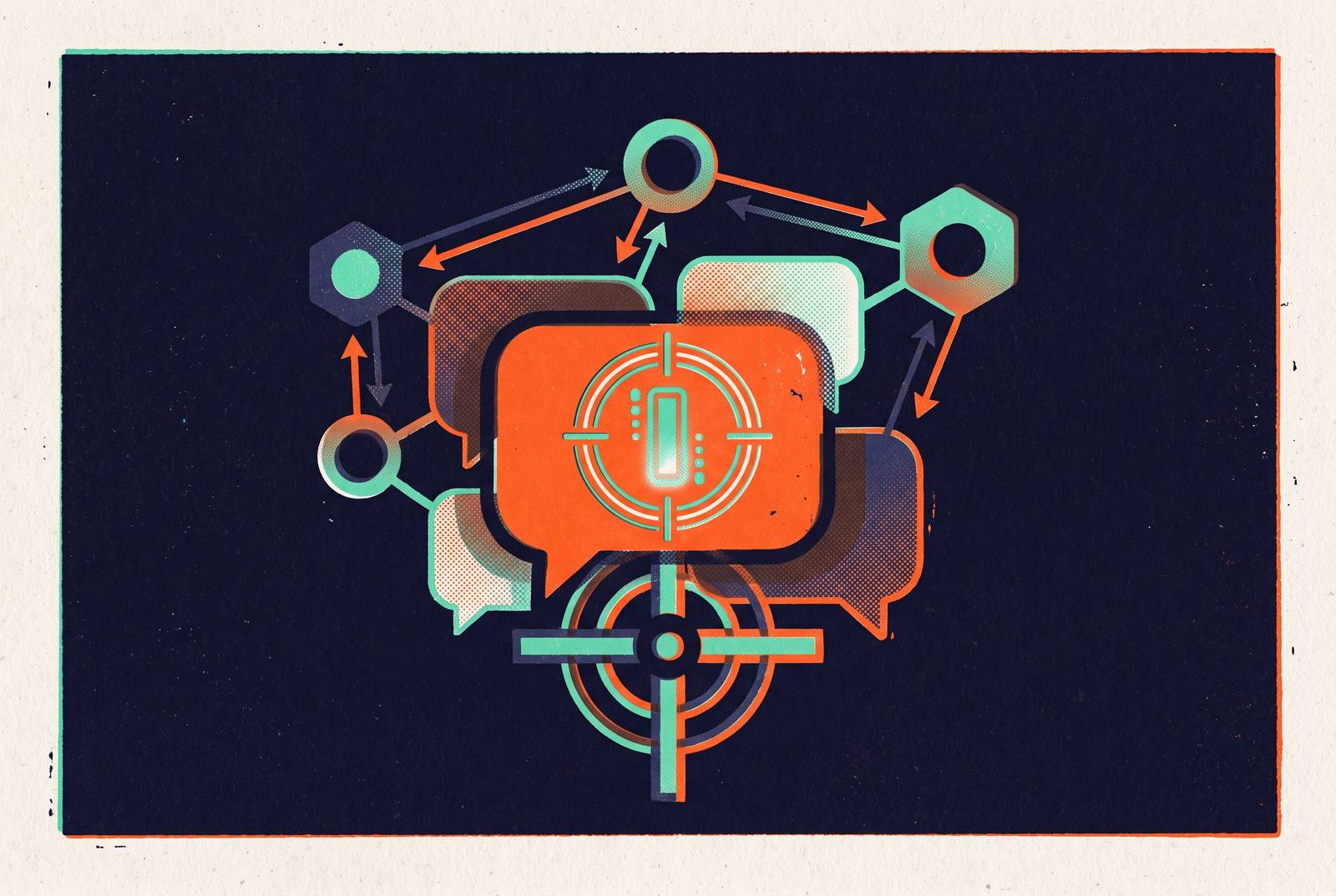
When you set up a DSP campaign to buy ads inside AI chat interfaces, you target a live conversation rather than a keyword, a page, or an audience segment. That single shift changes every decision that follows: how inventory gets mapped, how targeting gets written, how campaigns get structured, and how bids get set without any history to lean on.
Why Targeting Live AI Conversation Prompts Is Structurally Different
A search campaign targets a string someone typed into a box. A social campaign targets a profile built from past behavior, layered with demographic and interest segments. Neither of those units exists in a conversational AI interface. What exists instead is a dialogue in progress: a person mid-thought, having already said something three turns ago, having already received a response from the assistant, now typing a follow-up that only makes sense in light of what came before it. The targetable unit is that whole trajectory, not any single message inside it.
This matters because the entire path a buyer used to track across a funnel, from first search to retargeted impression to final conversion, now collapses into one exchange. A user comparing insurance options, describing their income situation, asking a follow-up about deductibles, all of that is one thread rather than three separate sessions spread across a week and reconstructed after the fact through cookies or pixel-based retargeting. Unlike search DSPs that match keywords or social platforms that layer audience segments, a platform built specifically for conversational AI reads the full intent trajectory of a live exchange, what the user asked three turns ago, how the assistant responded, what follow-up emerged, collapsing the entire consideration journey into a single contextual signal rather than spreading it across retargeting touchpoints.
The practical consequence is that there's no results page to bid for a slot on, no feed position to compete for, no "above the fold" to win. The match a buyer is making is between an offer and a moment of relevance inside a conversation, not a placement inside a layout. Bring over a keyword list organized by theme, or an audience stack built from lookalike modeling, and neither has anywhere to attach. The ad group structure, the targeting inputs, even the question a buyer is trying to answer when they write their first line of targeting copy: all of it has to be rebuilt around the idea that the unit of attention is a conversation, not a query or a profile.
What inventory is actually open to buy right now, and what is not
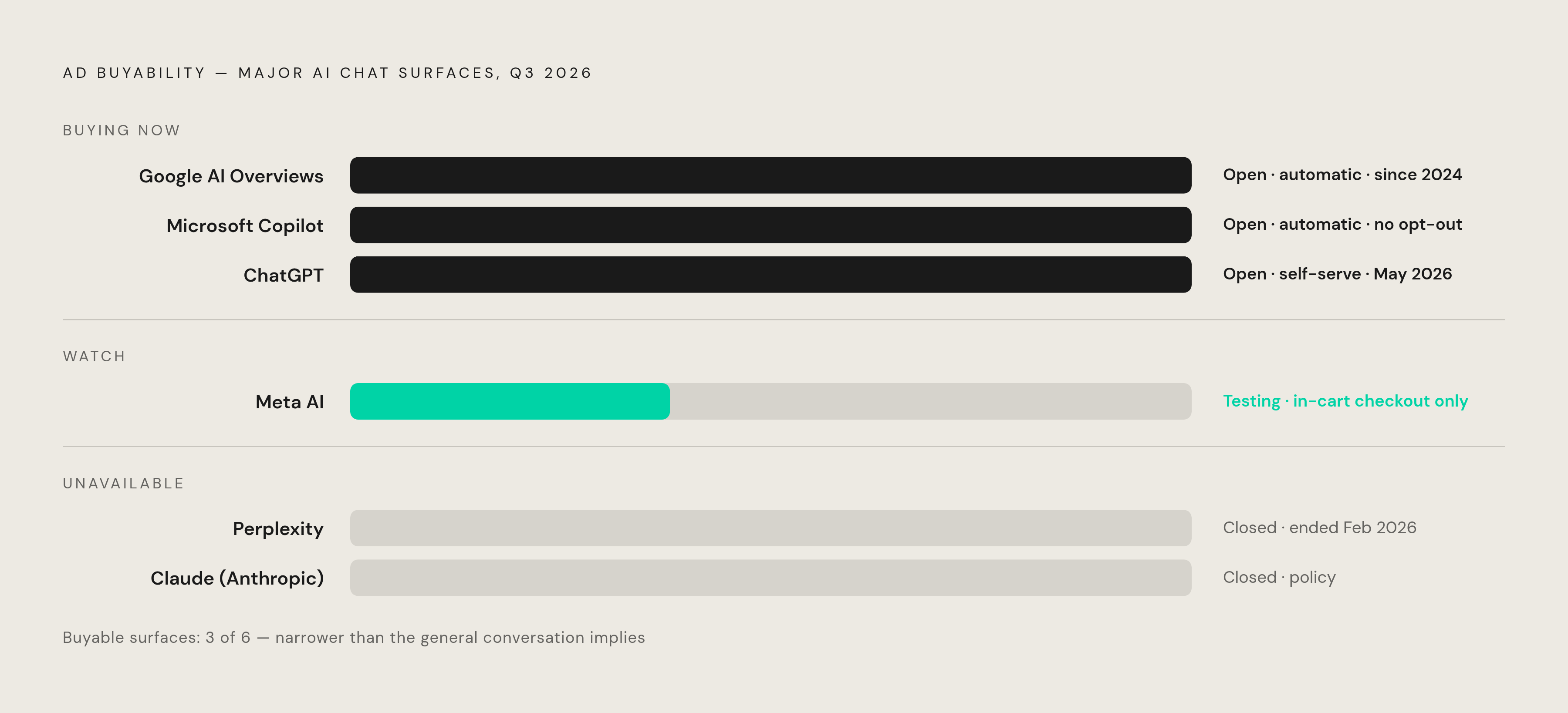
Before any of that setup work starts, a buyer needs a straight answer to which surfaces actually sell ads today. As of Q3 2026, the list is shorter than the general conversation about AI advertising would suggest, and skipping this audit is the fastest way to build a campaign aimed at a surface that no longer takes paid placements.
Google AI Overviews has carried ads automatically since 2024. If a campaign runs broad match or AI Max, Performance Max, or Shopping with smart bidding recommended, it's eligible to serve inside AI-generated answers, and there's no opt-in or opt-out setting to manage. So a buyer may have impressions already running inside AI Overviews, even if they never decided to put them there. The first task is auditing existing Google Ads accounts to see where spend is already landing.
Microsoft Copilot works the same way. Every Microsoft Advertising account is automatically eligible, and all qualifying campaign types are opted in to serving inside Copilot by default. Microsoft gives no guarantee of display and no mechanism to opt out. The audit logic that applies to Google applies here too: check what's already running before adding budget on top of it.
Perplexity is closed. The company ended its advertising program in February 2026, citing concerns about user trust, and moved to a subscription-first model. There's no paid inventory to buy there, and no indication that will change.
Meta AI isn't open for advertising yet. Meta announced in-chat checkout at Advertising Week 2026 on October 6, 2026, working with payment partners including Adyen, PayPal, Shopify, and Stripe, but that capability is still in testing. No ad format or launch timeline has been announced.
Anthropic's Claude carries no advertising inventory, by policy. Anthropic has said so publicly, and nothing suggests that will change.
ChatGPT is where most of the real setup work happens, and it deserves the most detail precisely because it's the surface with an open, working self-serve door. OpenAI's Ads Manager launched May 5, 2026, with no spend minimum, giving smaller buyers a genuine entry point into a managed-service sales process. OpenAI has also begun testing a new ad format, in early-stage testing with a limited set of U.S. advertisers as of publication. Understand this format as the platform matures, but don't build a first campaign's budget around it while it remains limited to select partners.
The Context Hint and Why It Is the Most Important Creative Decision
Once a buyer knows which door they're walking through, the next decision is writing the context hint. This single input replaces the keyword layer entirely, and it is matched against the live conversation rather than against a string someone typed into a search box.
A keyword answers the question "what did this person type?" A context hint has to answer a different question: what is this person trying to accomplish, and is the advertiser's offer useful to them at this exact point in their conversation? Those two questions produce very different inputs. A keyword is a fragment. A context hint describes a situation.
Consider the difference directly. A weak hint for a business insurance advertiser might list "business insurance, freelancers, coverage" as a set of comma-separated terms, treating the hint like a tag field. A strong hint for the same advertiser describes a scenario: someone comparing business insurance options after having described a freelance income situation earlier in the conversation. The first is a list of topics. The second is a situation and a decision point. If a team writes hints as topic lists, it gets weaker matching, because the system is reading the trajectory of the exchange, including what was said several turns earlier, to judge whether this moment is genuinely relevant to the offer.
The context hint is fundamentally different from keyword targeting because it asks not what string someone typed, but what situation and decision they are navigating right now. A DSP that reads live conversational context can weight relevance against bid strength, so a precisely written hint from a smaller advertiser can outcompete a vague one from a larger competitor, an unusual structural advantage in a market where most buyers are still writing hints like keyword lists.
The auction underneath these placements is relevance-weighted and runs on a second-price basis: the ad judged most relevant to the conversation can beat a higher bid, and the winner pays just above the next-closest competing bid. A precisely written hint functions as a multiplier on top of whatever the buyer is willing to pay. A smaller advertiser with sharper targeting language can out-compete a larger one running vague, category-level hints. The auction doesn't stop at the hint, either. It reads the ad's title, its copy, and its landing page as part of the same relevance judgment. If a hint describes a freelancer comparing insurance coverage but the landing page is about enterprise risk management, that creates a mismatch the system can detect and penalize. Consistency between what the hint promises and what the click delivers is a signal the auction itself reads.
Because the hint operates at the ad group level, every ad group needs to cover one coherent situation, not a bundle of related topics. That constraint shapes the entire campaign structure that follows.
Structuring the campaign: ad groups, creative assets, and the format constraints to work within
The account hierarchy inside a conversational AI DSP looks familiar: campaigns containing ad groups containing creative. What changes is the logic for dividing those ad groups. Instead of organizing around product categories or demographic segments, a buyer organizes around distinct intent moments, because that's what the context hint is built to describe at the ad group level.
A user early in category exploration, just starting to ask what kinds of coverage exist, is having a different conversation than a user actively comparing two named competitors. Those are two different intent moments, and each one calls for its own ad group: its own context hint, its own ad copy, potentially its own offer. Collapsing both into a single ad group with one generic hint produces weaker matching in both directions, because the hint can only describe one situation well.
The creative format itself is tightly bounded. ChatGPT's standard ad unit, as built for the self-serve launch on May 5, 2026, consists of an advertiser name, a favicon, a short headline, a brief description, an image, and a landing page. That's a small set of elements, and the brevity puts real pressure on the headline and description, since there's no secondary copy block or expanded format to fall back on if the first line doesn't land.
Setup friction has started to come down on the process side, if not on the targeting side. As of September 16, 2026, OpenAI introduced prompt-driven campaign management, letting advertisers use natural-language prompts inside ChatGPT Work and Codex to create, update, and analyze campaigns through an Ads Manager plugin, with a website link or brief sufficient to generate a first pass at ad copy and imagery. That's a meaningful convenience for getting a campaign built faster. It does nothing to replace the thinking that goes into writing a good context hint; a plugin can draft copy, but it can't decide what intent moment the ad group should be targeting.
For advertisers running large product catalogs, a demand-side platform offers a route to automatically generate creative from a product feed for ChatGPT inventory, which matters for e-commerce buyers where producing manual creative for every product isn't realistic. advertisers. It's a format to watch as the platform's ad infrastructure scales, not something to build a first campaign's structure around yet.
Restricted categories need resolving before any creative gets built, not after. Health and financial services ads on ChatGPT required case-by-case manual review as of mid-2026. Legal services in the U.S. were approved under ad policy v1.5 in August 2026. Politics, gambling, adult content, alcohol, tobacco, recreational drugs, weapons, and counterfeit goods remain ineligible. OpenAI's policy also blocks ads from showing to any account identified as belonging to a user under 18, based on account-level age data and age prediction where available, and keeps ads from appearing near sensitive or regulated topics including health, mental health, and politics. A buyer in a restricted vertical needs an eligibility answer before a single ad group gets built, because the review process runs on its own timeline, separate from campaign setup.
Setting bids and budgets when there is no keyword history to lean on
There's no Quality Score equivalent to reference here, no years of keyword-level CPC data to benchmark against, and no established CPM range for most verticals. A first-time buyer can't price this channel the way they'd price a Google or Meta campaign, because the thing they'd normally anchor to doesn't exist yet.
The auction rewards relevance, not just bid size, running on a second-price, relevance-weighted basis. That means the question worth asking isn't "what's the going rate for this placement," but "how precisely can this hint describe the intent moment a buyer is trying to reach. A sharply targeted campaign with a modest bid can out-perform a loosely targeted one backed by a much larger bid, because relevance functions as a multiplier on top of the bid itself, not a tiebreaker beneath it.
Budget sizing has to be honest about where the channel's friction sits today. A monthly budget under a few thousand dollars doesn't clear the setup cost involved at this channel's current stage. A modest monthly budget, in the low thousands, supports one controlled test, measured against assisted conversions rather than last-click performance, since the conversational nature of the surface makes direct attribution harder to isolate cleanly. If a buyer commits more per month, they can run a paid ChatGPT test in parallel with broader AI visibility work, with enough volume to read results inside a single month.
Specific CPM figures from the pilot phase of ChatGPT's ad program exist in the public record, but they describe a different, earlier stage of the market and shouldn't be treated as a current planning benchmark. Competition remains thin right now because most advertisers are still waiting for standardized performance data before committing budget, and that wait creates room for an early, well-targeted test to perform better than it would once the field catches up. Buyers with existing Amazon DSP relationships have a practical bridge into this uncertainty: Amazon DSP supports both CPC and CPM buying for ChatGPT inventory, giving those buyers a familiar mechanic to test with rather than starting from zero on the platform's native interface.
Choosing a buying path: self-serve, DSP, or managed access
Three distinct paths lead into conversational AI inventory, and the right one depends on whether a buyer needs reach across multiple AI surfaces, the ability to read conversational context precisely, or both at once.
A DSP purpose-built for conversational AI surfaces is the option for buyers who want a single campaign to reach users across multiple AI chat environments at once, with targeting built around conversational context rather than keyword or audience logic imported from older channels. Platforms in this category typically run their own exchange and hold direct supply relationships with publishers, alongside the buy-side interface a buyer actually touches. That combination matters because single-surface ad networks can read conversational context well but can't offer reach beyond their own surface, while generalist DSPs built for display or social bring broad reach but no real capacity to read a live conversation's trajectory.
ChatGPT's own self-serve option, through ads.openai.com, gives direct access to OpenAI's Ads Manager with no spend minimum, open since May 5, 2026. It's also reachable through a HubSpot integration, and, for U.S. merchants, through a Shopify integration launched September 16, 2026, with international expansion starting September 23, 2026, which puts the channel within reach of businesses already managing campaigns from inside those platforms. This path is limited strictly to ChatGPT inventory, with no capability to extend a campaign to other AI surfaces. It suits a buyer running a first, contained test on a single surface before deciding whether a broader, multi-surface program is worth building. Which path makes sense depends on how far a buyer intends to take this channel: a single-surface test calls for the native tool built for that surface, while a program meant to scale across the conversational AI landscape calls for a buying platform built to read that landscape as one continuous signal.