Turning a Live AI Prompt Into a Programmatic Bid Decision Before the Answer Loads
Ads in AI chats resolve their bids before the answer finishes generating.

Turning a live chatbot prompt into a targetable ad signal means scoring the user's actual words, in real time, against an advertiser's stated context, and settling the auction before the assistant's answer finishes generating.
Rebuilding the programmatic pipeline from scratch for conversational AI
Search advertising runs on a simple sequence. A user types a query, the engine infers intent from that string plus the page metadata it has crawled, and an auction resolves which paid result sits above the organic links. That sequence has held for two and a half decades, and the entire discipline of campaign management, keyword match types, negative lists, a relevance scoring system, bid modifiers, grew up around it.
Conversational AI breaks that sequence at its foundation. There is no query string to parse against an index of pages, because there is no page. None of that fits into the vocabulary search advertising built: there is no URL to score, no ad slot above the fold, no match type to tune. The entire apparatus has to be rebuilt around what is actually happening inside the conversation, not around a page that no longer exists in this interaction model.
The constraint that makes this rebuild non-optional, rather than a matter of style, is timing. A conversational assistant is already generating its answer token by token the moment the prompt lands. If an ad decision depends on reading and scoring that prompt, it has to resolve before or during that inference pass, inside a latency budget far tighter than the one search auctions have always enjoyed. That single constraint, more than any other, is why legacy ad infrastructure cannot simply be pointed at a new surface and expected to work.
How the raw prompt becomes a targeting signal
The prompt itself is the input the system has to work with, and what it contains is substantially richer than a search query ever was. A search engine never gets this. It gets "running shoes" or "best laptop for video editing," three or four words stripped of the context that produced them.
Multi-turn exchanges compound this advantage. The task for the platform is to take that raw language and turn it into something structured: a signal that can be scored against an advertiser's stated targeting criteria without handing the advertiser or the ad server the user's actual words. The power of the signal and the discipline required to handle it responsibly are the same fact, viewed from two sides.
The incompatibility between legacy ad infrastructure and conversational AI runs deeper than format. Platforms built for this environment are built from the ground up to read live prompt signals and resolve bid decisions before the inference pass completes, not to adapt keyword or page-based auction logic to a context it was never designed for.
Context hints as the primary targeting control
On ChatGPT, where buyable advertising inventory opened on February 9, 2026, the targeting control advertisers actually use is called a context hint: a freeform natural-language description, written at the ad group level, matched against the live conversation as it happens. There is no keyword layer sitting underneath it, no negative keyword list to maintain, no search term report to mine for new terms. The context hint describes the situation an ad belongs in; it is not a string a user might type.
That distinction is the whole skill transition advertisers have to make. A keyword asks what string someone typed. A context hint asks what the person is trying to accomplish right now, and whether the advertiser's offer actually helps them in that moment. A hint that describes someone comparing cushioned running shoes for marathon training after reading mixed reviews on a prior pair is answering the one the system is actually built to evaluate: what stage of decision is this person in, what have they already ruled out, and what kind of need are they expressing.
Writing that kind of hint well is a craft in its own right, and it's one most teams underestimate until their early placements underperform. The same logic holds beyond any single platform: any conversational AI system that targets by context rather than keyword bid is asking its advertisers to describe a situation, not list tokens, and that's the underlying skill every buyer in this channel has to build regardless of which surface they're buying on.
How the auction resolves before the answer loads
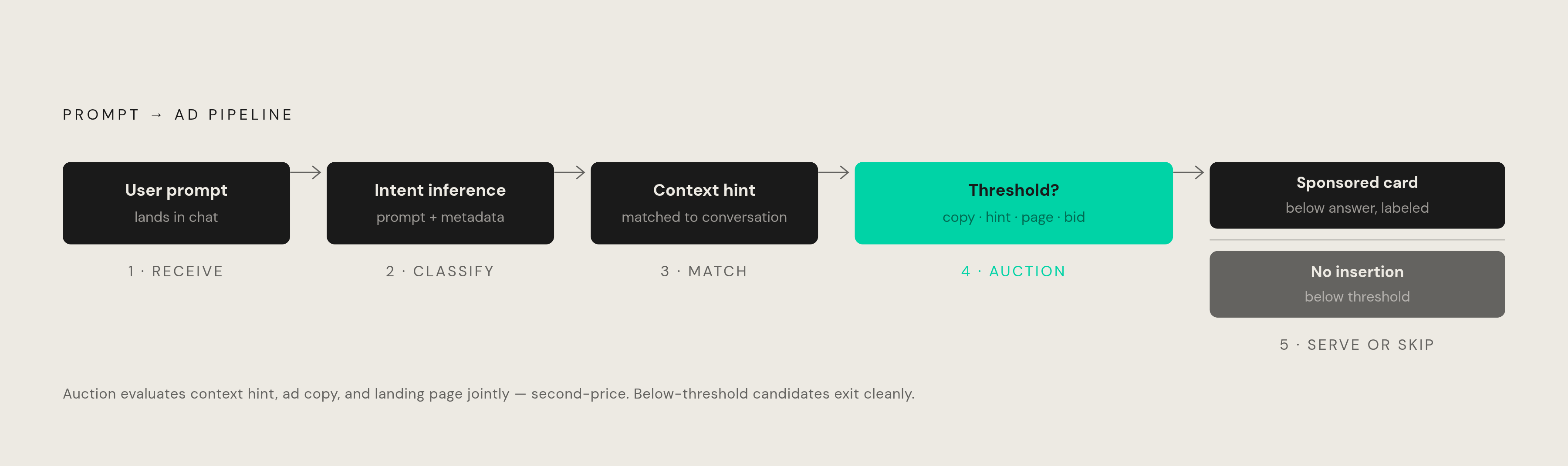
Once a context hint is in place, the decision about whether and which ad appears happens inside an auction built for this specific constraint. ChatGPT runs a relevance-weighted second-price auction, and the two properties in that phrase do different jobs. Relevance weighting is the property doing more work in the short term: a context hint that fits the conversation precisely can outrank a higher raw bid that fits it poorly. That means the quality of an advertiser's context hint functions as a direct lever on both placement rate and cost efficiency, a property closer to a relevance scoring system in search than to a pure spend auction, and one that rewards precision over budget size in a way paid media rarely does.
The auction doesn't evaluate the bid in isolation. It reads the context and intent of the live conversation, the advertiser's context hint, the ad's title and copy, and the landing page together. A landing page that doesn't match the conversational context can cost an advertiser placement eligibility before a single click ever happens.
Academic work at Duke's Fuqua School, led by Ali Makhdoumi, offers a structural model for how a platform can decide, turn by turn, whether to serve an ad. The framework proposes a threshold: if the best available ad at a given point in the conversation falls below a relevance or value threshold, the system keeps generating the conversation with no ad inserted. If a candidate ad clears that threshold, the auction resolves and serves the placement. That framing matters because it means an ad's presence in any given turn is itself a judgment the system makes about relevance, not a guaranteed slot sold in advance. Inventory, under this model, is produced by the quality of the conversation and the quality of the available ads together, not fixed in advance the way a results page's ad slots are. The same research proposes what it calls a tilted distribution mechanism, where the system can nudge the language of its response toward a sponsored result, but only inside a plausibility constraint that limits how far that nudged output can drift from what the organic, unsponsored answer would have said. That constraint is a guardrail against the response itself becoming an advertisement, and it is worth taking seriously as a design principle even where it describes a proposed model.
Sponsored result placement relative to the token stream
What the auction produces, on ChatGPT, is a labeled sponsored card that renders below the assistant's answer, not folded into the answer text itself. That separation is the format's central design decision: the model's response is not for sale, and the placement sits adjacent to it, visibly marked as sponsored. A user reads the assistant's actual answer first, uncontaminated by the auction that may have just run behind it, and only then sees a distinct, labeled commercial unit.
That design choice also narrows who the ad can reach. It serves only logged-in adult users on ChatGPT's Free and Go tiers; Plus, Pro, Business, Enterprise, and Education tiers stay ad-free. That has a direct consequence for B2B campaigns in particular: buyers in enterprise software or professional services are disproportionately likely to sit on a paid tier because their employer covers the subscription, so the inventory a B2B advertiser can actually reach is narrower than the platform's total user base would suggest.
Google's approach to placement looks structurally different. AI Overviews and AI Mode surface ads inside the AI-generated answer itself, through the same Google Ads infrastructure advertisers already use: Search campaigns running on broad match or AI Max, Performance Max, and Shopping campaigns. Microsoft Copilot runs on the same logic. All eligible campaign and ad types are automatically opted in to serving inside Copilot, advertisers have no mechanism to opt out, and no individual placement is guaranteed even once a campaign is eligible.
How each live platform implements this pipeline differently
If you ask which platforms actually let you act on live conversational intent today, you are choosing between a small number of systems, each of which has made a distinct architectural choice about where advertiser control sits in the pipeline.
ChatGPT opened its ad inventory on February 9, 2026, on Free and Go tiers in the US, with self-serve buying expanded to Europe, India, the Middle East, and North Africa by September 2026. Targeting runs through the context hint system at the ad group level, with a large per-ad-group limit on how many natural-language hints an advertiser can set. The auction is the relevance-weighted second-price model described above. Buying happens directly through a self-serve manager at ads.openai.com, which opened on May 5, 2026, and the same inventory is also reachable programmatically through StackAdapt, live the same day, and through Criteo, connected since March 2, 2026, which brings Criteo's existing advertiser base into the channel. Launch partners included Target, Adobe, Williams-Sonoma, and Albertsons, with agencies WPP, Omnicom, and Dentsu among the early buyers. Advertisers choose among three buying objectives: Reach on a CPM basis, Clicks on a CPC basis, or Conversions on an oCPC basis.
Google's AI Overviews have carried ads since October 2024, but AI Mode ads are still in a test phase as of 2026. Targeting runs through existing Google Ads campaign logic, broad match or AI Max, Performance Max, and Shopping, rather than through any separate context-hint layer built for conversational surfaces. Smart Bidding is required, there is no opt-in or opt-out control, and Google provides no segmented reporting for either AI Overviews or AI Mode placements, so advertisers cannot isolate how these surfaces perform apart from the rest of their search campaigns. The practical consequence is that any already-eligible campaign is already running inside AI-generated answers. The first step for most advertisers is an audit of existing exposure. Google Marketing Live 2026 announced two new AI Mode formats, Conversational Discovery ads and Highlighted Answers, neither of which is available to buy yet. On Gemini, the same two formats are now in live testing in the US, alongside a Business Agent for Leads format in open beta, but the standalone Gemini app itself stays ad-free.
Microsoft Copilot operates through existing Microsoft Ads inventory, with no separate Copilot-specific buy and no opt-out mechanism, matching the same automatic-eligibility model Google uses. Copilot Checkout, launched in January 2026, added in-conversation commerce directly inside the assistant, and the platform has since expanded its format set with "Compare & Decide" ads and shopping campaigns.
Only some conversational AI platforms have built toward this pipeline. Some assistants have explicitly declined to carry advertising in their conversational surface, a reminder that the auction-and-context-hint architecture described in this piece is a deliberate design choice each platform makes, not an inevitable feature of conversational AI itself. Budget decisions have to follow where inventory actually exists today, not where it has been announced for some future date.
Measurement and attribution inside assistant-mediated discovery
Everything described so far, prompt to context hint to auction to placement, handles the question of whether and how an ad gets served. None of it resolves the separate question of what happened afterward, and that gap is the honest limit of where this pipeline currently stands.
Last-click attribution assumes a user clicks an ad and converts along a traceable path. The assistant may name a brand and shape a decision without the user ever leaving the conversation to click anything at all, and the absence of a click here is a direct consequence of how the format itself is built.
The practical alternatives, assisted-conversion modeling, brand-mention tracking, and holdout testing, each require infrastructure and experimental discipline that most advertising teams do not have running before they start spending in this channel. Google compounds the problem on its own surfaces: AI Overviews and AI Mode offer no segmented reporting at all, so advertisers cannot isolate how much of their performance is coming from AI placements versus the rest of their search campaigns. The output of the pipeline, in other words, is currently invisible to the standard reporting most teams already rely on.
An agentic layer sitting on top of this adds a further wrinkle. Omnicom has confirmed an agent-to-agent framework, built on the Ad Context Protocol, disclosed on its Q1 2026 earnings call, in which agents execute media buys and interact with users with no human in the loop at each step. The IAB Tech Lab's Agentic RTB Framework, published January 6, 2026, takes on the latency side of this problem, the part of the pipeline concerned with settling bids fast enough to keep pace with inference, but it does not touch attribution. The two problems sit next to each other in the same pipeline, but they are not the same problem, and solving one does not solve the other.