Your Chatbot Closes Existing Visitors — Conversational AI Ads Reach Strangers Before They Find You
Chatbots convert existing visitors; conversational ads find strangers.
A website chatbot and a conversational AI ad are not variations on the same technology. They sit at opposite ends of the customer journey, solve different problems, and failing to tell them apart leaves the most valuable part of the funnel completely unattended. A marketer who installs a chatbot and considers the job of "AI advertising" done has covered one end of a two-sided problem and left the other wide open. The distinction matters because confusing them creates a gap in the funnel where potential customers form their needs and never once encounter the brand.
Why a website chatbot and a conversational AI ad are not the same tool doing the same job
The confusion is easy to understand. Both tools use natural language and feel conversational in the way that matters to a user typing a question instead of a search string. Both live inside AI interfaces, and both get filed under the same internal budget line labeled "AI." But that surface resemblance hides a categorical difference in what each tool does, when it does it, and who it's doing it for. A chatbot and a conversational AI ad are not two settings on the same dial. They are built for different moments in a buyer's path, and treating them as interchangeable leaves one of those moments unaddressed.
A conversational AI ad is a discovery tool. It reaches someone who has never heard of the brand, inside a conversation they're already having with an AI assistant, at the exact point a relevant need surfaces, before a search query gets typed and before any website gets visited. A chatbot, by contrast, only ever meets people who already found the brand on their own. Mistaking one for a substitute of the other means a company can spend real budget on "conversational AI" and still have no presence at the moment that turns a stranger into a prospect.
Where a chatbot sits in the funnel
Chatbots are built for people who already arrived. Their entire job is to take a visitor who searched, clicked an ad, followed a referral link, or typed in the URL directly, and move that person from "on the site" to "ready to buy." That's a real and valuable function. A well-built chatbot handles product questions, walks someone through configuration choices, works through pre-purchase hesitation, and routes a qualified visitor to checkout or to a sales rep, all without a human having to be available at 11pm on a Tuesday. None of that should be dismissed. It's the kind of friction reduction that measurably improves conversion rates once someone has already decided the brand is worth their time.
But the chatbot's usefulness depends entirely on discovery having already happened somewhere else. It has no mechanism for reaching anyone who hasn't already arrived. It generates no impressions among strangers, triggers no exposure for people who haven't typed in the domain, and has absolutely no way to intercept a need before that need gets directed at the brand by some other channel. It's a structural fact about where chatbots operate: everything upstream of the website visit is outside their reach, by design, because that was never the job they were built to do.
Where need forms now
The place where a need first takes shape has moved. People increasingly work out what they want, what fits their specific situation, and which options even exist, in a running conversation with an AI assistant, long before they open a search engine or type a single query. When someone tells an assistant "I need to plan a two-week trip to Japan with my family," that's a conversation, and the intent embedded in it is richer than any keyword could capture, because the context arrives fully formed: family size, trip length, destination, and the implicit constraints that come with planning travel for a group.
That shift changes what the search query actually represents. For a growing share of buying journeys, the query typed into a search box is closer to where a decision that already took shape gets confirmed than to where consideration starts. The conversation that happened earlier, inside the AI assistant, is where the real groundwork got laid: the options got narrowed, the priorities got named, and the shape of the eventual purchase got sketched out. A brand that only shows up once the search happens is showing up after the most important part of the decision has already occurred.
What makes the prompt-level intent signal different from a keyword or a demographic
A keyword is a fragment. It's a word or short phrase stripped of the situation that produced it, and advertisers have spent two decades trying to infer intent from that fragment using match types, negative keyword lists, and bid adjustments. A conversational prompt is a full brief, volunteered by the user, that lays out their circumstances, their trade-offs, and what they're actually trying to decide, all in one exchange.
Intent inside a conversation also breaks down into distinct layers, the same four categories that search marketers have long used to classify a query: informational (someone researching a topic), commercial or comparative (someone weighing specific options), transactional (someone ready to act), and navigational (someone looking for a particular site or resource). Each of those layers represents a different kind of advertising opportunity, and a system built to read conversational context can tell them apart in a way a keyword list cannot. The targeting is based on the full trajectory of the exchange, what was asked several turns earlier, how the assistant responded, and what follow-up questions came after. Relevance comes from the arc of the dialogue as a whole.
That also makes the signal more respectful of user privacy than the systems it's replacing. Relevance comes from what's actually being discussed in the conversation happening right now, not from a behavioral profile stitched together from weeks of cross-site tracking. That's a meaningfully different foundation than the demographic model search and social advertising have run on for years. A demographic segment tells an advertiser who someone is, statistically, based on age, location, and browsing history. A conversational prompt tells an advertiser what that specific person needs right now, in their own words, inside their own situation. One is a census category. The other is a live brief.
How ads are matched to conversations inside AI assistants
Conversational AI ad placement runs on four layers of infrastructure: demand and auction, context and targeting, creative generation, and measurement. Each layer had to be built new, because none of the assumptions that search and social advertising were built on carry over into a live conversation. There's no keyword list to bid against. Instead, a core advertiser control is the context hint, a plain-language description of the kinds of conversations where a given ad belongs. The system compares that description against what's actually happening in the live conversation, rather than matching it against a static keyword catalog. Advertisers layer in other controls on top of that, including geo targeting, custom audiences, and bid strategy, but the context hint is the mechanism that makes conversational matching possible.
Placement itself runs through a relevance-weighted, second-price auction. A more contextually relevant ad can beat a higher bid from a less relevant one. Relevance to the actual conversation functions as a real competitive lever in that auction, not a minor adjustment buried in a quality score formula.
Google takes a different route, running placement through its existing campaign infrastructure. Broad match, AI Max, Performance Max, and Shopping campaigns are all eligible to appear inside AI Overviews, and for AI Mode specifically, Google draws primarily from AI Max for Search, AI Max for Shopping, and Performance Max campaigns. There's no opt-in or opt-out for this placement: if a campaign qualifies under those categories, it's already running inside AI-generated answers whether or not the advertiser configured it with that placement in mind. Microsoft Copilot works on a session-level model, triggering ads based on the entire conversation within a session rather than just the most recent prompt, and it introduces the resulting ads through a feature called "ad voice," which frames how the ad relates to what the user and assistant were just discussing.
The discovery gap: what the funnel looks like when the chatbot is the only AI investment
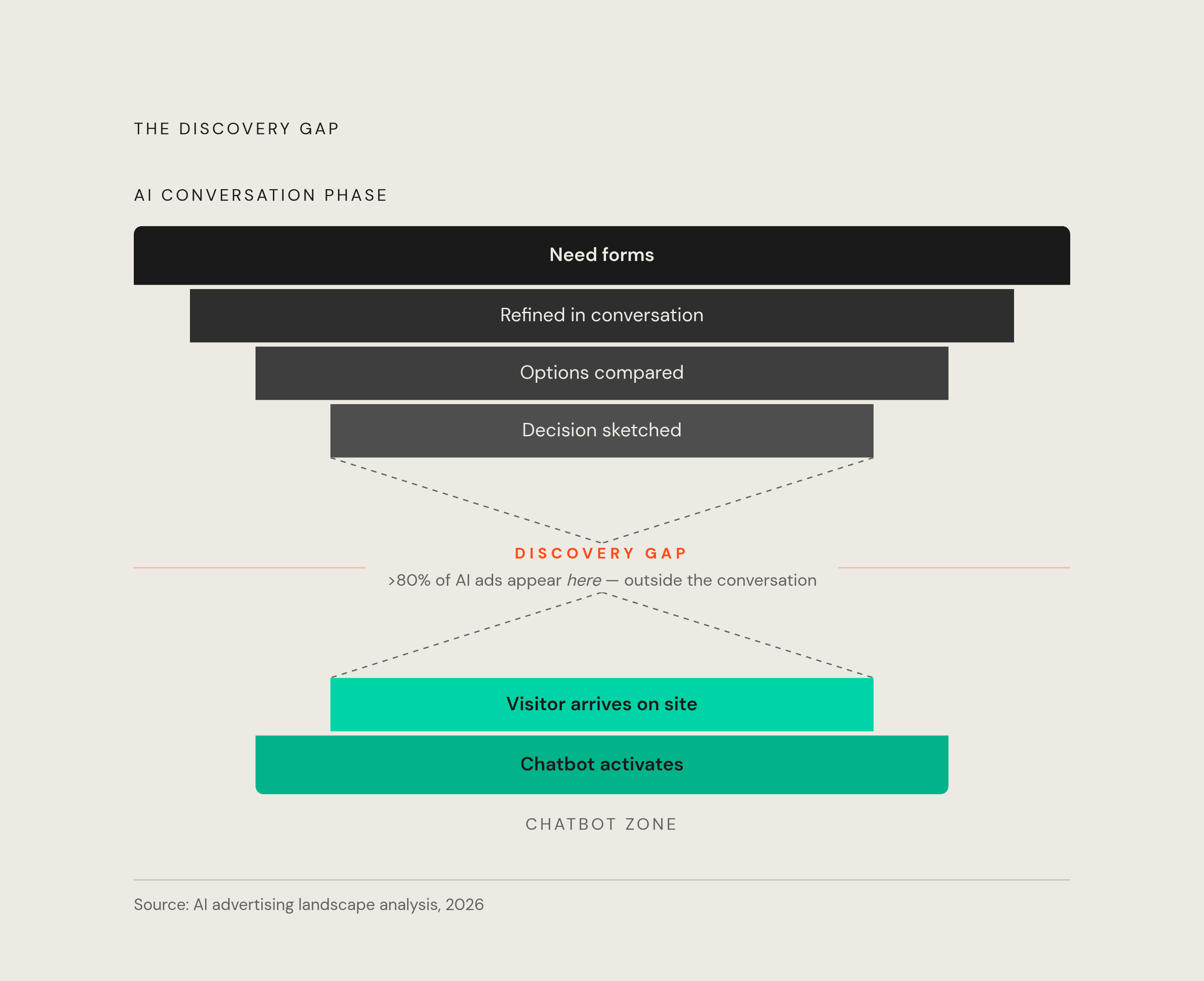
A brand that has built a chatbot but never invested in conversational AI advertising has covered the bottom of its funnel while leaving the top completely unattended. The chatbot converts the strangers who happen to find the site on their own. It does nothing for the far larger population of people forming a relevant need right now, inside AI conversations happening somewhere else entirely, who have no particular reason to type the brand's name into anything.
Call the space between those two points the discovery gap: the distance between where a need first takes shape, inside an AI conversation, upstream of any search, and the first moment the brand becomes visible to the person having that need. For a brand running a chatbot alone, that gap can stretch across the entire consideration phase of the purchase. The need forms, gets refined, gets compared against alternatives, and gets resolved into a decision, all without the brand appearing once.
That gap keeps widening. More than 80% of AI advertising in 2026 still appears adjacent to AI-generated content rather than inside the chatbot conversations themselves. Every conversation that starts inside an AI interface and ends in a purchase decision, without the brand ever appearing in that exchange, is a buying journey the brand never entered. The chatbot cannot close this gap on its own, because it only ever activates after someone has already crossed it. Closing it requires showing up at the point where the conversation begins, not waiting at the point where the site visit ends.
What a brand needs to operate at both ends of the funnel without creating two disconnected programs
Closing the discovery gap means building a presence upstream of the chatbot, so the top of the funnel matches the bottom, and so the conversations generating intent can be reached before the stranger having them becomes someone else's customer instead.
The surfaces where these conversations happen keep multiplying. ChatGPT, Google AI Mode, Microsoft Copilot, and the AI assistants that will follow each run their own inventory, their own targeting model, and their own creative requirements. Buying into each one separately, through each platform's own interface, recreates the same fragmentation that search and social advertising teams have dealt with for the past decade: duplicated effort, inconsistent reporting, and campaigns that can't learn from each other across surfaces.
What separates a cross-surface buying approach from a handful of single-platform experiments comes down to two capabilities working together. The first is reading conversational context, which requires parsing live dialogue instead of the pages and feeds generic demand-side platforms were designed around. That's a structurally different approach than either keyword-matching systems or profile-based demographic targeting. The second capability is reach across multiple AI surfaces at once, something a single-surface network can't offer, since its inventory stops at the edge of whichever one assistant it was built around.
Creative has to change too. Each AI assistant renders ads in its own native format, and conversational relevance rewards specificity over generic messaging. The sheer volume and variety of creative that requires isn't something static banner production can keep up with. Generative, context-matched creative is a structural requirement of running this channel.
Attribution needs the same honesty applied to it. A user can research a purchase and form real intent inside an AI conversation, then convert later, on-site, through an entirely different path. That gap between the conversation and the conversion makes last-click attribution models unreliable for this channel specifically. Teams putting budget here need measurement built to account for that gap, not models that quietly assume it doesn't exist.
How to think about deploying both tools as a coherent strategy rather than two separate bets
What matters is which tool does which job, at which moment in the journey, and the two turn out to be complementary by design. The ad reaches a stranger at the exact moment their need forms. The chatbot converts the visitor that moment eventually sends to the site. Neither one can do the other's job, and neither one needs to.
A brand running both has a funnel with a presence at the point where intent first forms and at the point where a decision gets made, which together make up the full arc of how a buying journey now plays out across AI interfaces. That's a materially different position than having a strong bottom-of-funnel tool and an empty top.
The place to start is intent mapping: figuring out which conversations buyers are already having with AI assistants, what problems they're describing, what comparisons they're running between options, what situations they're explaining in their own words, and then building context hints that place the brand inside those specific moments. Measurement needs to be set up from day one to track the path from an AI impression through to an eventual conversion, rather than assuming existing pixels and last-click models will catch it on their own, because they won't.
Marketers waiting for conversational AI advertising to become mainstream before getting involved are making the same bet that late entrants to search and social advertising made in those earlier cycles: that there would be plenty of time to catch up once the channel matured. Inventory is less contested now than it will be once the category gets crowded, and the intent signals available inside these conversations are richer today than they're likely to remain once every competitor is bidding on the same context. The funnel now has two ends that need covering, and only one of them has been getting most of the attention.