Paid Placement Opportunities in AI-Powered Answer Engines
AI answer engines are becoming a $25.9 billion ad market by 2029.
Paid placement inside AI answer engines is a real market now, with real auctions, real spend, and real conversion numbers behind it. The change driving all of it is easy to describe: people don't scroll through ten blue links anymore. They ask one question, get one answer, and stay inside that answer for the rest of the session.
Keyrus puts the number at 42% of users who now start their research with an LLM instead of a search engine. That means most of the discovery process is over before anyone sees a banner or a sponsored listing show up. The scale backs it up. ChatGPT became the fastest mobile app in history to hit one billion monthly active users, in May 2026, according to Sensor Tower, moving past TikTok, YouTube, and Instagram along the way. That's mass media at this point, not a search box tucked in the corner of a browser, and the inventory worth fighting for lives inside the conversation, not around its edges.
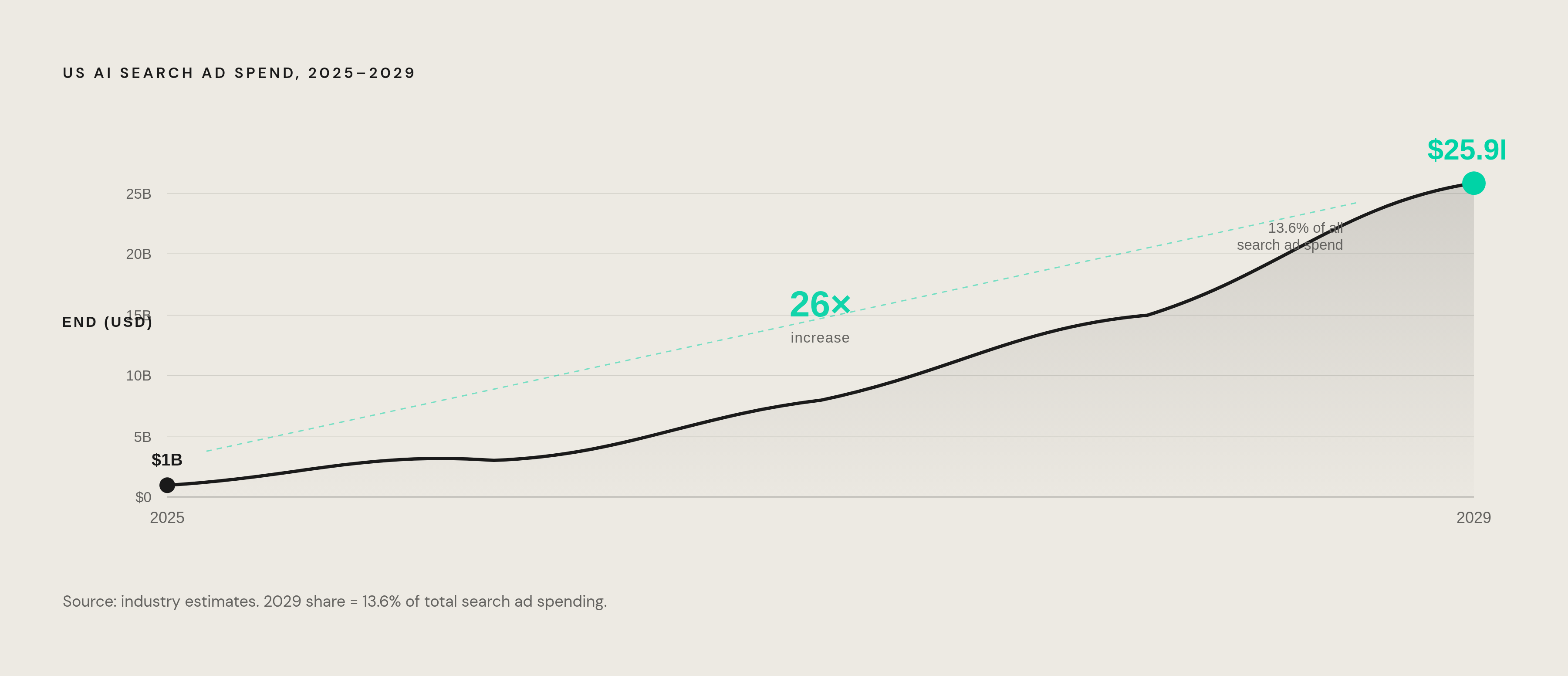
Digital Applied expects US AI search ad spend to go from $1 billion in 2025 to $25.9 billion by 2029, which would put it at 13.6% of all search ad spending. A 26x jump in four years isn't a rounding error on anyone's media plan; it's a new budget line, and whoever hasn't written it in yet is already behind schedule.
The broader AI marketing industry passed $47.3 billion in 2025 and is growing at 36.6% a year. Keyrus separately expects AI and LLM channels to go from 6% of digital ad spend in 2023 to 30% by 2027. Call that a test budget and a brand isn't just under-investing, it's misreading what's actually happening.
The early movers are already cashing in. US GenAI ad spend more than tripled in the first quarter of 2026 alone, and Sensor Tower attributes most of that jump to OpenAI, up roughly 800% year over year, and Anthropic, up over 1,100%. Nobody knows exactly where this settles, but the advertisers who understand how the auctions work right now are setting the terms everyone else will eventually have to follow.
Where paid placements can actually be bought today: the platform landscape as it stands
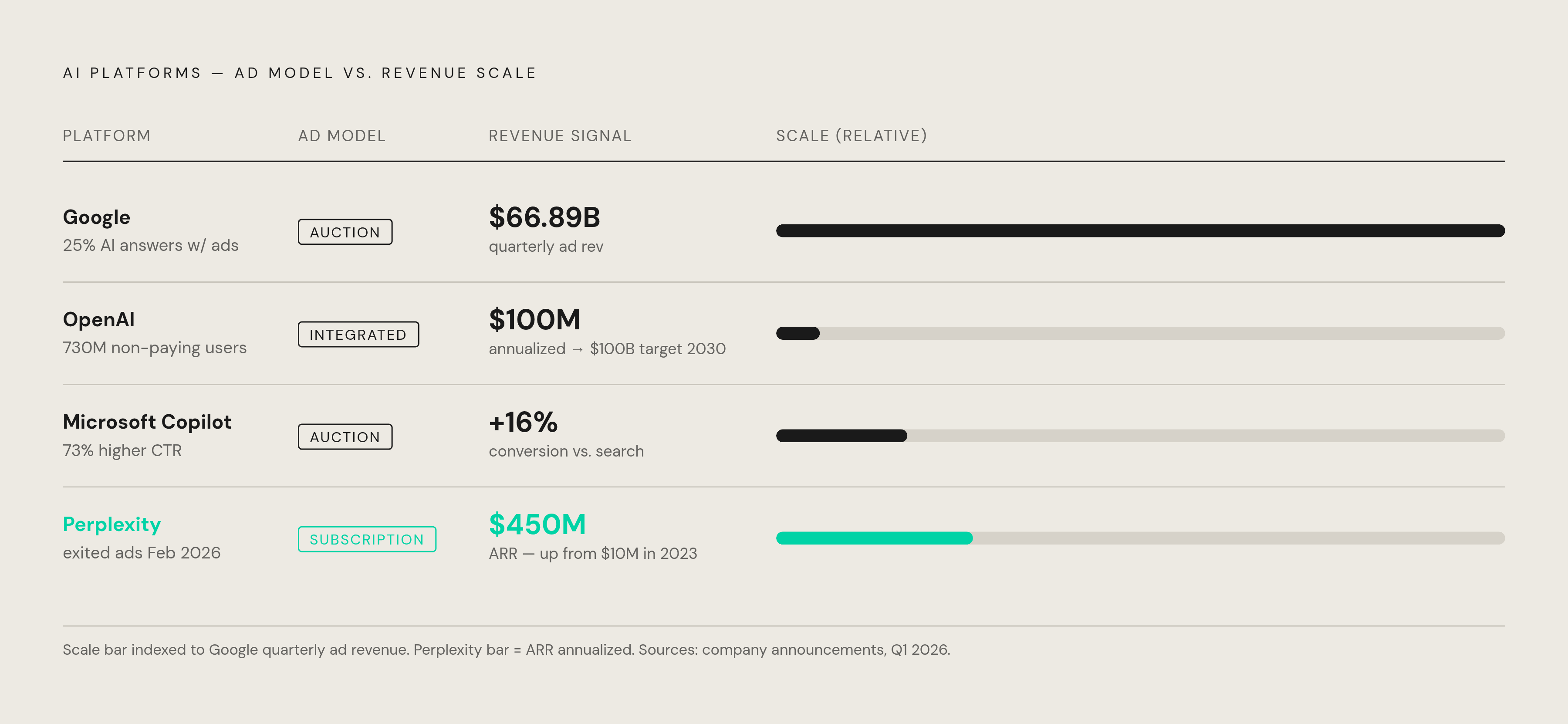
Four platforms are placing four different bets on how this should work.
OpenAI launched Sponsored Suggestions on February 9, 2026, then followed with an Ads Manager on May 5. Access is invite-only and limited to logged-in adult users in the US on the Free and Go tiers; Plus, Pro, Business, and Enterprise users see no ads at all. Only about 8.5% of ChatGPT's 800 million users pay for a subscription, which leaves roughly 730 million people OpenAI actually needs to monetize through ads. The early numbers are big already: $100 million in annualized ad revenue the moment the feature flipped on, a projected $29.4 billion in total revenue for 2026, and a stated target of $100 billion in ad revenue by 2030. Target's retail media arm, Roundel, is one of the first brand partners live in the system, which tells you something about how retail got there first while most other categories were still figuring out where the door was.
Google's incentives run differently, so its approach looks different too. Sponsored ads already run inside AI Overviews on desktop search, and sponsored content shows up alongside roughly a quarter of all AI-generated answers on Google. The company is also testing labeled "Sponsored" ads inside AI Mode, live now in the US on desktop and mobile. Google's core ad revenue hit $66.89 billion in a single quarter of 2025, so pushing that same machinery into AI surfaces isn't a hard call. Ads inside the standalone Gemini chatbot got pushed back to 2026, though, because the plan is to grow the user base first and monetize second.
Microsoft Copilot has the longest track record of the four, with ad formats that shift as the conversation moves. Microsoft's own data shows Copilot ads driving 73% higher click-through rates and 16% stronger conversion rates than traditional search, with customer journeys running 33% shorter. User satisfaction climbed roughly 2% a month through 2025, which looks like a relevance signal, not just a volume one.
Perplexity went the opposite direction entirely. In February 2026 it walked away from advertising, citing user trust, and shifted to a subscription-only model targeting $500 million in annualized subscription revenue. It's working: annualized recurring revenue crossed $450 million in March 2026, up from just $10 million in 2023. Trust turned out to be a real edge in this market, not a slide in a pitch deck.
Past these four, a long tail of LLM-powered apps, vertical AI tools, and chatbot interfaces makes up a growing pool of inventory, and getting into it usually takes far less friction than the closed betas above. Reaching that long tail at scale means using demand-side and supply-side platforms built for conversational AI specifically, not tools bolted on from an old display or search stack.
Why prompt-level intent is a structurally different signal than a keyword or an audience segment
In search, the basic unit of targeting is the keyword: a string of text matched against a list of terms. It's reactive and lexical, and the system waits for a match, then stops there.
A conversation doesn't work that way. People build up context, constraints, preferences, and timing across a whole session instead of typing one isolated phrase and walking away. Analysis of LLM interactions puts roughly 60% of prompts in the informational category and 40% as transactional, but even the informational ones carry purchase signals a keyword system would never pick up. eMarketer's sportswear example gets at this well: someone typing "Nike sneakers" shows in-market intent, sure, but a ten-prompt conversation about marathon training reveals product preference, budget, and purchase timing, none of which a single query could surface.
In high-engagement categories, users work through many prompts per session, building up a depth of signal that a search query never approaches. No search query comes close to that depth of signal. Users build up substantial context across a session before moving to an e-commerce site, and for high-intent categories, the conversion window can close quickly. A placement that fits into one of these conversations reaches a buyer earlier, and with more context attached, than any keyword bid ever managed.
How ad targeting, bidding, and format actually work inside a conversational AI environment
Ads fire off the content of the prompt itself, or the wider thread of the conversation, instead of a pre-built audience list or a cookie trail. Some implementations carry that signal across sessions using stored preferences or past interactions. The analysis happens in milliseconds, and the ad shows up the moment intent appears in the text. People say what they want more plainly in a chatbot than they ever did in a search box, and that raises the bar for whatever gets placed next to it.
Format follows the same logic. Inside ChatGPT, ads show up in a clearly labeled sponsored box at the bottom of the answer, kept visually separate from the AI's own response. Early infrastructure partners are building creative formats for this surface specifically, rather than reshaping old banner creative to fit somewhere it doesn't belong. Target's Roundel integration is the clearest live example: sponsored product ads appear next to a shopping conversation, served off keywords pulled straight from the user's own prompt. The ad sits right next to the answer the person actually asked for, which is a far less disruptive spot than a banner or a pre-roll clip ever got.
Pricing runs on two tracks. ChatGPT Ads sells on CPM for the Reach objective and CPC for the Clicks objective. OpenAI's recommended starting bid sits at $3 to $5 per click, with a default max CPM bid around $60. The auction itself is relevance-weighted, so how well an ad fits the conversation matters as much as the size of the bid. A small budget with a genuinely relevant ad can beat a bigger budget that misses the context, which upends a good chunk of old media-buying instinct.
Early infrastructure partners are handling targeting, measurement, and creative formats at the pilot stage, building tools that let marketers operate across both sides of this channel. For brands looking past the named platforms, DSPs and SSPs built for conversational AI are where the independent publisher ecosystem gets monetized, and where advertisers get at that inventory without waiting on an invite from any single company.
The answer independence principle and why ad transparency is load-bearing for this channel
OpenAI's stated approach keeps ads architecturally separate from the AI's own answer, with distinct visual treatment so people can tell them apart. There's a plain business reason behind holding that line. The moment someone suspects an answer might be for sale, the product's credibility and the ad inventory's value collapse together, at the same time.
Perplexity's exit from advertising is the clearest counter-example on the table. Trust concerns pushed the company away from ads entirely in February 2026, and subscription revenue picked up speed right after. Companies are making structural decisions around trust in this market already, not just writing about it in a press release.
For advertisers, the labeled sponsored box makes the placement credible to people who already distrust influence they can't see. Brand safety works differently here than in display or social, too, because the AI-generated context around an ad can shift from one turn of the conversation to the next. Judging brand suitability means looking at the level of the prompt, not the page. A placement that damages someone's trust in the interface doesn't fail just once; it drags down every placement that comes after it on that same surface.
What brands and agencies need to do differently to compete for placement in this environment
Since the auction is relevance-weighted, winning creative gets built around the conversational context of the prompt, weighted heavier than keyword density or a demographic match pulled off an old media plan. Ad copy has to answer or build on the question someone actually asked. Product framing needs to match the level of detail people use across a multi-turn conversation, which usually goes well past anything a keyword search ever captured. Creative built for banner inventory doesn't carry over here without rethinking the structure and the call to action from the ground up.
Measurement needs the same kind of rework. Conversion windows vary significantly by category, and last-click attribution models built around search behavior will undercount what conversational AI actually contributed, every single time. Session-level signals, prompts per session, how deep the conversation ran, say more about the quality of intent than impressions or click totals ever will.
This channel sits earlier in the journey than search, right at the point where intent first takes shape, before anyone lands on a results page or a product listing. eMarketer projects 133 million US adults will use generative AI in 2026, which is enough audience scale to treat this as a primary channel, not a pilot program. E-commerce, finance, health, and travel brands are especially well placed to move first, since people already lean on AI for recommendations in these categories, and purchase intent shows up right there in the text of the conversation, explicit and unmissable.
Direct access is still uneven. ChatGPT's program remains invite-only, so DSPs and SSPs built for conversational AI are, for now, how most brands and agencies reach the wider LLM ecosystem, including the long tail of AI-native publishers, without sitting in a queue waiting on one platform's approval. Platforms such as Thrad, a programmatic ad marketplace for AI chat inventory, sit squarely in that gap. The brands building real fluency now, matching creative to prompt context, measuring across longer and less predictable conversion windows, working across more than one AI surface at once, are building a lead that gets harder to close with every quarter this channel keeps growing.