Advertiser Readiness Assessment for the AI Search Transition
Most advertisers haven't rewired their playbooks for how AI search actually works.

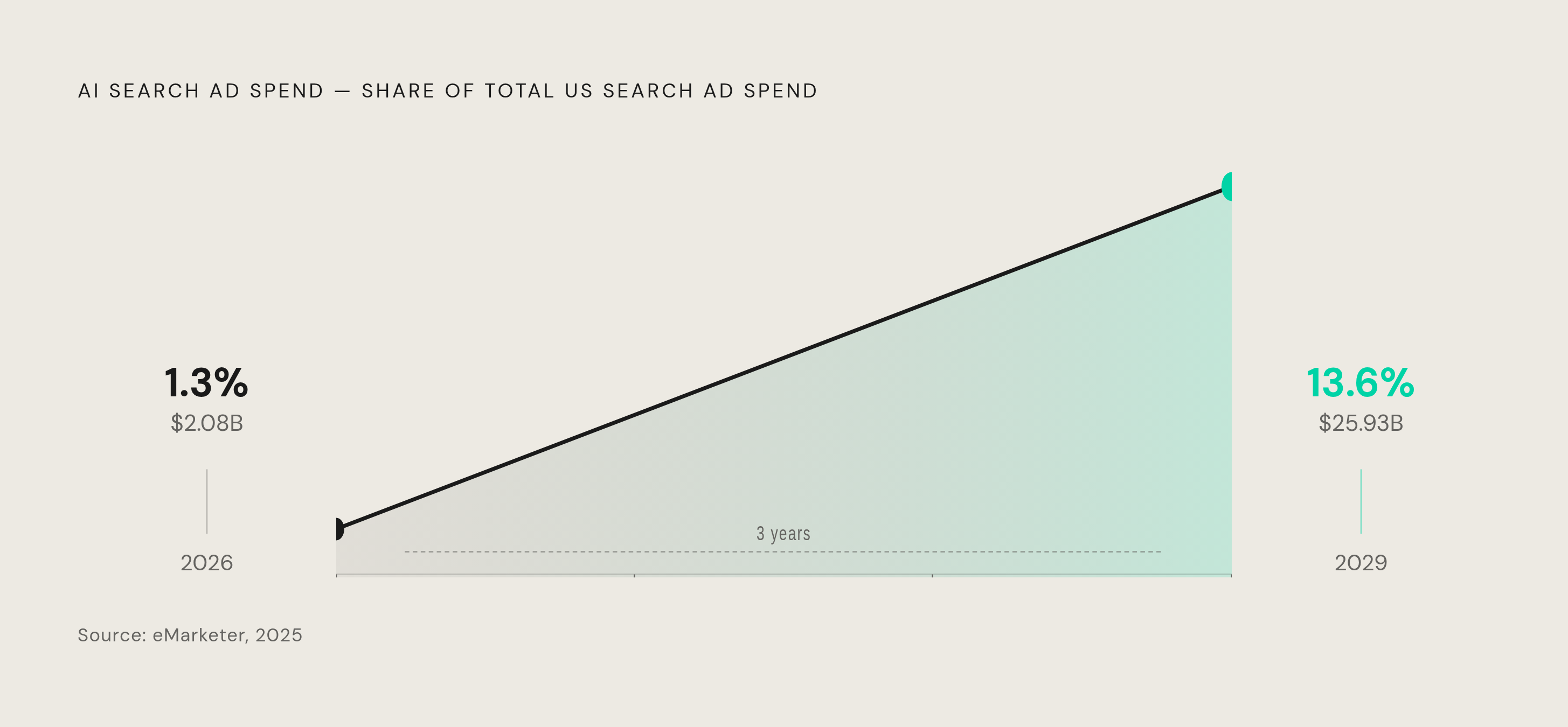
US spending on AI search ads is set to jump from $2.08 billion in 2026, just 1.3% of total US search ad spending, to $25.93 billion by 2029, when it will make up 13.6% of the market, according to eMarketer. That first number is small enough to wave off, but the climb from there to 13.6% inside three years is harder to dismiss.
Skepticism about the 1.3% figure misses what's already happening underneath it. By the second quarter of 2026, AI search had replaced 18% of classic US search sessions, per Similarweb, and ChatGPT was processing 2.5 billion queries a day by July 2025. Global time spent on generative AI apps is on pace to hit 36 billion hours in the first half of 2026, up from 17.2 billion hours a year earlier. People are already living inside these tools, and the ad machinery is scrambling to catch up to where their attention actually sits.
This is a share shift, and it's moving faster than almost any media transition on record. Advertisers who waited out mobile, waited out programmatic, waited out social, all paid a tax for showing up late once the shift became obvious to everyone. That pattern shouldn't need repeating at this point, yet most advertiser playbooks today, the creative templates, the targeting logic, the measurement models, the budget frameworks, were all built for a keyword-and-click world. Conversational interfaces strain against that mold in ways worth examining. Working through that mismatch is what this piece sets out to do.
What makes AI search fundamentally different from the environment advertisers know
Legacy search runs on a simple mechanic: a keyword triggers a discrete ad slot, and the auction resolves in a way advertisers have spent two decades learning to game. LLM environments run on a different logic. A multi-turn conversation produces a fluid, generated response, and where an ad shows up inside that response, in what format, and how relevance gets scored, follows rules that owe little to a search results page.
Four surfaces exist right now for LLM chat ads: an inline sponsored card that appears after the answer, a sidebar placement, a sponsored follow-up suggestion chip, and a brand mention woven directly into the generated text. Each one carries its own latency cost, its own tax on the user experience, its own performance quirks. None of them map cleanly onto a search ad unit, and anyone telling you otherwise hasn't actually bought media on both.
The query mix is different too. AI prompts skew heavily toward informational and research intent, with transactional queries making up a smaller share than in legacy search. Search inventory has always clustered around the transactional end, the moment someone's ready to buy. AI search drags ad opportunity earlier into the funnel, into the research-and-compare phase, which changes what an ad has to do and when it has to show up.
The plumbing underneath targeting has shifted too. Instead of keywords and cookies, the system runs on conversational intent and topic signals, often piped through OpenRTB 2.6. An LLM can render an ad differently for every single query it answers, so predicting click-through rate here is a much harder problem than in a keyword-matched auction, where the same query behaves the same way every time you run it.
Platform divergence is already locking in. ChatGPT launched ads in February 2026 at $25 to $60 CPM. Google now shows ads alongside 25.5% of AI Overview responses, up sharply from 5.17% in early 2025. Perplexity walked away from advertising entirely in February 2026, and Anthropic has said Claude will stay ad-free. Different platforms, different monetization bets, which means the inventory you can actually buy, and the audience behind it, will keep varying by platform for a while yet.
Readiness for AI search isn't one score, then. It splits into four separate questions, creative, targeting, measurement, budget, because each one is failing, or succeeding, for its own reason.
Diagnosing creative readiness: whether your ads are built for conversation or for a results page
Start blunt: was your current copy written for a keyword match, or for a conversation? Headline-and-description pairs built to sit next to a search query read stiff and out of place the moment they land inside a generated response. Copy in this environment has to feel like it's continuing the conversation, not interrupting it.
A few tells give the gap away fast. Copy leaning on search-results phrasing, "top results for," "see all options," reads like it got airlifted out of 2015. Value propositions generic enough to fit any query, instead of answering the specific thing the user just asked, are another giveaway. A creative library stocked with nothing but hero formats and long-form assets, with nothing short and contextual built for a quick exchange, is a third. And if there's nothing at all built for informational-intent queries, the majority of AI prompts that aren't overtly transactional, that's a blind spot worth naming out loud.
Early signals from AI-sourced placements suggest conversion quality can outpace other channels when the ad genuinely fits the answer — but that same dynamic sets a bar generic creative won't clear.
A decent scoring signal: advertisers who can produce at least three contextual variants per product category, one for informational intent, one for comparison, one for purchase-ready, are in noticeably better shape than the ones running a single master creative across every context. Creative readiness looks like copy that can sit inside a paragraph of AI-generated text without feeling bolted on, a value proposition answering a stated need instead of just announcing a brand name, and a landing page that keeps the thread going instead of dumping the user onto a generic homepage.
Diagnosing targeting readiness: what advertisers can actually control in a prompt-signal environment
Does your targeting lean on keyword lists, audience segments, or demographic overlays that have no equivalent inside a conversational interface? Conversational intent, what someone asked, how they phrased it, what came right before, carries more signal than a keyword ever could, but it runs on entirely different mechanics. There's no match type to set, and there's no negative keyword list doing the work it used to.
The gap shows up in recognizable places: campaign structures still organized around keyword themes with no intent-topic taxonomy sitting next to them, teams with no defined process for reading prompt-level intent data, targeting playbooks still leaning on third-party audience segments that mostly don't exist in cookieless LLM environments, no documented map connecting query types (informational, comparison, purchase-ready) to specific products in the portfolio.
There's a partial bridge already built. AI-powered bidding now drives 78% of all Google Ads spend in 2026, so most advertisers already have some working familiarity with signal-based optimization rather than pure keyword matching. Partial is the word to hold onto there; the bridge doesn't reach the other side. What's still missing is the shift from keyword taxonomies to intent-topic frameworks, ones built around what a user is trying to accomplish rather than the words they happened to type into a box.
Advertisers who've mapped their product lines against conversational intent stages, awareness questions, comparison questions, decision questions, are ahead of the ones who haven't bothered. That mapping doesn't require a live campaign; it's a whiteboard exercise, and it can happen today, before a dollar moves.
One more thing belongs here: brand safety. Adjacency in a conversational environment gets decided by the generated response itself, not by a site-level inclusion or exclusion list. Readiness means having a brand suitability framework built for that reality, not the one built for display inventory a decade ago and never revisited since.
Diagnosing measurement readiness: whether your attribution model can handle a channel with no click trail
Here's the test: if an AI search placement drives a conversion with no direct click attached to it, a view-through, a brand mention surfaced mid-response, an assisted conversion buried inside a multi-turn session, does your measurement setup catch it at all, or does it just vanish?
The state of play right now isn't great. OpenAI began rolling out conversion tracking in 2026, but the buying infrastructure still trails other digital channels, and the measurement standards are, frankly, being written as we go. Early reports from the Perplexity ad pilot pointed to limited inventory, slow feature rollout, and measurement too immature to yield meaningful ROI data. The channel's performance and the attribution model's fit are two separate questions, and this result speaks mainly to the second one.
The gap tends to land in familiar spots: attribution stuck on last-click or last-touch, structurally blind to a conversational touchpoint that happened well before a later direct visit; no view-through or assisted-conversion window tuned to the longer consideration cycles AI conversations tend to produce; a reporting stack with no field for "AI search" as its own channel, so the traffic just piles into direct or gets bucketed as undefined; no baseline data at all on how AI-referred traffic converts, even from the organic AI referrals that cost nothing to track.
The benchmarks that exist show a wide spread. Reported ROAS across AI search placements varies widely depending on platform and attribution window — wide enough that the measurement approach, not the spend level, ends up deciding whether a campaign gets called a win or a loss.
There's a useful parallel from legacy search. Paid click-through rate on AI-Overview queries fell from roughly 19.7% to roughly 6.34%, according to Seer's independent measurement. Advertisers watching CTR alone would've read that as the channel dying, while advertisers tracking downstream conversion saw a fuller picture. Going forward, the measurement-ready advertisers are the ones with multi-touch attribution already running, a defined view-through window, and the ability to see AI-sourced traffic as its own segment, distinct from direct, inside their analytics.
Diagnosing budget readiness: how to allocate into a channel that's growing faster than its proof points
Is AI search currently a nonexistent line item, an experimental sliver, or a structured allocation, and does that reflect an actual decision somebody made, or just inertia nobody's gotten around to revisiting?
Some context helps. Legacy search is still enormous. Google Ads generated an estimated $224 billion in advertiser spending globally in 2025, with 2026 projections above $248 billion. Google Search isn't collapsing; the marginal return on the next dollar into legacy search keeps shrinking, though, while the return curve on AI search is climbing.
The cost pressure on the old channel is structural, not a bad quarter. CPCs rose broadly across industries in 2026, driven by AI Overviews eating into organic visibility, Smart Bidding escalation, and more advertisers fighting over fewer visible slots. ROAS on legacy search has declined year-over-year and CPA has climbed alongside it. Every dollar into that channel now buys less than it did twelve months back.
Budget readiness doesn't mean moving dollars into AI search tomorrow; it means having an actual allocation logic instead of a guess. What share of the experimental budget is already earmarked for emerging channels? Is there a real trigger, a scale milestone, a CPM threshold, a measurement maturity gate, that moves AI search from test status into the core budget? And is there a team staffed to run a new buying interface, or would that responsibility land on a group with no bandwidth to touch it?
The proving ground already exists. ChatGPT's ad pilot reached $100 million in annualized revenue shortly after its February 2026 launch. The inventory is real, the CPM range ($25 to $60) is known, and a minimum viable test budget is arithmetic, not a guess. Budget-ready advertisers have a written allocation logic for emerging channels, at least one structured AI search test already behind them, and a named internal owner, not just a vague sense that the channel exists somewhere out there.
How the four dimensions combine into an overall readiness score
Score each dimension, creative, targeting, measurement, budget, on a 1 to 3 scale (not ready, partially ready, ready) and add them up: a composite between 4 and 12. The number matters less than the shape it makes.
Three patterns show up over and over. The creative-and-measurement gap is the most common one: budget willingness and decent targeting instincts already exist, but there's no creative built for conversational context and no attribution model capable of proving the spend worked. The targeting-and-budget gap looks different: creative and measurement are both in decent shape, but there's no intent-topic framework and no real budget behind it, usually a governance problem more than a capability one. And then there's the across-the-board 2, partial readiness in every column and mastery in none, which is the most common profile among mid-market advertisers who've run a scattered test or two without ever building a framework underneath it.
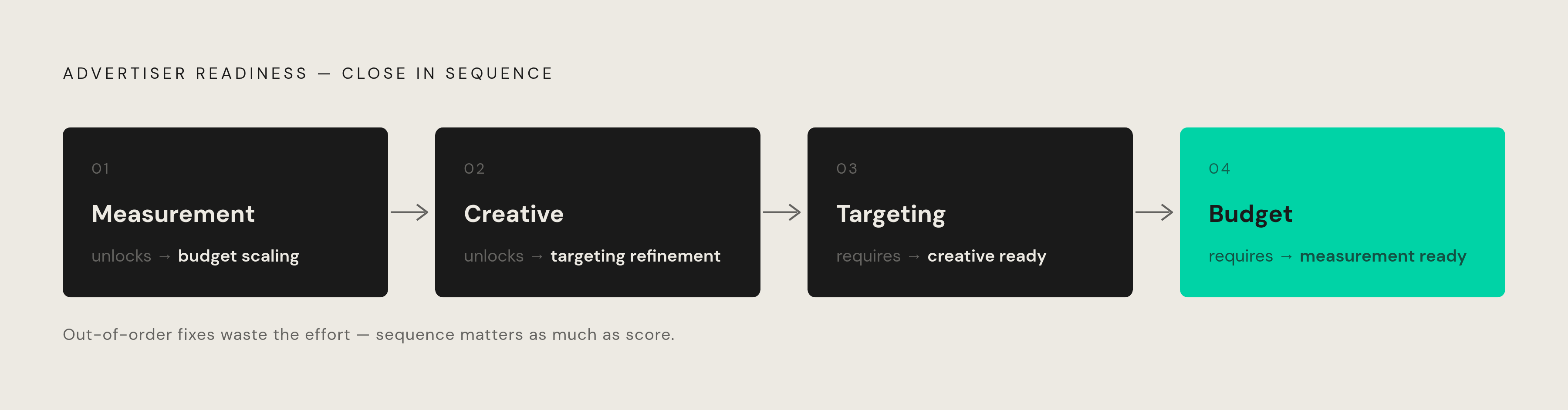
A middling score doesn't predict failure. It flags exactly which gaps turn into real problems the moment spend scales past a test budget. Sequence matters as much as the score: close measurement gaps before budget scales, close creative gaps before targeting gets refined, since refining targeting against weak creative just wastes the refinement.
None of this captures everything, and it shouldn't pretend to. Organizational agility, existing platform relationships, how crowded a given category already is, all shape outcomes independently of what an advertiser scores on paper.
Where to start depending on where the gaps are
If creative is the gap, write a conversational creative brief. Take one product line, rewrite its value proposition as though answering five specific user questions across different intent stages, and test those variants against existing copy in whatever channel is already running, before a dollar goes toward AI-specific placements.
If targeting is the gap, build an intent-topic map for the top three products in the portfolio. No platform access required, it's a spreadsheet exercise, and its real value is forcing the team to think in conversational terms before they're staring at a live dashboard trying to improvise an answer.
If measurement is the gap, start with tagging. Make sure UTM parameters, or something equivalent, are already capturing AI-sourced organic traffic, so there's a baseline sitting in hand before any paid AI search spend goes out. That baseline does double duty: it builds the internal case for multi-touch attribution without needing a full platform overhaul first.
If budget is the gap, a structured test doesn't need much. ChatGPT's known CPM range makes a meaningful 30-day test easy to cost out ahead of time. The more important move is naming an owner and setting a decision trigger before the spend goes out, not after the results land and someone has to improvise what they mean.
The platforms where advertisers can actually show up right now, ChatGPT's sponsored placement network among them, plus the emerging LLM demand-side platforms offering intent-based targeting without cookie dependency, are the proving ground for all of this. Walking into that proving ground with a framework already built, instead of improvising one after the budget's already spent, is the whole point of running through this assessment. AI search ads sat at 1.3% of US search ad spending in 2026, and eMarketer expects that number at 13.6% by 2029. The window to build readiness is open now, while the channel's still cheap enough, and uncrowded enough, to learn in without paying full price for the lesson.