Vertical Performance Benchmarks for AI Advertising in Health and Wellness
Late-night health searches reveal an advertising moment traditional channels can't reach.

Personal health queries on mobile devices pile up in the evening and nighttime hours, precisely when traditional healthcare access is most limited and search advertising can least meet the moment. This timing pattern is the clearest evidence that health and wellness is not simply a large market migrating toward a new channel, but a vertical where the structure of consumer prompts creates an advertising opportunity that search and social were never built to serve. Someone typing a question about a sleep supplement, describing a symptom at 11pm, or asking which wearable to buy before a marathon is expressing intent at a level of specificity that no keyword list or demographic segment has ever captured. That specificity is what makes health and wellness a proving ground for conversational AI advertising, and the stakes of getting it wrong are unusually high.
Health and Wellness as a High-Stakes Vertical for Conversational AI Advertising
When someone opens an AI conversation about health, what they ask is rarely generic. A user does not ask a chatbot something equivalent to a head-term keyword; the user describes a situation, a timeline, sometimes a fear, and the model reads all of that as context rather than as a string to match against a bid list. That shift in how intent gets expressed means the advertising opportunity in this category is qualitatively different from anything search or social could construct, because the signal itself did not exist in that form before conversational interfaces made it legible.
Health and wellness also carries compliance and trust burdens that most advertising categories do not. Health claims draw more platform scrutiny, user-generated content faces stricter review before it can run, and consumers approach health advertising with more skepticism than they bring to almost any other category. Those constraints change what a well-matched placement is worth. In a channel where the ad sits inside a conversation the system has already determined is relevant, the match is not just a targeting efficiency, it is a credibility signal, because an ad that appears contextually coherent with what the user just asked carries less of the skepticism tax that health advertising normally pays.
The timing pattern reinforces the stakes rather than existing alongside them. Personal health concerns appear on mobile late in the day and into the night, a period when clinics are closed, pharmacist lines are unavailable, and search ad inventory is both less competitive and less useful to someone in the middle of a specific, private concern. An AI assistant open at that hour is often the only responsive channel the person has access to. The advertising placed inside that conversation is reaching a moment of need that legacy channels structurally miss.
How conversational AI advertising works in this channel
Conversational AI advertising runs on a targeting primitive, and search advertising has never used it. Instead of a keyword, the advertiser supplies a natural-language description of the conversations an ad belongs in, and that description is matched against the live, multi-turn context of what a user is actually discussing. A health brand is no longer bidding on a static query; it is describing a kind of conversation, and the system decides, turn by turn, whether a given exchange qualifies.
That mechanism produces an auction that behaves differently from a search auction. Relevance carries enough weight that a more contextually appropriate ad can out-place a higher bidder. Health advertisers accustomed to bidding aggressively on high-cost medical keywords need to rethink what they are actually optimizing for in this channel. The landing page itself now gets evaluated for relevance, not just treated as a post-click destination, so its content carries targeting weight it never carried in a search campaign.
The underlying models are built to track coherence across multiple conversational turns. A user who asks about sleep quality, then about melatonin, then about dosage is not generating three disconnected queries but one accumulating signal of intent that the system can read as a single, strengthening expression of need. That capacity is what makes the context-hint model meaningfully different from keyword bidding rather than a minor variation on it.
Attribution is where the channel gets structurally harder to measure. A user can ask a question, leave the conversation, and convert hours or days later, and a last-click measurement framework will miss that entire path, undercounting the channel's real contribution. If health advertisers have built their measurement stack around Google's attribution model, they will need an adjusted framework to credit these conversations accurately.
The platform landscape, as of the third quarter of 2026, is still being defined. ChatGPT is live and expanding, Google is monetizing AI answers through its existing ad system without giving advertisers an opt-out (publishers, by contrast, can keep their content out of AI features through Search Console), and Microsoft runs a comparable model inside Copilot. Perplexity launched sponsored answers in November 2024, but it walked away from the category later. Anthropic has run advertising campaigns, including spots during the Super Bowl, but it has committed to keep Claude itself free of ads. ChatGPT's ad product launched on February 9, 2026, and its self-serve Ads Manager opened on May 5, 2026 with spend minimums removed, putting the platform live across more than 40 countries plus 31 European markets. Anthropic's Super Bowl spot, which ran February 8, 2026, carried the tagline "Ads are coming to AI. But not to Claude.", and the company credited an 11% jump in daily active users to that positioning. That moment says less about benchmark performance than about how aggressively the category is already being contested on trust grounds, which is precisely the terrain health and wellness advertisers have to operate on.
Existing paid media benchmarks for health and wellness
Legacy paid media in this category already costs a lot, and the trend line is moving the wrong way if you are trying to hold acquisition costs steady. Triple Whale's benchmarks run from August 2025 through July 2026, and on Meta, Health & Wellness now carries the highest median CPM of any vertical measured, at $21.80, after a jump from the year before. Click-through rates on Meta rose as well over the same period, so the vertical is generating more engagement at the top of the funnel, but advertisers are paying considerably more to reach it.
Google tells a more mixed story. MDMPPC benchmark data via Web Tonic shows health and wellness accounts carrying a notably low cost-per-click relative to other health verticals, with a conversion rate that beats the all-industry average. That average is roughly even across the category, but general fitness and wellness acquires customers far more cheaply than mental health and therapy, telehealth costs somewhere in between, and D2C supplement acquisition costs are lower still. That spread matters later, because the same sub-verticals that diverge on legacy cost-per-acquisition also behave differently inside AI conversations, and any benchmark that treats health and wellness as one undifferentiated category will miss where the actual opportunity sits.
Format performance adds another layer of pressure. Video is the strongest-performing creative format in the category: it draws a higher video-ad click-through rate than apparel, home and garden, or electronics. Yet the category's compliance constraints produce a measurable gap in format economics: UGC ads in health and wellness post a strong hook rate but a below-platform-average return on ad spend, a gap that Billo's UGC analysis attributes to the trust deficit specific to health claims. That deficit is exactly the kind of problem a contextually matched AI placement is positioned to close, because the ad is not asking a skeptical viewer to trust an anonymous creator, it is arriving inside a conversation the user already initiated in good faith.
Taken together, the baseline is a category where costs are rising, engagement is strong but increasingly expensive to earn, and the dominant creative formats carry built-in friction that a different kind of placement might be able to avoid. That is the backdrop against which any conversion premium from AI channels has to be judged.
What early conversion data from AI channels shows
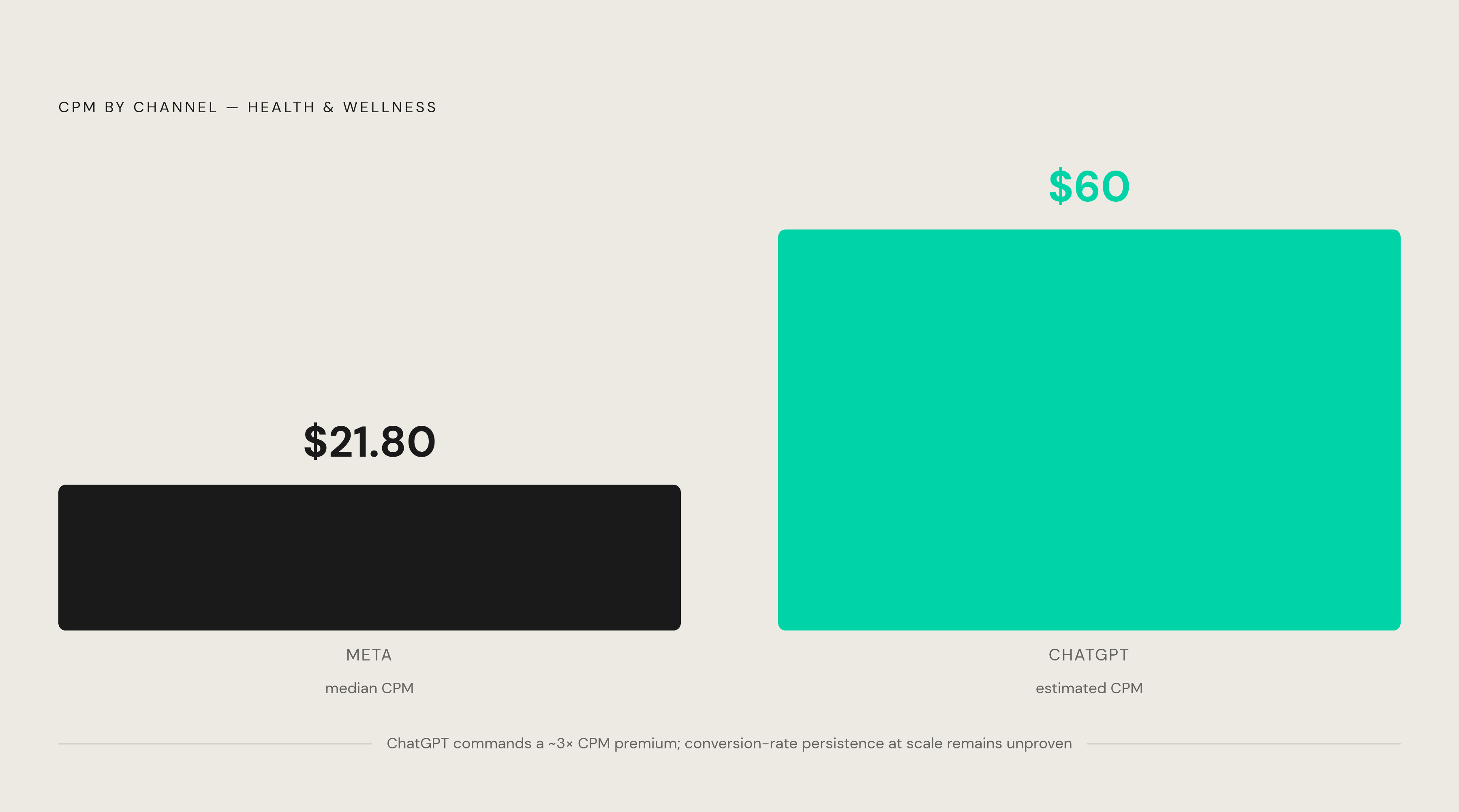
Early figures from AI advertising channels show a conversion-rate premium big enough to warrant real attention, but the higher cost per impression in this channel means the efficiency argument depends entirely on whether that premium holds up as volume scales. Microsoft reports that search ads inside Copilot produce meaningfully stronger click-through and conversion rates than traditional search placements, and if that gap holds specifically within health verticals, it would offset a significant share of the CPM premium advertisers are paying to be there. Criteo data from March 2026 found that users referred from ChatGPT convert at a substantially higher rate than other referral channels, suggesting the audience arriving through AI assistants is further along in its decision-making than the average visitor.
The CPM gap, though, is the fact that has to anchor any efficiency claim. ChatGPT's CPM runs around $60, roughly three times Meta's rate for health and wellness, so any argument that the channel is more efficient rests entirely on whether the conversion premium persists at scale, a question that has not yet been settled for health sub-verticals specifically. ThinkBrandedMedia's data via Web Tonic adds a related signal from outside paid advertising: healthcare achieves the highest conversion rate from AI-generated search traffic across every industry measured. That is not a direct measurement of AI ad performance, but it does point to a structural affinity between health-related intent and AI-mediated discovery that a paid placement could reasonably be expected to benefit from.
Because a user may continue a conversation, step away, and convert later, health advertisers relying on last-click attribution are likely undercounting performance in this channel systematically. The benchmarks available today probably understate the actual return rather than overstate it. The honest position is that the conversion premium is real enough to take seriously, the CPM gap is real enough to demand scrutiny, and the efficiency case will not be fully resolved until sub-vertical-level data catches up with the aggregate figures.
How health and wellness sub-verticals differ inside AI conversations
Health and wellness is not a single advertising market once it moves inside AI conversations. Different sub-verticals generate different kinds of prompts, convert at different rates, and sit under different compliance regimes, and all of that determines where the channel actually performs.
Microsoft's study of de-identified Copilot health conversations offers the clearest picture of what that prompt landscape looks like in practice. The single largest category is general health information and education, and it accounts for a substantial share of all health-related conversations, but even inside that broad category, the dominant queries are about specific treatments and specific conditions rather than abstract medical knowledge. Nearly one in five health conversations involves personal symptom assessment or a discussion of a specific condition, and these represent the highest-intent moments in the channel, phrased as personal, conversational questions that search has never been able to capture in keyword form. One in seven personal health queries is asked on behalf of someone other than the person typing, a caregiving pattern that opens an audience segment health advertisers have rarely had a reliable way to target directly.
Supplements and daily-wellness products show the highest concentration of AI retrieval visibility in the category, driven by podcast-mediated trust signals that have fed directly into the corpus these models were trained on. AG1's perfect 25-out-of-25 retrieval score in the Health & Wellness AI Visibility Index 2026 illustrates how dominant a brand's position can become in the greens and gut supplements space when it has built that kind of credibility into the underlying training data.
Wearables and recovery technology reward a different mechanism entirely: category creation. Oura's dominance across prompts like "best smart ring," "best sleep tracker," and "wearable that isn't a watch," consistent across every major AI engine, shows how a brand that defines a product category early can capture a retrieval advantage that later entrants have not managed to displace.
Mental health and therapy behave with more friction. The corpus these models draw from weights efficacy questions, regulatory criticism, and variance in therapist quality alongside straightforward brand recommendations, so BetterHelp and Talkspace surface reliably in response to relevant prompts, but the context surrounding those citations includes scrutiny as often as endorsement. Mental health and therapy already carry the highest cost-per-acquisition in the category on legacy channels, so if an AI placement offers more precise intent-matching, that is worth proportionally more here than in lower-cost sub-verticals.
Telehealth and D2C prescription brands sit in a middle position. Cost-per-acquisition on legacy channels varies widely by medical specialty, and AI conversations in this space tend toward symptom-specific and condition-specific framing that maps closely onto the context-hint targeting model described earlier. Regulatory and platform-policy constraints are tightest here of any sub-vertical. The targeting fit is strong, but the compliance runway is the narrowest in the category.
What AI retrieval patterns reveal for brands in this space
A brand's organic retrieval position inside AI engines reveals which signals those engines have learned to trust for its category, and that same set of signals should shape how a paid placement in AI conversations gets positioned so that it reads as coherent with what the engine already believes about the brand rather than working against it.
AG1 is the clearest demonstration of this dynamic. Its podcast advertising across the Joe Rogan, Andrew Huberman, Tim Ferriss, Peter Attia, and Lex Fridman networks did more than build brand awareness; it generated a durable corpus of transcripts, host endorsements, and secondary press coverage that AI engines now read as a form of expert endorsement. That signal compounds: per Avenue Z's AI Visibility Index, the top three brands in the category, AG1, Amazing Grass, and Bloom, together account for 66% of AI share of voice in the greens and gut supplements space.
The practical consequence for paid strategy follows directly from that pattern. Health brands that have already built a body of credible, expert-adjacent citations, whether through podcast partnerships, clinical references, or sustained press coverage, are positioned for their paid AI placements to land with contextual coherence, since the ad appears inside a conversation where the engine already extends the brand a measure of trust. Brands without that organic retrieval signal, or brands whose existing corpus includes significant regulatory or efficacy scrutiny, as is the case for several mental wellness brands, enter paid AI placement from a more complicated starting position, one where the surrounding context the engine draws on is not uniformly favorable. Building that underlying corpus of credible citation, not simply bidding well inside the auction, reinforces a brand's standing when a paid placement runs in this channel, while skipping it leaves the placement sitting awkwardly against that standing.