How Conversational AI Ad Placement Actually Works Mid-Dialogue
Conversational ads read intent across dialogue, not single queries.

Conversational AI advertising runs on a richer, more continuous intent signal than search or social has ever produced, and that single fact explains why the mechanics behind it deserve a close look rather than a quick comparison to what came before. A typed search query is a few words stripped of the reasoning behind them. A multi-turn conversation carries the reasoning itself, made up of the stated problem, the follow-up questions, the constraints the person mentions along the way, and where they sit in the decision. Someone might never type "project management software" into a chat window, but across several turns describing missed handoffs and slipping deadlines, a contextual system can read that as high-intent signal for exactly that category. OpenAI's own data puts this at scale: roughly one in five ChatGPT conversations carries shopping intent, spanning retail, travel, electronics, beauty, finance, and home, with that intent spread across a conversation rather than packed into a single query. Social feeds infer demographics and interests from passive scrolling, while a conversation reflects what someone is actively working through right now, putting the ad closer to the actual moment of decision. None of this is search wearing a new coat. There's no keyword layer to bid on, no list of links to rank above, no page URL to target. The conversation itself is the unit of inventory.
The three-layer stack that runs every mid-dialogue ad placement
Every ad that shows up mid-conversation passes through three layers, in order. First, a trigger layer decides whether the moment in front of the user is commercially relevant at all. Second, an auction layer picks the best-matched advertiser and sets the price, without a keyword in sight. Third, a render layer places the winning ad somewhere specific inside the chat interface. That sequence carries deliberate weight. It's the reason this channel doesn't behave like search, which runs on keyword match, or like display, which runs on page URLs and cookies. Here, the signal, the auction logic, and the render surface are all built for conversation from the ground up. The next three sections take each layer in turn.
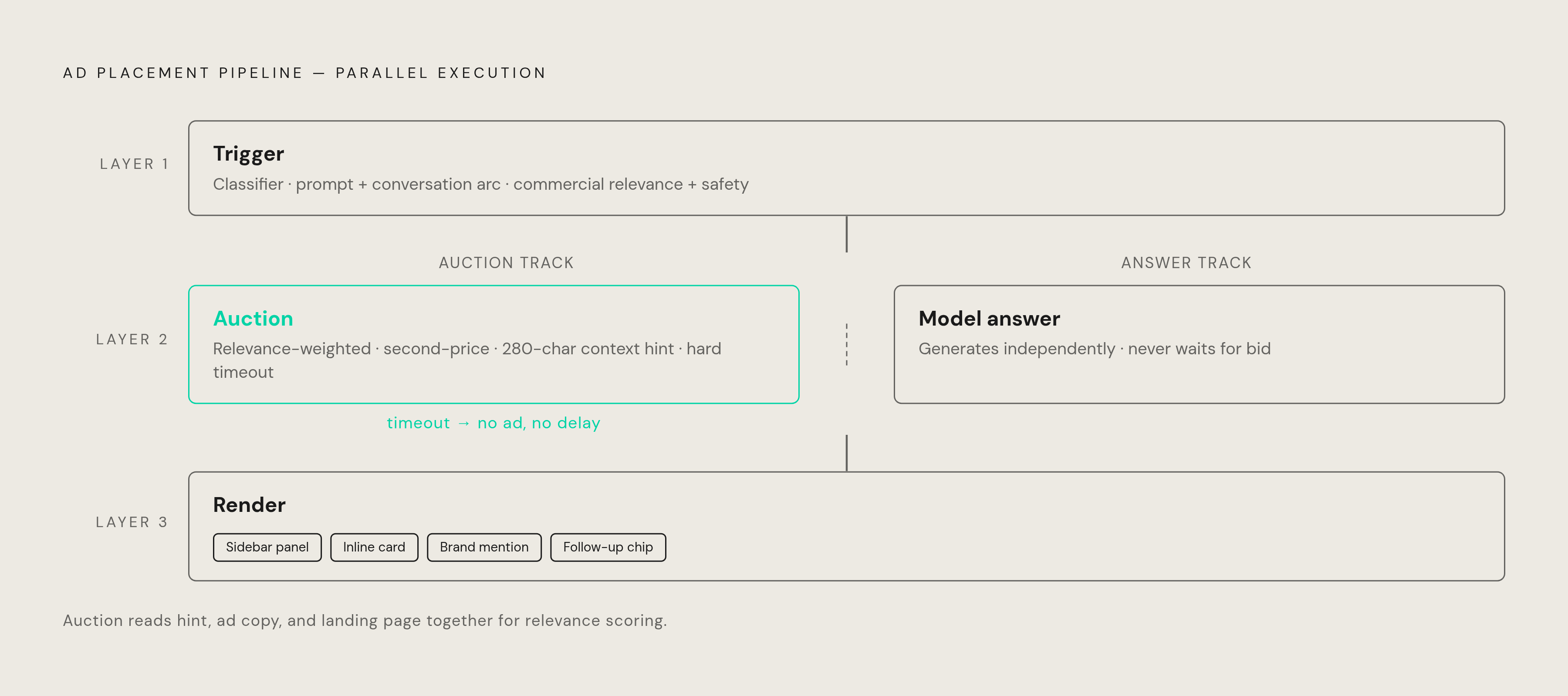
The trigger layer: how the system decides a conversation moment is commercially relevant
The trigger layer is a lightweight classifier sitting on top of the user's prompt and, in longer sessions, the arc of everything said before it. Its job is to answer two questions at once: is this moment commercially relevant, and is it safe to show a commercial unit here at all. It is reading for the meaning behind the words, in ways a keyword matcher never could. It's evaluating what the person is actually trying to accomplish. StackAdapt co-founder and CTO Yang Han has described this directly: the AI "has context and history and deeper concepts" that go well beyond anything a keyword could capture. That means a conversation like "I keep losing track of who's doing what on my team" can trigger relevance for a project-management advertiser even though nobody named the category.
Calibration here is a live problem still being worked out. A trigger set too loose burns auction calls on moments that were never really commercial and risks shoving an ad into a conversation where it doesn't belong. Enterprise and professional users skew heavily toward paid tiers. A category built around reaching decision-makers at work may find a meaningful share of its intended audience simply outside the inventory this channel can sell against. Every publisher running this stack is tuning that balance continuously. The second half of the trigger's job runs in parallel: sensitive-topic detection. Conversations touching health, money, or legal topics need a stricter bar before any commercial unit is allowed to appear, alongside classifying intent, the trigger layer must also classify content safety. OpenAI built this in directly, with explicit content restrictions on sensitive topics baked into the trigger layer as part of its February 2026 pilot design.
The auction layer: how ads are matched and priced without keywords
Once the trigger fires, a relevance-weighted, second-price auction decides the winner. The targeting input is a natural-language context hint written at the ad group level, capped at 280 characters on ChatGPT, describing the kinds of conversations where the ad actually belongs. This differs from contextual advertising as it's existed for two decades. Old-style contextual reads a page's URL or its declared topic and matches an ad to that category. This reads what one specific person is working through, in real time, mid-sentence. That's a different signal in kind, not just in degree.
Writing a good hint is its own craft, and it's not the same craft as writing a keyword list. Calibration here is a live problem. The auction doesn't evaluate the hint alone, either: it reads the hint, the ad title and copy, and the landing page together, and all three need to line up. A strong hint paired with a landing page that doesn't match the conversational context can get suppressed even when the hint itself was well written.
Second-price pricing means an advertiser typically pays just above the next-best bid rather than their own full bid, and relevance weighting means a smaller advertiser with a sharper, more precise hint can beat a bigger budget with a vague one. That's an unusual property in paid media, and it rewards specificity over sheer spend, at least while most buyers are still learning how the format works.
Microsoft Copilot pushes this further still. What Microsoft calls "ad voice" has the system explain, in the moment, how an ad connects to what's being discussed, rather than just dropping it in cold. A separate contextual triggering mechanism looks at the whole session, not just the latest message, to decide which advertisers are even relevant candidates. That's a real departure from matching a single query in isolation. OpenAI has a related idea on its roadmap: multi-turn retargeting, targeted for the fourth quarter of 2026, which would let advertisers come back to someone who had a substantive conversation about a problem their product solves but never converted. If it ships, the intent signal stops resetting at the end of a session and starts persisting across them.
The render layer: where inside the conversation the ad appears and how format determines trust
Where the winning ad actually gets drawn on screen is a trust decision with real economic consequences. It's a trust decision with real economic consequences, because surface position sets the CPM ceiling, the latency budget the system has to work within, and how easily a user can tell the difference between the assistant talking and an advertiser paying to be there. Four surfaces exist in practice. A sidebar panel sits outside the conversation column entirely, which makes it easy to ignore and keeps its CPM low; it's also desktop-only, since the surface has no mobile equivalent, which puts its economics closer to conventional banner display than to conversational inventory. An inline sponsored card appears directly below the answer, labeled as an ad. A response-grounded brand mention is woven into the answer's own language. And a sponsored follow-up suggestion chip offers a next question to ask, one that either re-submits a brand-favorable prompt or routes straight to the advertiser.
That last format is where the render layer's trust problem appears most clearly, because Perplexity built its ad program around exactly this unit starting in November 2024, then walked the whole thing back, phasing ads out through late 2025 and confirming a full exit in February 2026, citing concerns about user trust. The chips blurred a line that mattered: users read "you might also ask" as the product's own suggestion, not as paid placement. Once one of those suggested questions turned out to be sponsored, the entire exchange felt tilted, even in cases where the actual answer text was never touched by any advertiser. Perplexity's leadership told the Financial Times as much directly: sponsored placement risks making users suspicious of the whole answer, extending that suspicion beyond the sponsored part of it. That's the clearest evidence available of what happens when the render layer gets the trust tradeoff wrong. The lesson generalizes: a research-oriented or professional assistant should lean toward the sidebar or a subtler card, while a consumer shopping assistant, where users already arrive expecting commercial answers, can carry a more prominent after-answer unit without the same backlash.
Why mid-dialogue is a structurally different ad environment
Inside a single turn, all three layers run at once, racing the clock of the model's own response generation. The full cycle, from the moment a user hits send to a labeled ad card appearing under the answer, has to resolve inside a strict millisecond window, or the turn simply goes out with no ad attached. The sequence looks like this: the message arrives, the trigger classifier checks it for commercial relevance and safety in the same pass, and if it fires, an ad request goes out in parallel with the language model's own generation stream. The auction runs against the context hint and whatever's known of the conversation so far, a winner gets picked and held, the model finishes writing its answer, and only then does the render layer draw the card underneath it.
Take a user midway through describing a hiring problem: three turns in, no product name has come up, but the language has shifted from "we're struggling to fill roles" toward "what tools do teams like ours actually use." The trigger can fire right there, independent of everything that happened earlier in the session. The two calls, generating the answer and fetching the ad, run side by side rather than one after the other. The ad request carries a hard timeout, and if nothing comes back in time, the system commits to showing no ad for that turn and doesn't try again mid-stream. The written answer itself is never delayed or blocked waiting on the auction. That parallel design is what makes the whole format usable at all: nobody waits longer for a response because a business is bidding on their attention in the background. Whatever cost the ad imposes is visible as a card under the text, never as a lag in the text itself. Set too tight, genuinely high-intent moments pass through unmonetized. The conversation is the inventory, the prompt is the targeting signal, and the natural-language hint is the only lever an advertiser gets to pull.
Why the stack's mechanics make attribution and measurement harder than in search
The honest complication doesn't resolve cleanly. A user can read a sponsored card, keep talking, and convert three days later through an entirely different channel, with no click ever recorded against the ad that actually moved them. Last-click attribution simply doesn't see that path, missing the real role the ad played in the decision. This isn't a bug waiting on a patch. It follows directly from how the render layer works: influence without a mandatory click.
The pattern already appears elsewhere in AI search. On Google's AI Overviews and AI Mode, impressions keep piling up while clicks keep falling. Inventory already behaves more like brand awareness spend than direct-response spend. Any budget still calibrated against last-click cost-per-acquisition will undervalue it, systematically and by design. The highest-yield unit in the conversational stack, the after-answer inline card, is also the one most exposed to banner blindness over time, the exact fatigue that hollowed out display advertising years ago. That compression is already visible in the data: ChatGPT's ad CPM launched around $60 and had fallen substantially within nine weeks.
There's real movement toward fixing the gap. OpenAI has started rolling out conversion tracking, with StackAdapt covering the rollout as a technology partner, which gives advertisers something more concrete to measure against than they had before. But by StackAdapt's own account, the formats and the measurement tools around them are still moving targets, and the buying infrastructure hasn't caught up to what exists in mature digital channels. The straightest way to put it: early promise here does not automatically scale into reliable performance, and the channel is still better treated as an emerging one with real potential than as a proven line item. Early tests should be judged on inventory availability, how precise the targeting actually turns out to be, what can be measured at all, and how the whole thing fits against the rest of the media plan. OpenAI's multi-turn retargeting plan, if it lands on schedule in the fourth quarter of 2026, would help close part of this gap by letting intent signals persist and stay actionable across sessions instead of evaporating the moment a chat window closes.
Why the stack's mechanics make attribution and measurement harder
Once the three-layer stack is understood, the old search or social playbook stops being a safe default. Campaign controls, the creative inputs a team writes, and the logic behind how budget gets allocated all need rebuilding around what this stack actually does, not adapted piecemeal from what worked somewhere else.
The context hint is the main lever, and it's not a keyword list wearing a new name. Writing a tight, 280-character natural-language description of the exact conversational situation where an ad belongs is the highest-leverage skill anyone buying in this channel can develop, and teams that just dump a keyword list into that field tend to get matched poorly and often. Because the auction rewards relevance over raw spend, a smaller, more specialized advertiser with a precise hint can beat a much larger budget attached to a vague one, at least for now, while most of the market is still figuring the format out.
One structural fact affects B2B buyers specifically: ChatGPT ads only reach logged-in adults on the Free and Go tiers. Every paid tier, Plus, Pro, Business, Enterprise, and Education, is ad-free. Enterprise and professional users skew heavily toward paid tiers. A category built around reaching decision-makers at work may find a meaningful share of its intended audience simply outside the inventory this channel can sell against. Where the winning ad actually gets drawn on screen is a trust decision with real economic consequences. It's the first thing a media planner needs to check before assuming this channel maps onto the audience it worked so hard to reach through search or social in the first place.