Why the Live Prompt Outranks Every Other Purchase-Intent Signal in the Programmatic Stack
Live prompts reveal what consumers want, why they want it, and what stops them from buying.

A live conversational prompt tells an advertiser what a consumer wants, why they want it, and what is stopping them from buying, all in the same breath. No keyword auction or cookie pool has ever captured that combination, because none of them were built to read a declaration. This piece explains why the prompt outranks every signal the programmatic stack has relied on, and what has to change in the stack to act on it.
Why legacy signals infer intent rather than capture it
Every signal programmatic advertising has used up to now is a record of something that already happened, read after the fact to guess at what a person wants next. Keyword bidding works off a query string: a handful of words, stripped of the reasoning behind them, matched against inventory with no sense of tone or circumstance. Contextual targeting improves on both by reading what a person is looking at right now rather than what they clicked last month, but it still reads the page around the user, not anything the user has actually said about what they want.
None of this is a criticism of the engineering behind these systems. The limitation was structural: every one of these signals is a reconstruction, built from a residue of past behavior or a snapshot of surrounding content, standing in for something the system was never given directly. No prior interface asked a consumer to say, in their own words, what they wanted, why they wanted it, and what was holding them back. That absence is the gap the live conversational prompt closes.
What a live conversational prompt contains
A prompt typed into an AI assistant is closer to a declaration, carrying the consumer's current state of mind, their reasoning, and their hesitation, often within a single exchange. Where a search query might read "running shoes," a prompt names the category, frequently the specific product or product type under consideration, and the use case the consumer has in mind, whether that's training for a marathon or replacing a worn-out pair for daily walks.
What follows in the conversation tends to matter as much as the opening line. Strung together, a full conversation thread encodes a trajectory, showing where the person started, what changed their thinking partway through, and where they seem to be heading by the end. That is a different order of information than anything a cookie pool or a keyword auction has surfaced, because the consumer is doing the segmentation themselves, in plain language, as the conversation happens.
Microsoft's Copilot illustrates the point at the session level. The distinction matters: the targeting draws on the whole session, while the ad voice is simply how that targeting gets explained back to the person reading it.
This upstream positioning carries a second advantage.
Conversational context and intent precision
The live prompt is built from different material: a declaration, the context surrounding it, how recent it is, and the hesitation it reveals, combined into one interpretable unit in a way no keyword or behavioral model can reconstruct from the fragments available to it.
Consider what a keyword asks a bidding system to work with. Two or three words compress an entire purchase decision down to a label, discarding most of the nuance behind it. A prompt, by contrast, can run to a paragraph or more, and the nuance stays intact. The prompt skips the gap entirely. It is present-tense and self-reported, offered by the consumer in the moment they're actually deciding. Contextual targeting narrows the lag somewhat by reading the page a person is on right now, but it still reads the environment around the user rather than anything the user has said directly, a distinction that matters once the goal becomes precision rather than relevance.
The prompt also tells an advertiser something keywords and cookies simply cannot: what's standing between the consumer and the purchase. There's data behind the depth claim, too. Longer queries track with deeper research and stronger purchase engagement, not casual browsing.
The strongest objection to all of this is fair: a prompt is noisier than a keyword. That same ambiguity is why transformer-based context matching matters: it engages with what someone actually means, resolving a compressed string into its intended meaning. A transformer-based approach to intent matching, one that reads meaning and context instead of matching a keyword string, is the only way to unlock the precision a live prompt can offer, which marks the real difference between systems built to read conversational intent and ones only adapted to approximate it.
How the programmatic stack must change for conversational signals
Reading meaning instead of matching strings sounds like a model upgrade, but it changes the entire stack that sits above the model. Legacy demand-side platforms were built to bid on keywords, audience segments, and placement lists, and none of those map cleanly onto a conversation, which has no page to classify, no keyword to parse, and no audience cookie to read.
The targeting control at the center of advertising inside LLM environments is something closer to a context hint: a natural-language description of the kinds of conversations where a given ad belongs, matched by the system against the conversation actually happening in real time. That's a freeform semantic match across a fixed taxonomy of categories, and it asks advertisers to think in terms of conversational scenarios. The auction mechanics shift as well, driven by this same targeting change. Placement typically runs through a relevance-weighted second-price auction, where a more contextually relevant ad can beat a higher bid. Relevance here is a first-order factor in who wins the impression, not a tiebreaker sitting off to the side of the auction.
None of this is free computationally. Running full transformer inference on every single turn of every conversation would introduce delay that no production ad system could tolerate, so systems built for this environment tend to run in stages: a lightweight model filters a large candidate pool quickly, a second stage applies more careful analysis to what's left, and a final stage runs the auction among a small set of genuinely relevant candidates. Predictive optimization is already standard in enterprise DSP tooling, but optimizing toward a predicted outcome on a page or a feed is a different problem than reading where a conversation is heading and matching an ad to its present moment. The model doing that work has to be trained on conversational context specifically, not repurposed from impression-level signals built for a different kind of surface.
Platforms built to read and act on conversational context, rather than simply matching keywords to a query string, can surface a consumer's full trajectory, their category, their use case, their objections, their hesitations, all inside a single interpretable unit. So infrastructure built for conversational AI advertising reads this signal in a way a DSP retrofitted from banner and search logic never could. The gap left standing is structural: a generalist DSP can reach across many surfaces but can't read conversational context natively, while a single-surface AI ad network can read that context but can't offer reach beyond the one interface it was built for. Neither resolves the problem alone.
Which AI platforms sell conversational ad inventory today
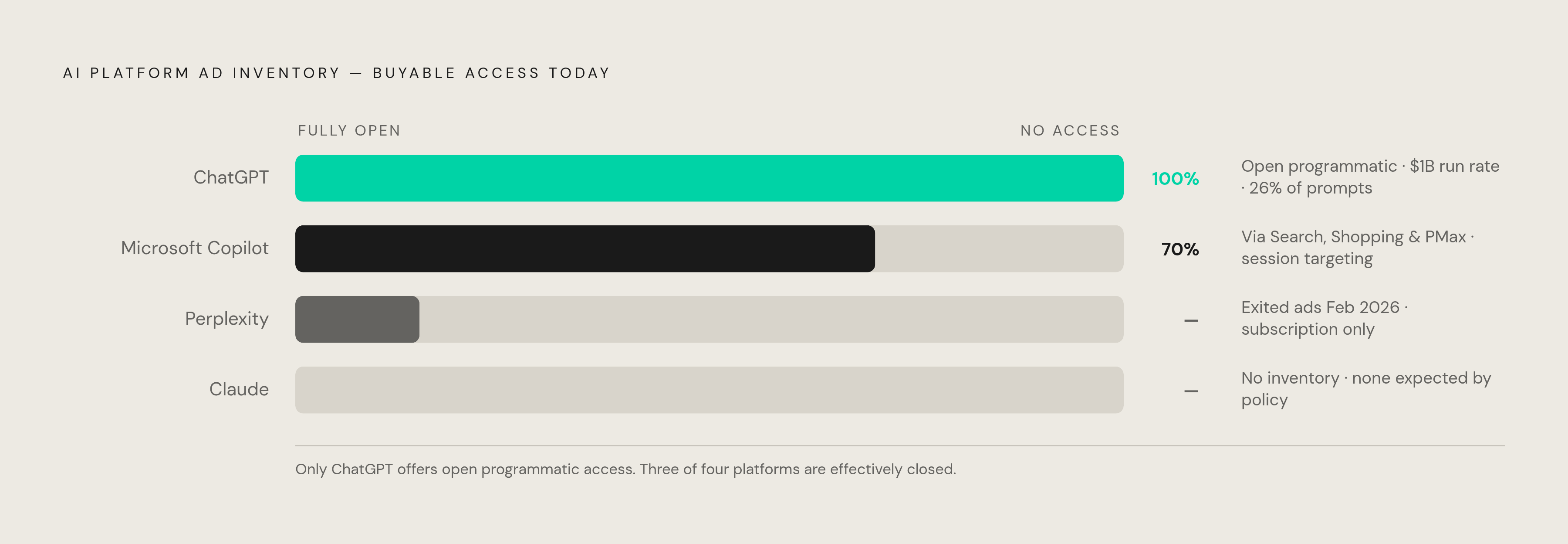
The theoretical case for the prompt only matters if there's somewhere to act on it, and as of October 2026, the inventory map is narrower than the attention around this topic would suggest.
ChatGPT is the only platform with meaningful open programmatic inventory right now. OpenAI reported a billion-dollar annualized run rate within months of that launch, and self-serve access expanded into Europe, India, the Middle East, and North Africa by September 2026.
Microsoft Copilot carries general inventory open through existing Microsoft Advertising campaign types, including Search, Shopping, AI Max, and Performance Max, as of 2026. Copilot's session-level targeting is among the most sophisticated conversational ad models demonstrated publicly, and it is worth planning around even where the newest formats aren't yet broadly buyable.
Perplexity phased out its advertising program in February 2026, with company executives confirming the exit, and moved to a subscription-first model citing user trust. Organic visibility is the only route left on that platform. Anthropic's Claude carries no ad inventory, and none is expected by policy. But not to Claude."
Buyers whose employers pay for enterprise AI plans sit on tiers where ads simply don't appear, which makes the highest-intent professional audience structurally unreachable through paid placement on most of these platforms. None of this is theoretical. A study found ads appearing on roughly a quarter, 25.94%, of commercial prompts sampled on ChatGPT, concentrated heavily in comparison, recommendation, and purchase-oriented conversations.
How different verticals are already capturing high-intent conversational moments
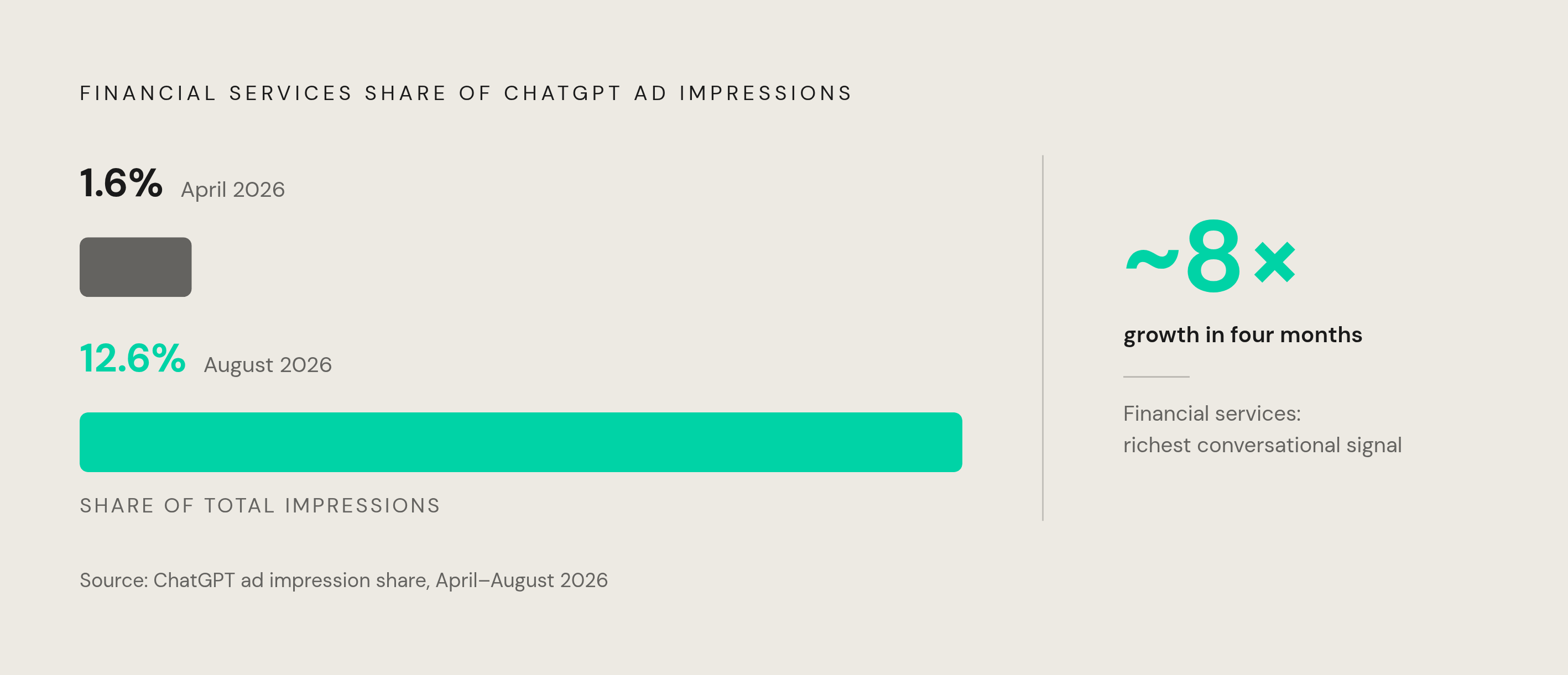
The prompt's value as a signal isn't spread evenly across categories. It concentrates wherever a purchase decision is complicated, considered, or carries some emotional weight, and that happens to be exactly where keyword matching was always weakest.
Financial services is the clearest case. The category surged nearly eightfold to capture 12.6% of total ChatGPT ad impressions between April and August 2026, and that growth makes sense once you consider what a prompt about retirement planning or mortgage options actually contains: far more decision-stage reasoning than a keyword like "mortgage rates" could ever carry. That doesn't mean retail is retreating; retail still spends the most of any category in search advertising overall. It means other categories, which carry richer conversational signal, are catching up fast.
Amazon's Rufus offers a more transactional version of the same pattern. Here the prompt is literally a shopping query, asked inside the same surface where you make the purchase.
The common thread across financial services, the shifting retail mix, and Rufus is that the categories gaining ground fastest are the ones where a consumer's decision needs explanation, comparison, or reassurance before they'll commit. A person working through a mortgage decision or comparing two products says far more, and reveals far more hesitation, than a person typing a four-word search query ever would, so these are precisely the conversation types that generate the richest intent signals.
Why measurement must change when the signal changes
Acting on a signal this rich doesn't mean much if it can't be measured, and the honest answer is that measurement hasn't caught up yet. An AI assistant can answer a question, name a brand, and shape a purchase decision entirely inside the conversation, with the user never clicking through to anything at all, which makes that influence invisible to standard attribution models built around the click.
Last-click attribution assigns credit to the final touchpoint before a purchase happens. A few approaches are workable today: assisted conversions, which credit touchpoints appearing earlier in the path rather than only the last click; brand mention tracking, which measures whether a brand shows up in AI responses to relevant prompts; and holdout testing, comparing conversion rates between a group exposed to a given placement and a group that wasn't.
Where AI-sourced traffic does produce a click, the signal is disproportionately strong: AI referrals convert at rates far above their share of overall traffic, and that ratio between conversion rate and traffic share makes an economic case for the channel on its own, even before attribution catches up fully. If your team can only recognize last-click data, fix that before you spend against this signal, not after a campaign produces results nobody can explain. The measurement framework needs to exist before the first dollar goes out, not get built afterward to make sense of numbers that don't line up.
Infrastructure for the prompt signal
Everything argued above points to the same conclusion: the prompt is the richer signal, inventory exists to act on it, and measurement approaches exist even if they're imperfect, but all of it depends on a buying platform built specifically to interpret conversational context, bid across more than one AI surface at once, and connect to publisher supply through infrastructure designed for LLM environments.
On the buy side, that means a DSP built to read context hints, natural-language descriptions of the conversations where a given ad fits, rather than keyword lists or predefined audience segments. That's a different kind of targeting logic altogether, not a new configuration layered on top of the old one. On the supply side, it means direct relationships with the AI interfaces and LLM products themselves, not just access to an open exchange, because the most precise conversational inventory doesn't sit on the open web. It sits inside specific conversational products that run their own monetization infrastructure.
Bidding and targeting logic built for keywords and page context can't arbitrate conversational intent without real architectural change. The auction has to operate on session-level context rather than a single query, scoring has to weigh what a consumer is actually hesitating on, and the exchange itself has to be built to match advertiser intent against conversational moments. That distinguishes systems designed from the start to read conversational intent from systems retrofitted to approximate it after the fact.
The structural gap described earlier, between generalist reach and single-surface contextual reading, doesn't close by itself. If a platform offers both, it does something categorically different from either approach alone. On the publisher side, a newer model is emerging to meet it: LLM-native supply platforms that identify monetizable moments inside AI conversations, run real-time auctions for placements built for that environment, and connect those auctions to demand sources on the buy side.