Why Native SSP Architecture Beats Retrofitted Display Infrastructure for AI App Publishers
Conversational ads need intent signals, not page URLs and ad slots.

The display SSP model fails AI app publishers because it was built to transact a fixed impression on a fixed page, and a conversation has neither. The mismatch is not a matter of missing features or thin integrations. It runs down to three assumptions baked into the architecture of every supply-side platform built for the open web: the thing being sold is a fixed impression tied to a visible ad slot, the creative is a finished file uploaded before the auction ever runs, and context comes from the URL, the page category, and a cookie ID, meaning signals about where a user happens to be, not what that user is trying to do. Each of those assumptions holds for a news article or a shopping page. None of them holds inside a chat session. There is no URL to parse in a conversation with an AI assistant, no slot to detect when the page loads, because there is no page, and no prebuilt creative to drop into a fixed container, because the container itself doesn't exist until the model starts generating a response. The inventory in a conversational product is not placed on a page. It appears in the live output of a language model, turn by turn, shaped by what the user just said and what the assistant is about to say back. Infrastructure built to route impressions against known slots has no slot it can point to. That is the structural fact the rest of this argument builds from.
What a standard RTB auction encodes
A standard real-time bidding request, the kind that runs the open display and video web in under 100 milliseconds, encodes a user's location in a media landscape: the page URL, a browsing category derived from that URL, device type, geography, and an anonymized cookie or device identifier. Every one of those fields answers the question "where did this user show up," and none of them answers the question "what does this user want right now." That distinction is not a nuance, it is the entire gap. A conversational bid request has to carry something categorically different: a structured read of user intent, meaning what the person is actually trying to accomplish; the constraints they've stated out loud, like price, location, or timing; what stage the conversation is in, whether it's research, comparison, or decision; how deep into a multi-turn thread the opportunity shows up; and what the assistant is about to do next, whether that's recommending, comparing, booking, or summarizing. A standard bid request also presupposes something a chat session can't offer at the moment the auction needs it: a stable, pre-existing slot. In the conventional flow, the SSP detects an available ad slot as an early step before bidding even opens. In a chat session, no slot exists until the model has already generated a response. The auction has to resolve against something the page-based model assumes is already sitting there waiting to be filled. No adapter layer bridges that gap, because the thing being translated, location-in-a-landscape, has no equivalent mapping to intent-in-a-task. One is a snapshot of where someone is standing. The other is a description of where someone is trying to go.
How supply path proliferation compounds the problem for publishers
Retrofitting display infrastructure onto conversational inventory doesn't just weaken targeting signal, it imports a cost structure built for abundant, interchangeable impressions into an environment where every opportunity is scarce and unrepeatable. Jounce Media's 2026 data found that rebroadcasting supply chains, the practice of routing the same impression through multiple intermediary paths, account for a meaningful share of display auctions and a significant share of video auctions. The same inventory gets recycled through several paths at once, creating an illusion of scale while adding real processing cost and real decision fatigue for the systems trying to evaluate it. In display, that pathology is wasteful but survivable, because the underlying inventory is abundant and fungible: one impression on one page looks much like the next, so recycling it through extra hops dilutes value without destroying the transaction. A conversational opportunity carries no such redundancy. It exists once, tied to a specific point in a specific user's specific conversation, and it closes the moment the model moves on to its next response. Routing that kind of opportunity through a legacy supply chain built for fungible slots multiplies latency at the exact moment latency is least affordable, inside the live generation of a model's answer. Every additional hop strips revenue from the publisher, and it doesn't add a single piece of targeting signal the conversational context didn't already contain on its own. Display SSPs built transparency and control tools, category filtering, price floors, yield reporting, to manage slot inventory at scale. None of those tools were designed to manage the intent-stage distribution of conversational opportunities, so publishers running conversational products through that stack pay the supply-chain tax of display without getting any of the control display was built to provide.
What the industry's structural moves reveal
The strongest evidence that legacy display infrastructure can't carry conversational advertising isn't a technical argument at all; it's what the companies that built that infrastructure are doing with it. Microsoft kept its Xandr-descended Monetize SSP and Curate layer running, but framed the decision explicitly as a pivot toward what it called "AI-powered, conversational advertising," and named Amazon DSP as the preferred migration partner for buyers displaced by the shift. A founding name in programmatic advertising chose to retire its own buy side rather than retrofit it for conversational environments. OpenX made a comparable move in April 2026, repositioning itself as "The Intelligent SSP" and naming the problem directly: "AI reshapes how campaigns are planned, bought, sold, and optimized," and the complexity that built up across the past decade of programmatic has become one of the advertising industry's greatest liabilities. OpenX's own framing describes modern buying systems as requiring clean real-time data signals, direct access to quality inventory, and transparent reporting, while characterizing legacy supply chains as routinely failing to deliver on all three. Neither of these moves is a prediction about where the market is headed. They are decisions already made by companies with the clearest possible view into their own infrastructure's limits, and both point to the same conclusion: the architecture built for the open display web cannot simply be extended to cover conversational inventory.
How conversational inventory works
The largest available case study for conversational inventory is ChatGPT's ad rollout, and its timeline shows what any infrastructure serving this space actually has to do. Programmatic access arrived through StackAdapt in May 2026. Self-serve access then expanded to Europe, India, and the Middle East in August 2026, broadening the base of advertisers able to buy against conversational opportunities directly. The bidding model that emerged alongside this rollout breaks from keyword-based display advertising at the root: there's no keyword layer. Targeting runs on a 280-character natural-language context hint set at the ad group level, and the auction itself is relevance-weighted and second-price, with advertisers bidding on conversational contexts, meaning clusters of intent signal inferred across the full arc of a conversation, rather than on keywords tied to a single query. Bidding is also stratified by how deep the user is in a thread. Entry-point conversations call for awareness-level CPM bids built around education and problem framing, while mid-thread conversations, where commercial intent concentrates, call for higher bids and more direct, conversion-focused creative. Any SSP operating in this environment has to respect a structural wall OpenAI has built between paid placement and organic response: ads do not influence what ChatGPT says. The model generates its answer based on what's most helpful, and only after that does the ad system decide whether a sponsored unit belongs in the response. Advertisers cannot buy their way into the answer itself. On top of that, OpenAI is layering in deeper automated bidding, platform-level targeting, and one-day view-through conversion reporting, giving advertisers the ability to optimize toward downstream conversion events and to control whether ads run on iOS, Android, or web. The rest of the field is moving at different speeds. As of the third quarter of 2026, Claude remained ad-free by policy. Grok has stated a pro-ads direction and is building toward it, with Grok integration in Ads Manager reaching beta on July 21, 2026. Together, these cases define the functional surface any native SSP has to cover: context-hint targeting instead of keywords, conversation-depth-aware bidding, a hard separation between paid and organic generation, and conversion infrastructure built around what happens after the chat, not just the impression inside it.
The revenue equation for AI app publishers who monetize natively versus those who don't
The monetization pressure on AI app publishers isn't a future risk, it's already structural, and native ad infrastructure is the one lever that addresses it at the level of actual revenue rather than masking it with workarounds. ChatGPT has hundreds of millions of users and a subscription business that is growing quickly, and it still turned to advertising to expand reach and maximize monetization. If that calculation holds for a product at that scale, smaller and more specialized AI products will need advertising even more, because they lack the subscriber base to fund themselves on subscriptions alone. Perplexity's own ad experiment was framed explicitly around sustainability and revenue-sharing, built on the premise that subscription revenue by itself doesn't fund a scalable publisher program. Meanwhile, the traffic that used to fund publishers through referrals is drying up. Anecdotal feedback gathered from publishers and SSPs in CES discussions points to web traffic referrals from AI-driven discovery declining materially year over year, with some publishers describing the losses as steep. Some publishers are responding by pursuing content licensing deals as a parallel revenue stream, where multi-year agreements can generate meaningful incremental revenue and a source of predictable, non-ad income. That's a reasonable hedge, but it doesn't substitute for ad monetization built into the product itself, and OpenAI's own position doesn't guarantee publishers more than they currently receive. Publishers are not paid when their content trains a model, so owning native monetization infrastructure gives them revenue a platform's revenue-sharing terms cannot take away. The infrastructure difference appears directly in the numbers below. PubMatic's AI-first infrastructure can reportedly process trillions of auction decisions daily at near-zero latency, and when paired with AI-native ad generation, it produced a meaningful increase in average revenue per user across Gen AI publishers compared against control cohorts running traditional monetization. The gap between native and retrofitted infrastructure is not cosmetic. It appears on the revenue line.
The three specific incompatibilities that native SSP architecture resolves
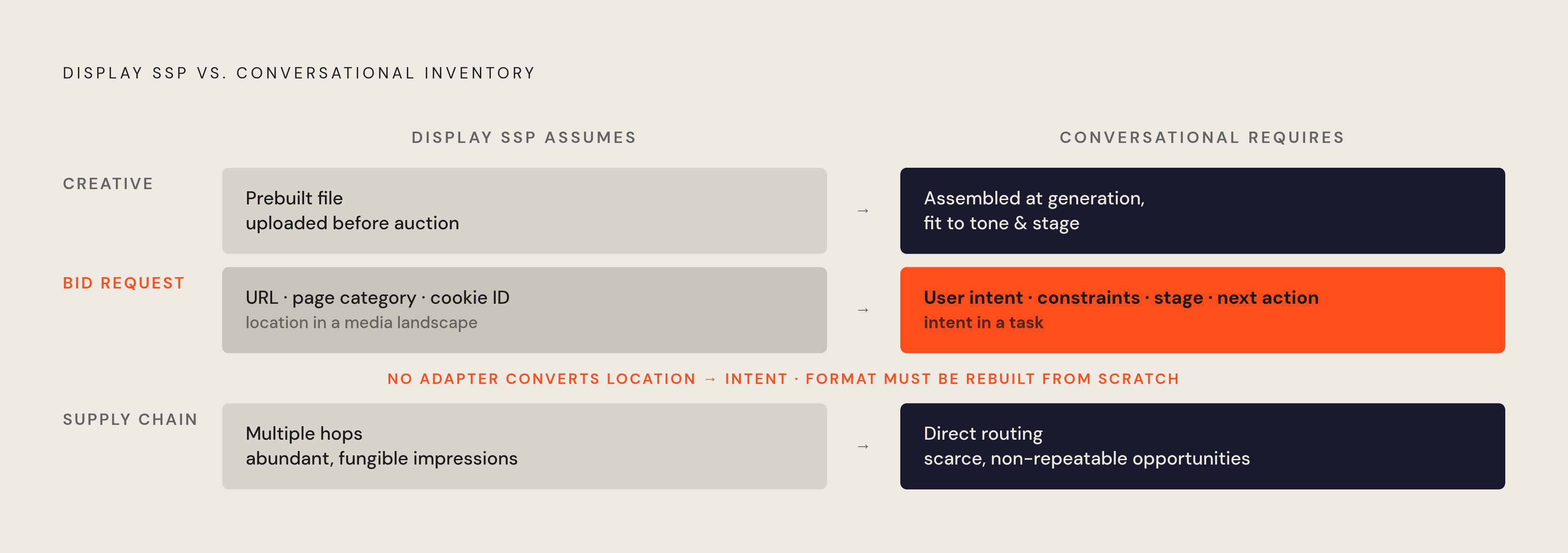
A native SSP built for LLM environments isn't a display SSP with conversational features bolted on. It replaces three foundational assumptions of display infrastructure with architecture built for how conversational inventory actually behaves.
The first incompatibility is fixed creative. Display SSPs are built to receive and route prebuilt creative assets, files that exist in finished form before the auction ever runs. Conversational inventory can't work that way, because the ad unit has to be assembled or adapted to fit the specific shape, tone, and stage of the conversation it's appearing inside. The creative pipeline has to operate at generation time rather than upload time.
The second incompatibility is the impression-based bid request itself. Display infrastructure encodes location-in-a-media-landscape: URL, category, device, geography, cookie ID. A native SSP has to encode intent-in-a-task instead: what the user is trying to accomplish, what constraints they've stated, what stage of the conversation they're in, and what the assistant is about to do next. There is no adapter that converts one into the other, so the bid request format itself has to be built around intent from the ground up rather than patched after the fact.
The third incompatibility is the supply chain. Legacy display infrastructure routes impressions through multiple intermediary hops built for abundant, fungible slot inventory, the same pattern behind the rebroadcasting inflation Jounce Media documented in 2026. Conversational opportunities are scarce and non-repeatable, so every added hop costs latency at the exact moment it can least be afforded and strips revenue without adding signal. Native SSP architecture resolves this by routing conversational opportunities directly, matching the actual scarcity and specificity of the inventory instead of running it through a chain built for a different kind of supply.
Taken together, these three resolutions describe what "native" has to mean in this category: an SSP whose creative pipeline, bid request format, and supply path are each built around conversational inventory as a distinct asset class, not a display SSP extended with a new input source. That is the architectural bar any infrastructure serious about AI app monetization now has to clear.