Emerging Ad Standards for AI Search and Answer Interfaces
Regulators, platforms, and advertisers scramble to define AI ad disclosure standards.

AI assistants had the traffic story of 2025: visits up 86%, time spent up 101%, both ahead of nearly every other web category tracked. ChatGPT now counts roughly 800 million weekly active users, Gemini around 650 million monthly. The rise in US ad spending inside AI search, expected by eMarketer to climb from about $1.1 billion in 2025 to roughly $26 billion by 2029, appears well before the rules meant to govern it exist. Regulatory mandate, platform labeling policy, and the plain mechanical problem of matching an ad to a live conversation are all landing on advertisers at once, and none of the three has caught up to the other two. The platforms are further ahead than the regulators, and the regulators are further ahead than the actual technical problem of disclosure inside a chat window, which nobody has solved yet.
Regulatory requirements: the EU AI Act, UK ASA, and US state-level mandates
The EU AI Act's Article 50 is the closest thing to a hard deadline anywhere in this space. Most of the act takes effect August 2, 2026, and it requires AI-generated content, ads included, to carry a machine-readable mark. Watermarks and metadata are the methods the accompanying Code of Practice points to. Anyone running ads into EU markets needs to know three things cold, and skipping any one of them is not a small miss.
A deepfake, meaning image, audio, or video showing a real person doing or saying something they never did, has to be disclosed as artificially generated or manipulated. AI-written text on matters of public interest needs a label saying so. And any system using emotion recognition or biometric categorization, ad targeting included, has to tell people it's running. That last rule reaches well past advertising into any deployer of that kind of technology, which is a wider net than most media buyers currently assume it is.
The European Commission put out a first draft of its voluntary Code of Practice in December 2025, with a final version due June 2026. It's meant to give watermarking and metadata standards actual shape, spelling out what a disclosure should look like to a real user rather than a compliance officer. None of it is locked in yet, and regulators are already floating delays to parts of the AI Act. Treating August 2026 as a fixed date is a mistake. Watch the calendar. Don't assume it holds.
How platforms are translating regulatory pressure into labeling policy
Google is building its own labeling layer on top of whatever the EU eventually finalizes, and it's worth being clear that the two are not the same thing. Starting July 2026, advertisers can add text or visual labels directly onto image and video ad creative built or altered with AI, and Google Ads will auto-apply labels to anything made with Google's own AI tools. The rollout spreads across Google Ads, Display and Video 360, Campaign Manager 360, Merchant Center, and Ads Editor through the month.
Google says flipping on the AI label setting does not make an advertiser compliant with any regulation. Legal review still sits with the advertiser, full stop. Election advertisers carry a separate, older obligation that hasn't budged: synthetic or altered content in political ads still needs the "Altered or synthetic content" checkbox in political content settings.
Meta labels digitally generated or altered photorealistic video and realistic-sounding audio, and anything built with Meta's own generative tools gets an automatic "AI info" tag. TikTok requires disclosure for realistic AI images, video, and audio, and backs that requirement with membership in the Coalition for Content Provenance and Authenticity (C2PA), using Content Credentials to flag AI material at the file level instead of just on the surface. YouTube requires disclosure whenever content is meaningfully altered or synthetically generated in a way that looks real. Four platforms, four separate rulebooks, and no shared definition of what "realistic" or "meaningfully altered" actually means. Anyone buying across all four is, in effect, complying with four different laws that happen to share a subject.
Industry self-regulation: IAB, ICC, and the voluntary frameworks filling the gap
The IAB has stepped into the space between platforms with an AI transparency and disclosure framework, meant to give brands, agencies, publishers, and platforms a shared reference for disclosing AI use. It's the most direct attempt yet at getting everyone to speak the same language across surfaces that otherwise define "AI-generated" however they like, and its real test isn't adoption, it's whether platforms fold its terms into their own policies rather than treating it as a suggestion.
An international standards body updated its Advertising and Marketing Communications Code in 2024 to address AI directly, laying out principles meant to hold regardless of which platform runs the ad. The code moves slower than any platform's policy team, but national advertising associations around the world treat it as a reference point, which gives it a kind of weight no single platform's rulebook carries on its own.
C2PA is the deeper cause: a cross-industry technical standard rather than a policy statement, it attaches provenance data to content at the machine level and has already been adopted by TikTok. It matters because it doesn't depend on a visible label a user might scroll past without reading. The European Commission's own Code of Practice, due in final form by June 2026, is voluntary in name only. Expect it to become the reference that mandatory national rules point back to once it's finished, the way GDPR guidance documents ended up functioning long before courts fully caught up to them.
The structural problem that regulation hasn't caught up to: context-matching in conversational interfaces
None of the rules above touch the real problem sitting inside a chat interface. Traditional ad standards were built for a static piece of creative matched to a static page or a keyword. Conversational AI advertising has to match a paid message to the live intent of a back-and-forth exchange that shifts with every turn a user takes, and that's a different job entirely from matching a keyword to a search results page.
A typical Google search is brief. A ChatGPT prompt runs a paragraph, sometimes several, and carries far more intent signal than keyword-based advertising ever had to work with. What doesn't exist yet, not in law and not in any settled industry norm, is the disclosure infrastructure for telling a user which part of that richer answer was paid for.
OpenAI has made a design choice in place of a formal standard: ads sit at the bottom of a response, below the organic answer, with technical guardrails meant to stop the ad from shaping what the model says. That's a real safeguard, and it's better than nothing. But it's a product decision, not a regulation, and product decisions change when the incentives around them change.
Perplexity is the clearest cautionary tale on record here. After testing sponsored follow-up questions with brands including Whole Foods, Universal McCann, and PMG, the company stopped onboarding new advertisers and confirmed a full pivot to subscription revenue. The company's own account pointed to user trust: ads inside results put the reliability of the answers themselves in question. Perplexity built the feature, watched what it did to user trust, and walked away from the ad revenue rather than risk the product. Perplexity built the feature, watched what it did to user trust, and walked away from the ad revenue rather than risk the product, reading its own data and concluding the trade wasn't worth it. That's a company reading its own data and concluding the trade wasn't worth it, which every other platform running ads inside a chat interface should sit with.
The performance data on where placement and disclosure intersect
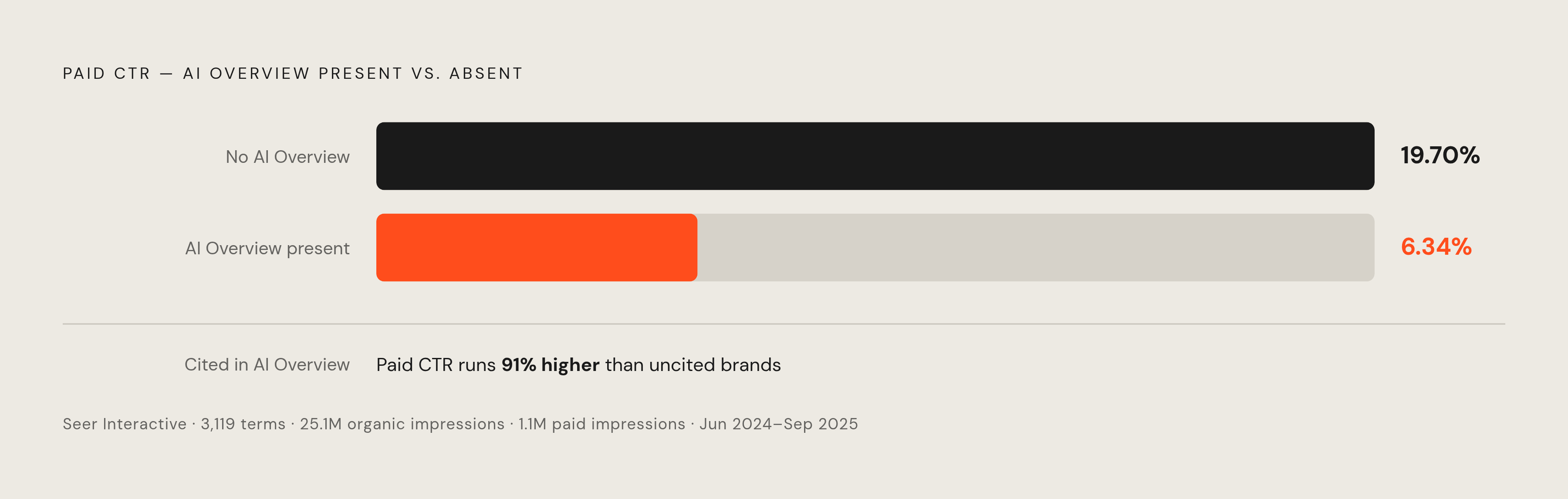
Seer Interactive studied 3,119 informational and educational search terms across 42 client accounts, covering 25.1 million organic impressions and 1.1 million paid impressions between June 2024 and September 2025. It's the clearest picture available of what AI placement does to paid performance, and the headline number is stark: when a Google AI Overview appears on a query, paid click-through rate falls from 19.70% to 6.34%. That's a drop of more than 13 points, and it happens the moment an AI-generated summary takes the space a paid link used to compete for.
There's a flip side, and it's the more interesting number in the study. A brand cited inside the AI Overview itself sees paid CTR run 91% higher than an uncited brand, based on Q3 2025 averages. Seer stops short of claiming the citation causes the lift, and that caution is right. But the correlation is strong enough that citation inside an AI answer now behaves less like organic exposure and more like a paid media asset in its own right, one that belongs on the same dashboard as spend and conversions rather than filed under "SEO" and forgotten.
The decline isn't confined to AI Overview queries either. Even on paid queries with no AI Overview present, CTR dropped from 19.1% in June 2024 to 13.04% by September 2025, a 32% slide that points to a broader shift in how people click on search results generally, AI Overview or not. Meanwhile the eligible surface area keeps expanding: Google's AI Mode is showing ads in a growing share of results, running well ahead of any disclosure standard built to keep pace with it. The rules are not just behind. The gap is widening.
Steps advertisers buying inside AI interfaces need to take right now
Start with the calendar, not the creative. Any campaign reaching EU audiences after August 2, 2026 needs its AI-generated creative audited against Article 50: watermarking, metadata, deepfake disclosure, regardless of which platform delivers the ad. The European Commission's Code of Practice belongs on that same calendar, since it's shaping up to be the practical standard mandatory rules will eventually cite. New York's disclosure requirements already appear by name in Google's July 2026 policy update, a strong signal that other states follow with versions of their own soon.
On labeling, turn on Google's AI label setting as it rolls out through July 2026 across Ads, Display and Video 360, Campaign Manager 360, Merchant Center, and Ads Editor, but don't mistake the switch for compliance. Google says outright it isn't one. Every platform needs its own line on the checklist: Meta's automatic "AI info" tag paired with manual policy review, TikTok's disclosure rule plus its C2PA Content Credentials, YouTube's synthetic content policy, and the placement norms specific to conversational surfaces like ChatGPT and Copilot. Treating these four rulebooks as interchangeable is how compliance gaps open, and audits tend to find them one platform at a time, usually the one nobody double-checked.
For conversational placements, document the separation between the AI-generated answer and the sponsored message now, even without a law demanding it yet. That separation is currently enforced at the platform design level, the way OpenAI enforces it, and design choices tend to get formalized into rules more often than the reverse happens.
On context-matching, the absence of a formal disclosure standard inside a multi-turn conversation is not a loophole worth exploiting. Borrow the gut check the UK's CAP guidance already applies: would the user feel misled if they didn't know this part of the response was paid for? Answer that honestly and compliance mostly follows from it. Buying well into this channel also means retiring tools built for the last one. A DSP built around keyword volume or demographic buckets cannot read the intent sitting inside a five-turn conversation. Treating that conversational intent as its own signal, richer than a keyword with extra words bolted on, is both a performance edge right now and the direction the eventual standards are headed anyway.
On measurement, Perplexity's exit is the clearest warning available: running paid media in this channel without real attribution is a liability that gets more expensive the longer it sits unaddressed. The reported 4.4x downstream conversion value tied to AI-sourced users argues for building that measurement now, since last-click attribution built for search misses most of where the value actually lands. And given the 91% CTR gap Seer found between cited and uncited brands, tracking AI citation presence alongside paid metrics stops being optional. Citation is a brand asset now, not an SEO afterthought, and it should be measured like one.
Sources
- The Future of Search in 2026: What to Expect | NoGood
- How Will AI Search Affect Paid Ads in 2026? What Marketers Need to Know
- Updates to AI labeling requirements (July 2026) - Advertising Policies Help
- FAQ on search advertising: AI assistants, shifting traffic, and the new demand capture mix
- Update on AI transparency in advertising: the European Commission’s guidelines on the AI Act | Gleiss Lutz
- The EU AI Act: What the August 2026 Deadline Means for Your Ad Creative - Billo
- iab.com