Comparing Intent Quality Between AI Search Users and Google Search Users
AI search users arrive further along in their buying journey than Google searchers.
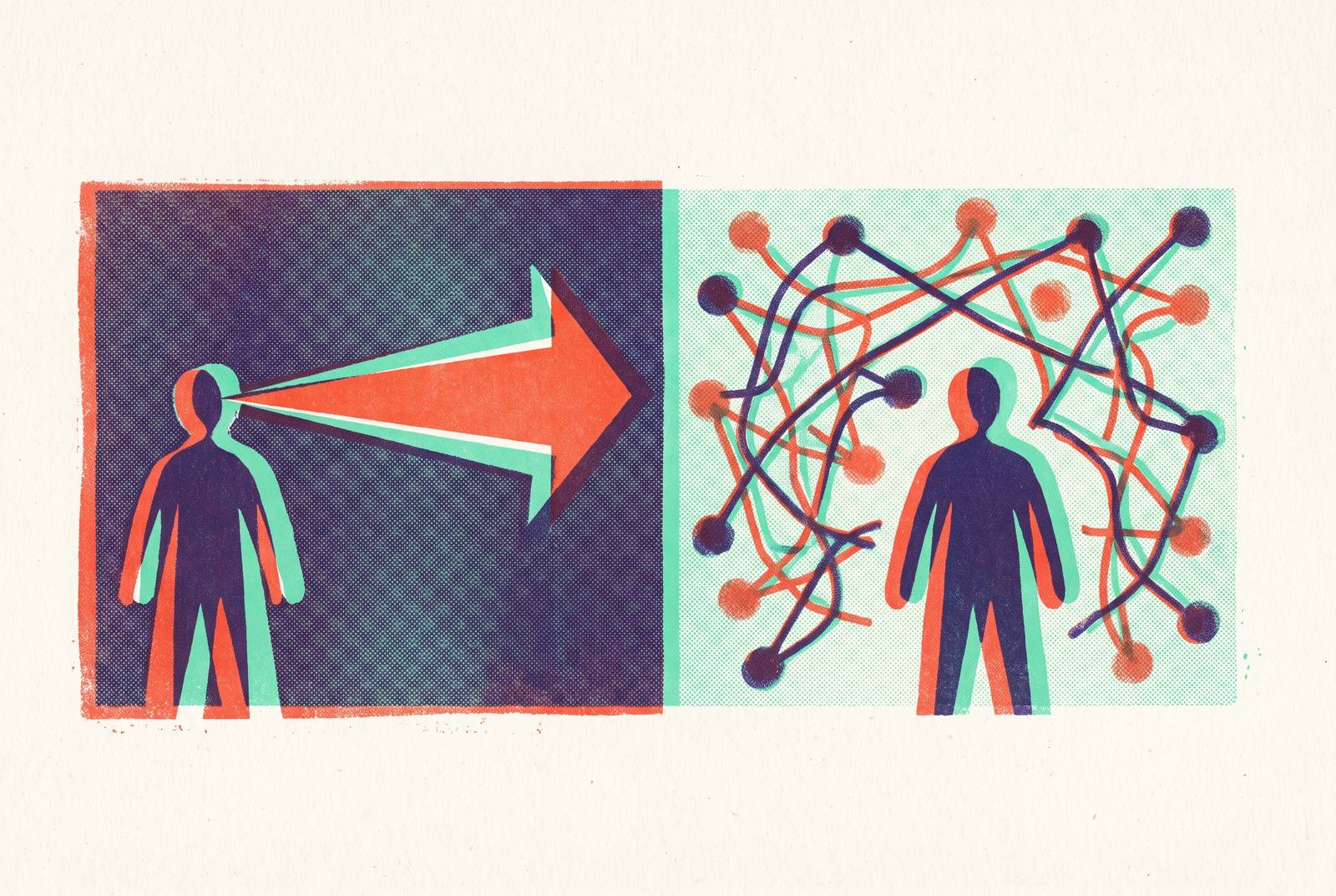
A keyword is a fragment a person hands to a machine and hopes it fills in the rest. A prompt is closer to a statement of fact: here's the budget, here's the timeline, here's what was already tried, here's why the question is even being asked. Google search users and AI search users are not competing for the same attention with different levels of enthusiasm. They're producing two different kinds of signal, and one of them structurally carries more than the other ever could.
How fast the user population is shifting and what that shift looks like
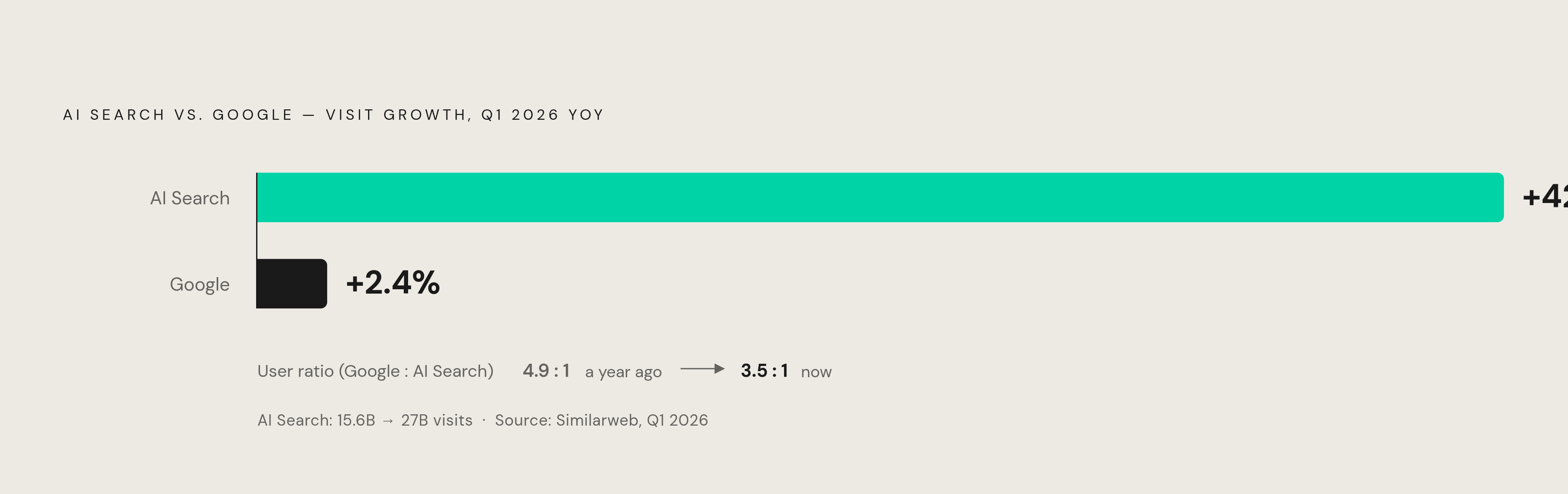
Start with the traffic numbers, because they're large enough to settle any argument about whether this matters. AI search visits grew 42.8% year over year in the first quarter of 2026, climbing from 15.6 billion visits to 27 billion, Wix's AI Search Lab reported. Google grew 2.4% over the same stretch. That's not a rounding difference; that's two products moving at completely different speeds.
The user base is catching up too, if more slowly. Average monthly AI search users rose 6% quarter over quarter, from 851 million in the last quarter of 2025 to 904 million in the first quarter of 2026, while Google's monthly user count actually dipped slightly, down 0.26%, the same Wix data showed. The ratio of Google users to AI search users is now 3.5 to 1, down from 4.9 to 1 a year prior. Survey data points in the same direction, with a growing share of consumers reporting they now start searches with an AI tool instead of Google.
None of this means Google is being displaced. It still handles a volume of queries that dwarfs anything AI search touches, by a wide margin, and AI search still accounts for a modest share of combined search traffic overall. The honest reading of the data is behavioral direction, not parity. "AI search" isn't one thing anymore. Wix data shows ChatGPT's share of AI search has narrowed to 61%, with Gemini at 24.8%, so even the growing side of this comparison is really several channels wearing one label.
What's emerging looks less like replacement and more like task division. Broader industry data points in the same direction: Google still wins for the quick stuff, store hours, prices, a headline you need in five seconds. AI tools get chosen for the slower work: synthesizing a complicated topic, comparing options across a longer conversation, actually deciding something. That split is the setup for the argument that follows.
What the conversion data says about who arrives from AI search and why
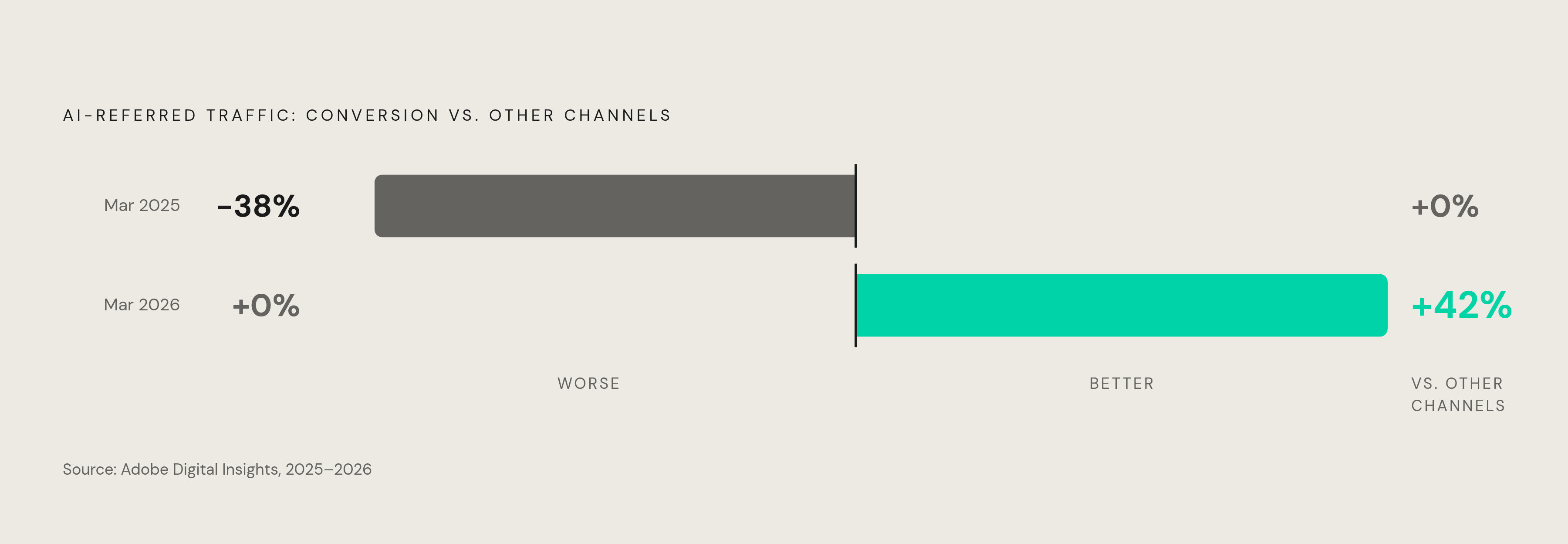
Here's the number that should stop anyone treating AI search as a novelty. In March 2025, traffic referred from AI sources converted 38% worse than traffic from anywhere else, Adobe Digital Insights found, having tracked over a trillion visits to retail sites in a national market. retail sites for its Q1 2026 report. By March 2026, that same referral traffic converted 42% better. That's roughly an 80-percentage-point swing in twelve months, on a channel that went from "probably junk clicks" to "the best-converting traffic Adobe tracks."
The technology didn't get better in a way that explains a swing that size. What changed is the user: people arrived further along in the decision, already having done the comparison work somewhere else, in a conversation instead of across ten browser tabs. The rest of Adobe's numbers back that reading up. AI-referred visitors spent 48% longer on-site, generated 37% more revenue per visit, with engagement up 12% and pages per visit up 13%. During the 2025 holiday season, AI referrals converted 31% better than non-AI traffic and revenue per visit was up 254% year over year, the same Adobe dataset reported through omnibound showed.
A consumer-confidence layer underneath these numbers explains the mechanism rather than just describing the outcome. Adobe's Q3 AI Traffic Trends report found 79% of consumers using AI for shopping feel more confident in a purchase after using an AI assistant, and 69% say they're less likely to return an item bought with AI's help. Those aren't the marks of an impulse click. Those are decisions that got made somewhere upstream of the retail site.
Some reports cite AI traffic converting at something like 23 times better than other channels. That number is almost certainly an artifact of how tiny AI search's share of total traffic still is, which makes any ratio look enormous. The 42% figure is the one that survives scrutiny at something closer to real scale, and it's the one this argument rests on.
The multi-prompt journey and where intent forms
Verve's analysis of more than a billion daily signals, cited via eMarketer, shows that by some measures, more than one in five users now start their pre-purchase research in a chat window rather than a search box, and the number climbs sharply in specific categories: the share of queries beginning in an LLM rather than a search engine climbs sharply in specific categories like travel. Users typically go several prompts deep before they ever click out to the open web to buy something, though the timeline varies by category. Some categories convert quickly while others involve a longer deliberation window.
Available research found a majority of consumers use AI tools to research products, and a meaningful share do it daily. Available data suggests a significant portion of ChatGPT conversations carry shopping intent, spanning retail, home goods, beauty, travel, cooking, auto, electronics, and fitness. This isn't a niche behavior confined to early adopters chatting about gadgets.
What's harder to see, and more consequential, is where that intent goes once it's expressed. The progression that used to leave a trail, a search here, a retargeting cookie there, a comparison page bookmarked for later, now happens inside a single conversational thread. Beet.TV called this out directly: that thread is invisible to the ad infrastructure built for the old trail. And it's not confined to consumer retail, either. Industry research found 51% of B2B software buyers now start their research in ChatGPT before they ever open Google.
By the time an AI user clicks out to a website, they've often already done the work that a Google user spreads across five sessions and a dozen tabs. The click isn't the start of the research. It's closer to the end of it.
Why keywords structurally cannot carry what prompts reveal
A keyword is a compression. The user strips out everything but three or four words, hands that fragment to a retrieval system, and the system spends its effort guessing at what got left out, usually by way of click patterns and co-occurrence data built up over millions of other searches. A prompt skips the guessing, because the context never gets stripped out in the first place. Budget, timeline, what's already been tried, who the purchase is for. It's all sitting there in the text.
Decision stage is the clearest example of what gets lost in translation. Type "best running shoes" into Google and there's no way to tell if that's someone six months from a marathon or someone standing in a store aisle with a credit card out. The keyword can't hold that distinction; it was never built to. A prompt that says "I've narrowed it down to these three, which fits a first marathon on a flat course" cannot be misread the same way. The stage is right there in the sentence.
Some of the richest intent never produces a keyword at all. A user might spend an entire conversation talking about team coordination problems, missed deadlines, and the friction of coordinating a remote team, without ever typing "project management software." The need is fully expressed. It just never crystallizes into a search term, so a keyword-based system has nothing to catch. That's not a hypothetical gap; it's the ordinary shape of how people actually talk when they're not trying to talk like a search engine.
Google's own numbers make the asymmetry worse, not better. Semrush reported that 60% of Google searches now end without a click. The keyword fired, the intent was likely real, and the channel simply had no way to surface an answer worth clicking on. None of this is a flaw in Google's engineering. It's a structural ceiling that comes built into the keyword format itself; no amount of ranking refinement changes what three words can hold. The same person, expressing the same need, produces a thinner signal in a search box than in a conversation, and a brand only shows up for the richer version if it's actually present inside that conversation.
How the advertising infrastructure inside AI conversations is catching up to the intent signal
The ad platforms are moving to close that gap, and moving fast. OpenAI announced plans to test ads in ChatGPT on January 16, 2026, started showing them to users on February 9, and rolled out an Ads Manager for advertisers in a national market. Advertisers gained access in May, with expansion into Australia, the United Kingdom, Canada, New Zealand, Brazil, South Korea, Japan, and Mexico following soon after. The pace of adoption has been fast enough to raise eyebrows: ChatGPT ads hit a billion-dollar annualized revenue run rate in under 200 days, with tens of thousands of advertisers buying in across more than 40 countries, and according to Beet.TV, ad impressions grew more than sevenfold between March and May 2026.
Google took a different path, threading ads into Gemini-powered AI Overviews starting in October 2024, in a national rollout. mobile only at first, then desktop in May 2025, then eleven more countries by December 2025. Coverage stays limited to English, keeps sensitive categories out entirely, and restricts placements to Text or Shopping ads pulled from existing Search, Shopping, and Performance Max campaigns. Microsoft is building toward something similar with Copilot, reportedly planning ad formats inside Copilot chats. Perplexity, for its part, tested native ads and affiliate links and then ultimately stepped back from advertising to focus on subscriptions instead. Anthropic has said it intends to keep Claude ad-free on the consumer side, at least as of the most recent reporting on its policy.
Underneath the branding, a four-layer stack runs all of this: demand and auction, context and targeting, creative generation, and measurement and attribution. OpenAI, Google, and Microsoft each control the first two layers on their own turf, which means any advertiser buying into ChatGPT or Gemini is playing by that operator's rules on that operator's surface only.
That's the coordination nobody's fully solved yet. A generalist demand-side platform gives an advertiser reach across many properties but no real grip on conversational context. A single-surface AI ad network gives context but only within one company's walls. What the moment calls for is something that can read intent signals across multiple conversational surfaces at once, without being boxed into any single operator's environment. The company's press release from March 10 stated that Verve moved in that direction in March 2026, expanding its targeting infrastructure into AI chat environments and integrating conversational intent signals across major LLM environments for programmatic activation. The approach draws on opted-in users across multiple environments, aggregates and pseudonymizes the data, and produces modeled audience intelligence rather than one-to-one tracking, which lines up with how contextual matching works in this new environment generally: relevance comes from the conversation happening right now, not a profile built from cookies over months.
What the trust gap and zero-click collapse mean for where intent goes next
None of this should read as a claim that everyone's already made the switch. A survey by a research firm of 1,110 respondents in a national market. respondents found 49% still trust Google results over AI chatbots, and 36% say they're unlikely to ever trust AI tools at all. That's a real and durable reservation, not a rounding error, and any honest account of this shift has to hold it alongside the growth numbers rather than explain it away.
But trust and behavior aren't moving in lockstep. The same Orbit Media survey found 44% of respondents say AI has already changed how they search, and AI use is climbing across every query type, including the simple lookups that used to belong entirely to Google. People can distrust a tool and still reach for it increasingly often; that tension is exactly where this transition sits right now.
Meanwhile the zero-click rate on Google's side keeps getting worse, not better. That 60% of searches ending without a click climbs to 83% when an AI Overview appears on the results page, Bain and Dynata research from 2024 and Similarweb data from 2025 showed. Organic click-through rates for top-ranking pages drop by somewhere between 34.5% and 61% once an AI Overview appears above them. Publishers are already feeling it: data from an analytics firm reported by a trade publication showed Google search traffic to publishers fell 33% globally in the year ending November 2025, with a national market's figures showing an even steeper drop. organic search referrals down 38% year over year. Gartner has forecast traditional search-engine volume will fall 25% by the end of 2026 as query demand keeps shifting toward chatbots and virtual agents, a projection that should be treated as directional rather than a hard ceiling.
Follow that logic and it points somewhere specific: as decision-stage queries increasingly migrate into conversation, what's left behind in traditional search skews more informational, more navigational, less commercially loaded. The valuable intent, the kind that converts, doesn't vanish. It concentrates on the conversational side.
None of this is really an argument for AI search over Google, or the other way around. It's a case that they've become two different kinds of surface, built to catch different moments in a decision, and the one that reveals more, structurally, is the one where a growing share of high-value intent is choosing to form. The practical question for anyone selling something isn't whether to show up in AI conversations. It's how to be present in the place where the decision is already happening, well before the user ever reaches the open web at all.