Prompt Injection Risks for Advertisers in AI Chat Channels
Prompt injection attacks can now manipulate ads inside AI chats with no detection.
Prompt injection is at the top of OWASP's 2025 list of large language model vulnerabilities, and that ranking isn't academic. For advertisers now buying space inside AI chat products, it describes a structural flaw that changes what brand safety even means once ads live inside a conversation instead of a page.
OWASP didn't put prompt injection at LLM01:2025 because someone shipped a buggy release. It's there because of how these models are built. An LLM takes in system instructions, a user's question, and whatever text gets pulled in from outside sources, and it processes all three as one continuous stream of tokens. Nothing in that stream marks which part is a command it must obey and which part is just content it happens to be reading. That distinction, obvious to a person, doesn't exist for the machine, and no one has found a reliable way to make it exist.
Compare that to the brand safety problems advertisers have spent two decades learning to manage: an ad running next to the wrong article, a keyword match that lands a car ad on a crash story, bad placement on a low-quality page. Those failures happen at the distribution layer, and a network can catch most of them with a pre-bid scan or clean them up after the fact with a post-campaign audit. Prompt injection doesn't work that way. It happens inside the model's reasoning, at the moment it decides what to say, and there's often nothing left to catch afterward because the damage is baked into the output itself.
The SQL injection comparison gets reached for constantly, and it holds up to a point. Both attacks exploit the same failure: a system that can't tell trusted commands apart from untrusted data. SQL injection got fixed, though. Parameterized queries gave developers a clean syntactic wall between the query structure and the data going into it, and that wall holds. No equivalent exists for natural language, and it probably won't arrive soon, because you can't fence off "instruction" from "content" in a sentence the way you can in a database query. Meaning in plain language comes without delimiters. That's why prompt injection stays open as a problem years after security researchers started flagging it, while SQL injection is largely solved.
Ad placement inside AI conversations and the resulting attack surface
This isn't a future-tense concern. OpenAI started showing ads inside ChatGPT in February 2026 and opened self-serve buying in May. The channel has been scaling rapidly since launch. The channel is live, scaling fast, and money is already moving through it.
Ads show up in a chat conversation in a few distinct spots. There's the inline sponsored card that appears after the model's answer, OpenAI's reference format: a clearly labeled card that can feature one or more items, priced through a relevance-weighted second-price auction. There's a sidebar placement running alongside the conversation, a sponsored follow-up chip suggesting the next thing a user might ask, and the response-grounded brand mention, where the model itself works a brand into the answer it's generating. The after-answer sponsored card trades at a premium price for a premium spot, so a compromised placement there costs more than a compromised banner ad ever did.
A four-layer stack underlies those formats, and each layer produces its own version of injection risk. The demand and auction layer decides which ad gets served and what it costs. The context and targeting layer matches an ad to a conversation, and here the targeting signal isn't a cookie or a search keyword: it's the topic and content of the conversation itself. The creative layer sometimes has the model generate or adapt ad copy on the fly instead of serving a fixed asset. The measurement layer runs through the model too, mediating an outcome that often has no clean click to log. Every one of those layers reads from the same undifferentiated token stream, so every one of them is a place an injected instruction could steer the outcome.
Three concrete ways prompt injection can damage an advertiser's position inside a chat channel
None of this is speculative. Each failure mode traces directly back to the architecture flaw above, applied to the specific surfaces where ads now live.
An injected instruction, buried in a page the model reads or in text a user pastes in, can tell the model to skip, ignore, or reframe a sponsored placement before it ever renders. The advertiser paid for that impression. In a display campaign, a failed ad call gets logged and the advertiser gets credited back. Inside a model response, suppression happens with no equivalent trace in a delivery log, because the ad wasn't blocked by a technical failure. It was talked out of appearing by the model's own reasoning, and there's no record to point to afterward.
Brand message corruption works differently but lands just as hard. If an injected instruction changes how the model talks about a brand, that message can come out altered, contradicted, or cast in a negative light, and the advertiser has no way to know until someone notices. Documented cases of brand chatbots being manipulated into off-script outputs serve as the reference point here. Running that same manipulation against a paid, sponsored placement changes its character: a customer-service embarrassment becomes a brand safety incident with a paying client attached. Response-grounded brand mentions carry the most exposure here, since the model composes the brand reference in real time, and changing the instructions it's working from changes what it says.
The third failure mode already happened, and it's the one that should worry advertisers most. In December 2025, Palo Alto Networks' Unit 42 documented what it identified as the first known real-world case of indirect prompt injection built specifically to get past an AI-based ad review system. The attacker didn't rely on one clever payload. Multiple injection methods were stacked together, which points to deliberate, targeted work aimed at the moderation layer itself rather than an opportunistic probe. The system built to keep bad ads out of the channel can itself be the thing that gets compromised, and any advertiser leaning on AI-powered brand safety tooling inherits that same weak point.
Agentic AI's expanded blast radius for advertisers
Agentic systems don't just answer questions. They browse the web, run code, send messages, and query databases on their own, and that changes what a successful injection can do. A manipulated chatbot answer is embarrassing. A manipulated agent with tool access can pull data out of a system it was never supposed to touch, or take an action nobody authorized, and that gap between the two is the whole reason agentic ad tooling deserves more scrutiny than it's getting.
Reported attack success rates against agentic systems with auto-execution capabilities run strikingly high. That's a wide-open door by any security standard, not a marginal exposure.
For advertisers, the agentic layer adds points of exposure that a plain chat interface never had. Agents that browse the open web to figure out how to target or contextualize an ad pull that page content into the same undifferentiated token stream, so every external page an agent reads becomes a possible injection vector. Agents wired into other tools, API calls, payment processing, writes to a CRM, can carry an injected instruction past the conversation and into systems the brand actually runs on. In a multi-tool setup, a successful injection in one component can spread to whatever else that agent's credentials let it touch: a pattern sometimes called cross-plugin poisoning.
Obsidian's research has found that AI agents move data at volumes that dwarf what a single human user handles. At scale, a compromised agent holding advertising data or audience segments is an uncontained incident. It's a leak at the moment of compromise, not after some delay where someone catches it.
The industry's current detection and defense posture leaves advertisers exposed
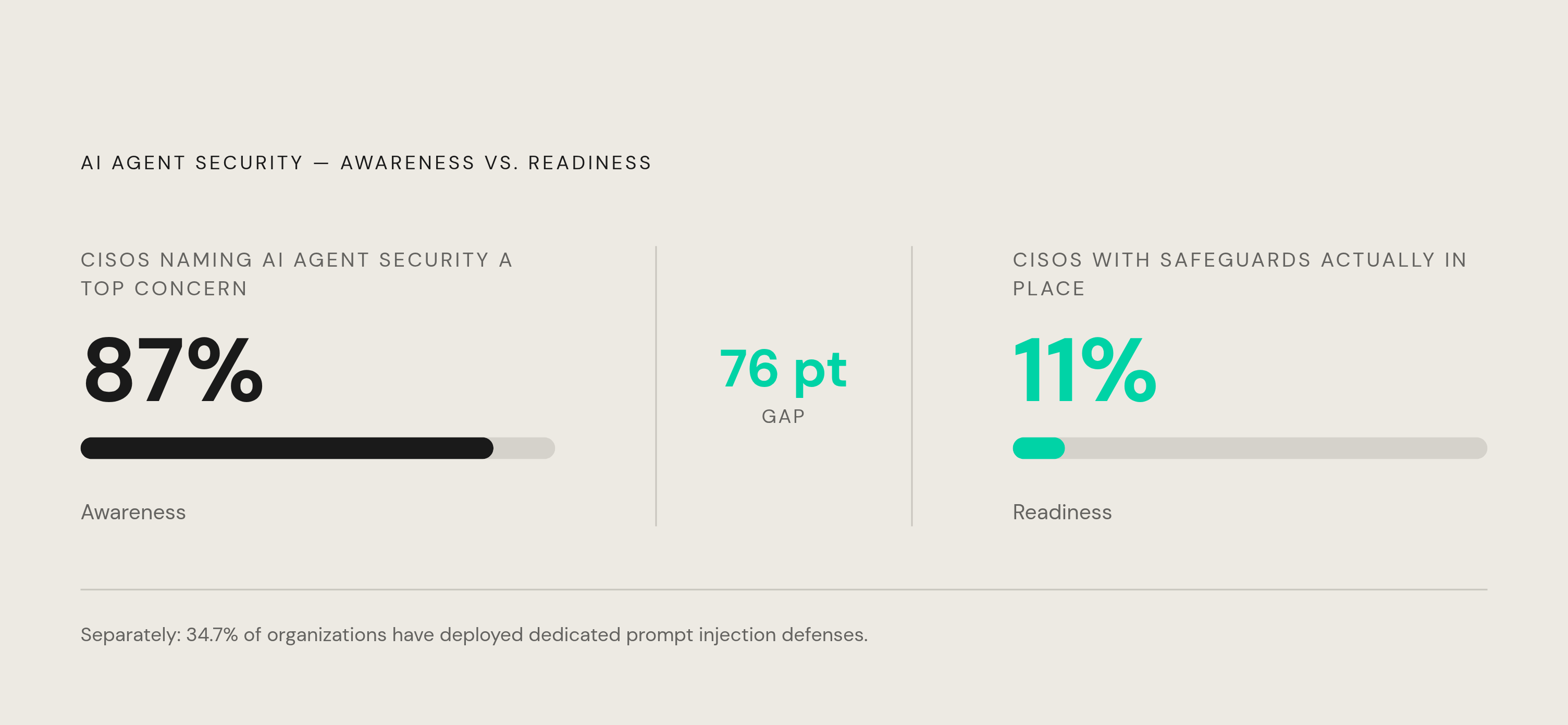
The awareness is there. The readiness isn't, and the gap between the two is the real story. Surveys of CISOs put the number who name AI agent security as a top concern at 87%, but only 11% of organizations have safeguards in place. That gap between what security leaders worry about and what they've actually built ranks among the widest in enterprise security right now.
The exposure appears in deployment numbers too. Only about 34.7% of organizations have put dedicated prompt injection defenses in place. Most enterprise AI systems running today sit exposed, full stop, and advertisers piping campaign data through those systems inherit that exposure regardless of intent.
Part of the reason is that the old toolkit doesn't apply here. Web application firewalls and input sanitization work by inspecting syntax, structure, patterns in code or requests. Prompt injection lives at the level of meaning: the attack works through what the words mean to the model, not through some malformed character sequence a filter can catch. Tools built for the network or application layer are looking in the wrong place.
Even the defenses that do exist don't hold up well alone. Adaptive attacks, ones built specifically to work around a known defense, get past nearly every published mitigation when that mitigation is tested in isolation. The research consensus calls for three layers working at once: architectural prevention baked into how the system is built, runtime detection watching behavior as it happens, and governance setting the rules for what agents are allowed to do. Skipping any one of the three leaves the other two unable to hold the line alone.
Operational steps for advertisers to reduce exposure without waiting for a platform fix
The fix at the model layer doesn't exist yet, and there's no clear timeline for one arriving. So protection has to live at the application, process, and governance layers for now, which happens to be exactly where advertisers and their agencies already have some leverage.
AI-channel brand safety needs to become its own discipline, separate from what came before it. Keyword blocklists, URL exclusions, and contextual classifiers were built to judge whether a page is safe to sit next to. None of that watches what a model actually says in real time. Advertisers working with platform partners should ask directly what injection detection exists at the point where a response gets rendered, as well as at the point where an ad gets accepted into the system.
The stack itself needs an audit for anything that can reach outside data. Every external source an agent can pull from, a retrieval pipeline, a browsing tool, an email processor, is a door an injection could come through. Applying least-privilege thinking to any agent handling advertising or audience data means limiting what it's allowed to fetch and read in the first place, instead of trusting it to sort good input from bad on its own.
Behavioral monitoring and configuration reviews aren't interchangeable, and treating them as such is a mistake advertisers keep making. A config review tells you what an agent was set up to do. It says nothing about what the agent actually did, and a compromised agent can look perfectly normal on paper while behaving very differently in practice. For any agentic ad operation, the API calls made and the outputs generated need their own audit trail, checked against the intended configuration rather than assumed to match it.
A structurally sound buying posture
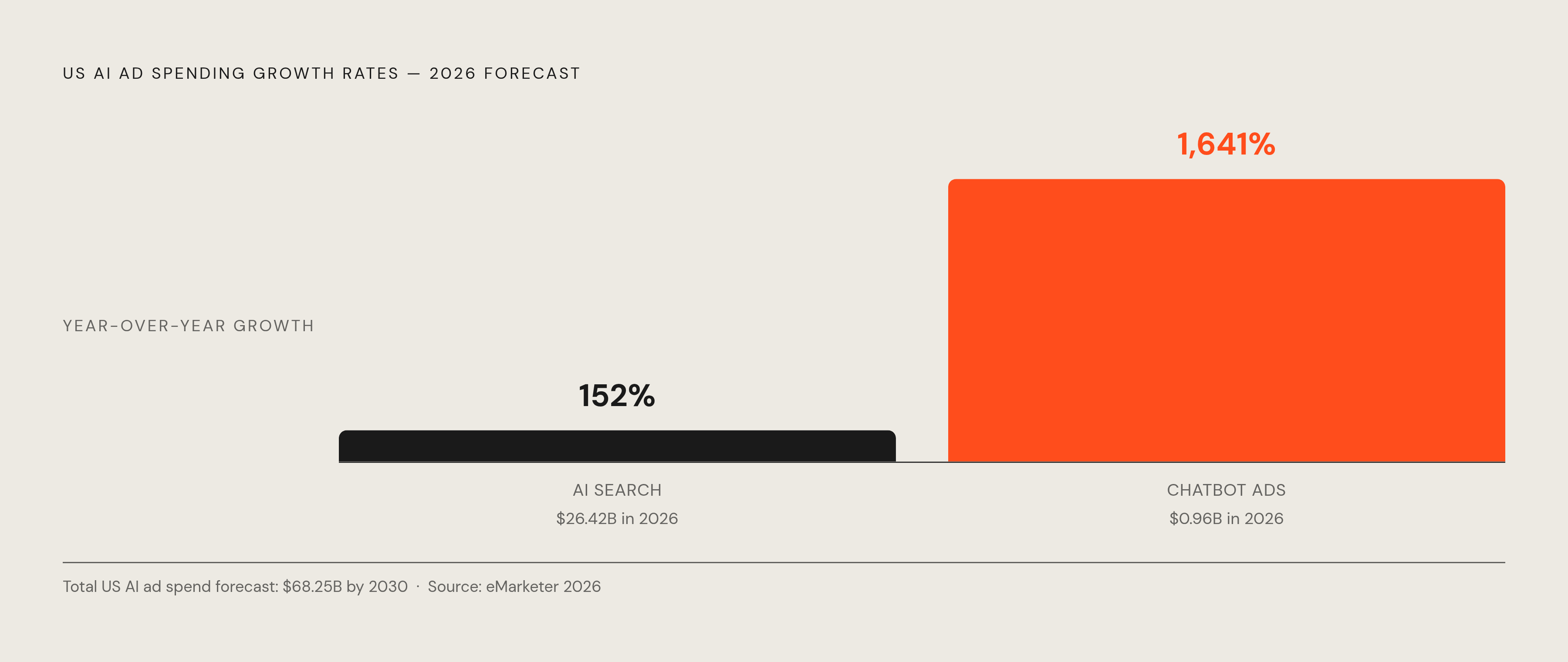
None of this is an argument to sit out the channel. Sitting it out would be the wrong call: the growth numbers show a channel expanding too fast to ignore. eMarketer's 2026 forecast has US AI ad spending climbing to $68.25 billion by 2030. Chatbot-specific ad spending alone is projected to jump 1,641% in 2026, hitting $0.96 billion, and AI search-adjacent formats are set to grow 152% this year to $26.42 billion. That growth curve isn't waiting for the security flaws to get fixed first, and neither should the advertisers watching it.
The intent signal explains why the channel earns that growth. A user typing out a real question in a chat window hands over nuance, constraints, and timing that a keyword search never captures. A growing share of pre-purchase digital journeys now start inside AI chat. The consideration set narrows too: someone shopping through AI chat weighs about 1.96 brands on average, against 4.21 in a traditional search session. Fewer brands in the running means each one that makes the cut carries more weight in the final decision.
Brands building a presence now, while CPMs stay modest and the inventory is still young, are accumulating a familiarity and data edge that late arrivals won't be able to buy their way into later.
A sound buying posture rests on three things, and skipping any of them undermines the other two. Injection risk management, the steps outlined above, needs to run as a day-one part of campaign operations. Platforms with direct publisher relationships and real visibility into where an ad actually lands inside a conversation deserve preference over ones that only confirm an ad fired. And measurement has to account for the fact that the model can answer the question, name the brand, and steer the decision without a click ever happening. Attribution models still built around click-through will undercount a channel that's working exactly as intended, and undervalue it right out of the budgets it's earned.
Sources
- Prompt Injection Attacks on AI Agents: How to Detect and Prevent Them
- Fooling AI Agents: Web-Based Indirect Prompt Injection Observed in the Wild
- LLM01:2025 Prompt Injection
- Prompt Injection Statistics 2026: Hidden Risks Now
- Adaptive Evaluation of Out-of-Band Defenses Against Prompt Injection in LLM Agents
- The Injection Paradox: Brand-Level Suppression in Safety-Trained LLM Recommendations via RAG Context Injection